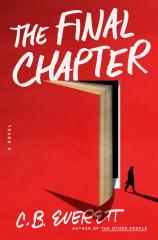
The Final Chapter


Review
The Final Chapter


Regarding C.B. Everett's sort-of mystery/suspense novel, THE FINAL CHAPTER: Yes, there is an element of traditional mystery novelization and, as expected, a significant group of surprises in one of the two primary stories comprising this brilliant, puzzling, confusing, two-novels-in-one work of art. And if the preceding sentence already has you a bit confused, hold onto your seat because you ain't seen nuthin' yet.
Everett has given you the opportunity to unravel a set of mysteries that require all your detective abilities and your own imagination to even come close to the myriad solutions. When I read in my advance copy that the publisher of the piece dares us to solve the mysteries that fill the pages, I laughed. I thought that even gigantic-Einsteinian-brained readers might drive themselves crazy before finally giving up and simply absorbing what is ultimately revealed.
So here goes my attempt to briefly summarize this book while also offering some clues to the author's fascinating but intentionally foggy methods. The novel that I'll label novel #1, written by fictional author Jonathan Durward, is the story of an assassin who is proud of his talents and successes but is saying, in effect, "Take me out, Coach. I can't take this game any more." However, he is given an ostensibly final assignment by his spy bosses to find and dispose of an international criminal who is so good at disappearing that he's known in the business as The Ghost. But the assassin is also a master of disappearances once his murders are carried out. After the deed is done, he changes everything about himself: his appearance, his character, his made-up occupation, his name. That's why he's known as a shapeshifter. So the hunter and the hunted are parallel or mirror-image figures.
"[G]ive THE FINAL CHAPTER a try and attempt to untangle its webs of confusion, fogginess, muddiness and murkiness. Puzzles, after all, can be fun. And the work of C.B. Everett certainly deserves your attention. It's a work of art."
That case is one of many identity mix-ups that make up a primary element of THE FINAL CHAPTER. In further evidence of the technique, the hunter becomes the hunted --- another identity mix-up, of course. The motif of disappearance is a primary element in the novels and in the lives of the most important characters, namely the two first-person narrators, Jon Durward and the fictional C.B. Everett. The name of novel #1, incidentally, is Russian Doll, a reference to the Russian Nesting Dolls, wherein several dolls rest comfortably inside gradually larger dolls --- an oblique symbol of the novel-within-a-novel form of THE FINAL CHAPTER.
We learn everything about the relationship of those two narrators primarily through the details of novel #2. Everett the character is given the opportunity to edit Russian Doll because he had been Jon's closest friend and frenemy before Jon's shocking disappearance at the height of his popularity and success as a novelist. So with the publication of Jon's sudden reappearance as a novelist (novel #1 here) 10 years after he vanished, Everett provides notes and comments immediately after each chapter of Russian Doll. They seem enlightening at first glance.
But it becomes painfully clear that Everett is obsessed with Jon and jealous of his near-rock-and-roll-star status as an author whose work is loved and admired by critics and adored by the public. His books are made into major motion pictures, and those are also rousing successes. Meanwhile, Everett is struggling. His novels are okay but barely noticed. So he decides to start writing mysteries --- good old traditional whodunits, sort of like Russian Doll. What a coincidence! His plan succeeds...to a degree. His mysteries are successful, and he makes the kind of money that he's only dreamt of before. Life is good. But is he really happy? Can he ever truly match Jon's successes? All is doubtful.
The two novels continue chapter after chapter by Jon, each one followed by Everett's notes --- editorial statements and, more importantly, his comments about the information in each chapter. But suddenly, at the end of chapter 35, purportedly the Final Chapter of Jon's mysterious novel, stunning literary explosions hit us right between the eyes: a new narrator, timeline changes, new chapters to Jon's final novel, more new (or used) narrators, sudden plot twists out of the blue, and new roles for relatively minor characters. From here to the actual conclusion of THE FINAL CHAPTER, faux endings attack us. We are confused, which is exactly the aim of Everett the author. I am personally struck and fascinated by the whole messy picture. His goals have been shockingly accomplished.
So the title of the book is profoundly ironic. There IS no actual Final Chapter. But there is much more to say about it. Most notable is the extreme use of the technique that was finally "officially" named in 1961, but was employed often by great and not-so-great authors long before that date: the "unreliable narrator." Examples include Mark Twain's Huck Finn, who truly understands neither himself nor the characters all around him; J. D. Salinger's Holden Caulfield; Joseph Conrad's Charles Marlowe in HEART OF DARKNESS; and, more recently, Percival Everett's JAMES, Huck's story as told (brilliantly) by Huck's slave and friend, Jim. And hundreds more. But I can think of no other that offers at least two unreliable first-person narrators while juggling their stories. It is a surprising and admirable feat.
Within Everett's novel, there is a mention of "lit-fic," a piece of writing that qualifies as real literature based on expert literary observation, as well as the love of the general public. Think of the efforts of F. Scott Fitzgerald, John Steinbeck, and the aforementioned Twain, Salinger and Conrad. I think C.B. Everett, the pen name of Martyn Waites, qualifies now as an authentic writer of lit-fic. Some readers will disagree. They'll say something like, "I can't enjoy the work of an author whose main intention is to confuse me."
This would be similar to the reactions of traditional classical music fans when they hear and hate the music of Arnold Schoenberg, Alban Berg, Anton Webern, and other composers of atonal music. But there is no denying their genius. Breaks from long-standing traditions are always controversial and likely to garner responses like, "I just don't get it. And I really don't want to." But give THE FINAL CHAPTER a try and attempt to untangle its webs of confusion, fogginess, muddiness and murkiness. Puzzles, after all, can be fun. And the work of C.B. Everett certainly deserves your attention. It's a work of art.
Reviewed by Jack Kramer on June 5, 2026


The Final Chapter
- Publication Date: June 2, 2026
- Genres: Fiction, Mystery, Psychological Suspense, Psychological Thriller, Suspense, Thriller
- Hardcover: 384 pages
- Publisher: Atria Books
- ISBN-10: 1668058332
- ISBN-13: 9781668058336