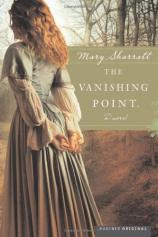
The Vanishing Point


Review
The Vanishing Point


Historical novels are a double treat --- where else can you learn about the past while having a rattling good time in the present? It helps that these days we are no longer wading through huge, elaborate tomes replete with family trees and detailed maps (actually, I have a soft spot even for those). Now, although the books are often shorter, they are longer on accuracy and emotional intensity.
This is also a genre that women --- as authors and as readers --- have laid special claim to, finding courage and inspiration for our own daring adventures in these stories of pioneers of all sorts...sexual, artistic, scientific. Maybe we need a new sub-category, the feminist historical novel: fiction with female characters who flout convention and prefigure our (relatively) more liberated times.
THE VANISHING POINT features two English sisters who seem specifically designed to score points off the misogynistic moralists of 300 years ago. May Powers is a veritable Paris Hilton, going to bed with anybody in pants and finally married off to a cousin in the colonies (Maryland, to be exact) to save the family's reputation and finances. Hannah Powers is a shy, epileptic redhead who has been trained by their physician father in the medical arts, but cannot practice them because of her sex. Although the two women are "types" (the sexual revolutionary/wild child; the intellectual who struggles with the domestic arts), they are also juicy, engaging characters who invite us to identify with their struggles.
And struggle they do. Author Mary Sharratt reminds us that this country wasn't literally "born on the Fourth of July"; its roots reach back to the very first colonists. "Once upon a time Americans were the British, lost" is one of the quotes she uses as her epigraph: She is quite brilliant at evoking the bewilderment of people raised in cities and towns who suddenly find themselves hacking out a life in an untamed land, and the way their emotions and personalities seem to evolve in relation to the environment. Gabriel, May's husband who was born in Maryland, is the only character who is really in his element; the others are displaced persons, perplexed by the alternating bounty and harshness of nature.
This is a suitable backdrop for a story that is very much in the tradition of the gothic romance, heavy with atmosphere, mystery, tension, and the occasional ghoulish touch. After May and Hannah's father dies, Hannah follows her sister to Maryland, but on the tobacco "plantation" --- more a rough compound than an aristocratic spread --- she finds only Gabriel (he, too, is something of a type: He hunts, he cooks, he cleans, he wears buckskins...). He claims that May succumbed to a fever after their baby died, and the truth of what happened to her emerges only slowly, through flashbacks. Meanwhile, Gabriel and Hannah fall in love and have their own child. Sharratt also gets in some commentary on the evils of racism --- plus a soupcon of Afro-Caribbean magic --- via Adele, a former slave from Martinique with supernatural "powers" who was May's servant and friend.
All this is more than slightly reminiscent of JANE EYRE or REBECCA: the first wife --- victim or villain? --- shadowing the happiness of the second; the ambiguous character --- murderer or martyr? --- of the husband. As in those riveting classics, the pleasure is in the telling, not in the familiar plot, and for the most part THE VANISHING POINT kept me happily and suspensefully engaged.
True, it takes itself a little too seriously as historical scholarship. We find letters bristling with capitalized nouns and old-fashioned spellings, detailed recipes, herbal lore, and lavish descriptions of clothing. Sometimes these minutiae add richness and authenticity to the narrative; sometimes they just slow it down.
But when THE VANISHING POINT remembers that it's fiction, which is most of the time, it is an intelligent and gripping book that takes us to the New World of outcasts --- indentured servants, mail-order brides, failed tobacco planters, slaves --- rather than the more prosperous early Americans we know from conventional historical accounts. Mary Sharratt has a passion for her story, and it shows.
Reviewed by Kathy Weissman on January 24, 2011


The Vanishing Point
- Publication Date: June 2, 2006
- Genres: Fiction, Historical Fiction
- Paperback: 384 pages
- Publisher: Mariner Books
- ISBN-10: 0618462333
- ISBN-13: 9780618462339