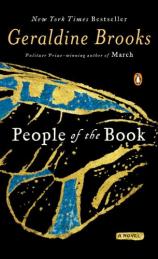
People of the Book


Review
People of the Book




Every year at Passover, Jews around the world gather for a festive meal at which they are commanded to retell the epochal story of the Exodus from Egypt. The text for that retelling is known as the “haggadah,” the root of which is the Hebrew verb “to tell.” Today, it is estimated that there are more than 3,000 versions of this book, a compendium of biblical excerpts, rabbinic commentary, stories and poems. In her emotionally resonant new novel, Geraldine Brooks spins an intricate and moving tale of one of them, the Sarajevo Haggadah, and its stirring, almost miraculous, story of survival.
The true story of the haggadah’s narrow escapes from destruction, chronicled in a December 3, 2007 New Yorker article by Brooks (featuring a color reproduction of one of the haggadah’s striking illustrations), is so fantastic it seems almost impossible to fictionalize it. But what Brooks does so convincingly is what empathetic historical novelists do best --- offer us rich insights into the interior lives of both real and fictional characters that reveal the human drama behind a fact-based story. As one of the book’s characters reminds us, “a book is more than the sum of its materials. It is an artifact of the human mind and hand.”
The novel opens in the spring of 1996, after the Bosnia hostilities have ceased, leaving the city of Sarajevo a shattered remnant of its former self. Hanna Heath, a brash young conservator of medieval manuscripts from Australia, is summoned to the National Museum of Bosnia to restore the 15th century codex, featuring 34 pages of striking illuminations. Her discovery in the manuscript of a butterfly wing, a wine stain, a residue of sea salt and a fine white hair launch the novel’s other narrative thread, as Brooks transports us in extended flashbacks to reveal the source of these items and thereby recount the haggadah’s history.
Brooks’s recreation of five historical epochs --- Sarajevo in 1940, Vienna in 1894, Venice in 1609 and Spain in 1492 and 1480 --- is so rich with period detail, lavishly and yet effectively displayed, that one stands in awe of the thoroughness of her research. In each era the existence of the haggadah is threatened. Most dramatic, and most grounded in historical fact, is the story of how the book --- only moments away from almost certain destruction by the Nazis --- was hidden by the chief librarian of the Bosnian National Museum and then stored for the balance of World War II among Korans and other Muslim religious books in a remote mosque.
The chapter recounting the haggadah’s jeopardy in early 17th century Venice is almost as heart-stopping. There, Giovanni Domenic Vistorini, the censor of the Inquisitor whose job it was to consign heretical works to the bonfire, sits with his pen poised above the parchment before deciding to spare it from the flames. All of the novel’s historical sections are so packed with vivid detail and complex characters --- princes, rabbis, artists, scribes and bookbinders --- that each time the narrative returns to its contemporary setting we’re eager to be transported back in time and, once there, find ourselves longing to linger.
What also sets this novel apart from more conventional works of historical fiction are the sophisticated themes that suffuse the narrative: the persistence of religious persecution, issues of religious and personal identity, and the close relationship between Muslims and Jews among the most prominent. Those ties may seem particularly startling to those familiar only with the Middle East conflict, and offer perhaps a glimmer of hope that someday they can be revived.
Although it doesn’t detract unduly from the impressiveness of the novel, the contemporary narrative suffers in comparison to the historical segments. There is a melodramatic subplot describing the fractured relationship between Hanna and her mother Sarah, an eminent but emotionally distant neurosurgeon, from whom Hanna ultimately learns a jealously guarded family secret. And Hanna’s love affair with Ozren Karaman, the Bosnia librarian who protected the haggadah at the outset of the Bosnian hostilities, has a perfunctory feel to it.
Geraldine Brooks most likely had herself in mind when Hanna observes, “By linking research and imagination, sometimes I can think myself into the heads of the people who made the book. I can figure out who they were, or how they worked. That’s how I add my few grains to the sandbox of human knowledge.” Following on her Pulitzer Prize-winning novel MARCH, in PEOPLE OF THE BOOK she continues to raise the bar for practitioners of this literary genre.
Reviewed by Harvey Freedenberg on January 17, 2011


People of the Book
- Publication Date: December 30, 2008
- Genres: Fiction, Historical Fiction
- Paperback: 372 pages
- Publisher: Penguin Books
- ISBN-10: 0143115006
- ISBN-13: 9780143115007