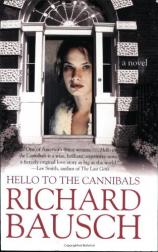
Hello to the Cannibals


Review
Hello to the Cannibals




Mary Kingsley was a brilliant, self-educated, articulate, well read, strong willed, Victorian woman. For thirty-one years she was trapped in the roles of maid and caregiver to her family, until her parents died. Only then, could she finally escape her circumscribed life in England, to follow her wanderlust --- to pack up and travel. As a result, she became one of the first females to brave the mysterious environs of West Africa. Her book, TRAVELS IN WEST AFRICA, remains a classic to this day.
A part of Kingsley's legacy is to be found in her stoicism and loyalty; in her honesty and courage; in her commitment to her family, and unwavering devotion to her friends; the men whose respect she gained as a writer, a traveler, and a humane being. In HELLO TO THE CANNIBALS, Richard Bausch's latest novel he writes both beautifully and lovingly as he celebrates the life of his heroine.
"I wanted in particular to write a book about friendship, and about the affections we form for those who have gone before us. Some of what Mary Kingsley is known to have done is here, all of it in a form that is transmuted by fancy … ," writes Bausch in his authors' notes.
But, Bausch does not simply give us Mary Kingsley's story as a straight, dry narrative of "faction"; rather, he segues back and forth from Victorian England to the American south of the late nineteen eighties to offer readers a second voice, that of Lily Austin, who becomes not only the reader's guide to Kingsley's extraordinary life, but also confides the confusions she must reconcile on her own journey to some kind of self fulfillment.
Lily's dream is to write a play about Kinglsey, working title: HELLO TO THE CANNIBALS. She is the daughter of theater people and has been enchanted by Kingsley since her fourteenth birthday, when she received a book of famous explorers. Kingsley, of course, was the only female. Lily is inspired by this woman's larger than life accomplishments and is determined to celebrate her on the stage.
Bausch's strategy is ingenious: he frames his story through fictional letters and journals from the past juxtaposed against the ones Lily writes in the present. As the novel unfolds Lily begins to write to Mary in the same way Mary "wrote in her journals to a fictionalized reader in the future". We learn about both women in long lyrical passages that seem to compress time and put them in the same space. The architecture of the book is riveted by the similarities in the women without losing the sharp contrasts between them.
This works beautifully because Bausch uses language and events like an alchemist to create an atmosphere wherein the women seem to become "friends". Bausch's writing is so skillful, his genius for setting so real, his ear for dialogue pitch perfect, his gift for plot unmatched and his ability to seamlessly segue back and forth from nineteenth century England to the American south in the twentieth century, resembles the fabric of a tightly woven tapestry imbued with historical veracity and contemporary angst.
HELLO TO THE CANNIBALS is a deeply moving novel. It speaks to the loss of innocence all children experience as they grow up, especially, that "special" pain when youngsters begin to understand that their parents, like everyone else, are not perfect; it deals with women's sexuality or lack of it, in sympathetic understatement; it presents psychological and geographical terrain that Mary and Lily both learn to navigate; it presents the breadth of diversity in the different kinds of marriages and friendships people are bound up in. And, Bausch proposes, that the most important lesson for all us is to learn that self respect is gained not only by sacrifice to others but, too, in one's ability to recognize one's own intrinsic needs and when the time is right we must generate the courage needed to garner what is most valuable to our self growth and individuation.
Reviewed by Barbara Lipkien Gershenbaum on January 22, 2011


Hello to the Cannibals
- Publication Date: February 19, 2013
- Genres: Fiction, Historical Fiction
- Paperback: 688 pages
- Publisher: Harper Perennial
- ISBN-10: 0060930802
- ISBN-13: 9780060930806