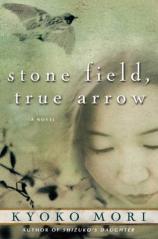
Stone Field, True Arrow


Review
Stone Field, True Arrow


Read an Excerpt The
The
character of Maya Ishida would be like that of any other young
American woman except that she was raised in Japan but then moved
to Minneapolis, of all places, when her mother left her father. Her
father, a visionary artist, affected Maya's life in specific ways,
many of which Maya doesn't really consider until she finds out
about his untimely death. At this point in her life, the renewed
vision of her father causes her to question everything about her
life, from her near-death marriage to her pursuing a career other
than the artistic one she wanted to pursue and the strained and
strange relationship she has with her mother. STONE FIELD, TRUE
ARROW is a beautifully rendered book about the complexities of
balancing where you came from with where you want to be
going.Mori's language is poetic in places, but her strong suit as a
novelist is her succinct way of letting the reader in on the
interior monologues that are going on in her character's head.
Using Maya as a sounding board, the other characters reveal the
truths of their lives but always in context with the way Maya is
feeling about them, a sure shot path to maintaining dramatic
interest. Maya is an active character both in her life of the mind
and in her physical world and she becomes a most compelling beacon
of change for everyone around her.
Mori
has created a wondrous female protagonist whose mysterious past and
imbalanced present lead us along to her unwarranted and unknown
future with all the wide-eyed aplomb of children learning about the
real elements of life for the first time. STONE FIELD, TRUE ARROW
and all the significance of the relationships between Maya and the
others is a beautiful and moving portrait of a real adult
character.
Reviewed by Jana Siciliano on January 23, 2011


Stone Field, True Arrow
- Publication Date: September 20, 2000
- Genres: Fiction
- Hardcover: 288 pages
- Publisher: Metropolitan Books
- ISBN-10: 0805040803
- ISBN-13: 9780805040807