
Excerpt


Excerpt
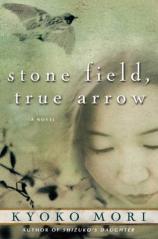
Stone Field, True Arrow


 Chapter One When Maya comes home from work in the late afternoon, the leaf truck is in front of her house, taking away the last of the maple leaves she and her husband have raked. Her engine idling, she waits in the street. Next door, Mrs. Nordstrom is standing behind her living room curtain, her thin, wrinkled face bunched up into a frown. Last year, a heavy downpour started while the truck was in front of Maya and Jeff's house. The men finished their pile, drove away, and did not return to the rest of the block for a month. Maya beeps and waves to her neighbor, wishing there was a universal beep that meant, Don't worry. This year will be different.The truck lunges forward. Mrs. Nordstrom taps the window. She is smiling. Parking her car in the driveway, Maya gets the mail from the box and sits down on the front steps. She listens to the whine of the machinery turning the leaves to dust.Near the bottom of the stack, there is a padded envelope sent to Maya in care of her mother, Kay, in her Chicago suburb. Kay has forwarded it to Milwaukee. The envelope has three Japanese stamps: a woman in a red kimono, a white egret soaring across the sky, a child's wooden toy. The return address is written in black ink, the color of the steeply pitched slate roofs of Maya's childhood. Her house in Osaka had a hedge of yews that blocked out the sun, so they had to leave the light on in the kitchen even on sunny days; two small bedrooms; a garage where her father painted. She has never forgotten the address, but the handwriting on the envelope is a painstaking imitation of the Palmer method, with exaggerated loops around the Gs and Ms. Her father's handwriting was spiky and slanted to the left, the letters leaning together like people standing shoulder to shoulder.Maya rips open the envelope and finds another sealed envelope the size of a manila folder, an onionskin sheet folded in two, and a black-and-white photograph from which her father stares straight ahead without a smile. His hair, though gone gray, is parted in the middle and tied back, the way he always wore it. He is dressed in a dark kimono—brown, navy, or gray, it is hard to tell. His face is covered with tiny wrinkles, his mouth grown smaller and more round with age. Still, in his high cheekbones, large wide-apart eyes with long lashes, and dark arched eyebrows, Maya recognizes her own face. His hair was once thick and very black like hers, and his mouth, of which hers is an exact copy, was full, shaped like a small heart. She cradles the photograph in her palm. His eyes look sad, as though he were speaking to her from another world. She does not have to read the letter to understand that he is dead.The leaf truck is moving down the street as she unfolds the onionskin paper. In his meticulous handwriting, in the formal Japanese Maya struggles to follow, Mr. Kubo, who introduces himself as her father's assistant, gives her the news. Her father died of cancer in the last week of October, leaving the house in Osaka and everything in it to Mr. Kubo and his family. He was sixty and had no relations; his parents and older brother had died years ago. Mr. Kubo says little except that the end was sudden but peaceful. He closes the letter by assuring her that everything is being done to honor her father's spirit. Mr. Kubo and his wife, who have moved into the house with their two daughters, have been burning incense every morning at the Buddhist altar, offering fresh tea and flowers. He is enclosing a copy of the portrait that hangs above the altar, along with an envelope her father had left in his desk.On the front of the sealed envelope, her father had written her name, Ishida Mayumi, in the four pictorial characters that mean Stone, Field, True, Arrow. The family name leading the given, it is the name Maya lost at ten, when her mother—newly remarried—sent for her. Kay had left Osaka three years earlier to finish her doctorate in the States. In Minneapolis, Kay lopped off the end of her daughter's name just as she had changed her own from Keiko to Kay. She made Maya take her stepfather Bill's last name, Anderson, so that no one who saw her listed on a school roster knew she had grown up in Osaka. Maya changed her last name back to Ishida during her junior year in college, but by then she and her father had lost touch. He had sent back every letter she wrote to him, unopened.In the planter by her door, the marigolds have withered standing up; they look like seaweed. Maya opens the envelope and takes out a piece of cardboard folded in two. It contains a pencil drawing on white sketching paper. The date in the lower left corner—March 20, 1996—was her thirty-fourth birthday seven months ago. Her father's signature is next to the date: Ishida Minoru, in pictorial characters that mean Stone, Field, Harvest. The sketch is the only thing in the envelope; there is no letter. That does not surprise her. Every morning when she was a child, Maya woke up to find her father sitting at the table in their dark kitchen with the light on, drinking his tea and drawing on a sketch pad. Sometimes the images showed what was on the table—a vase of flowers, a piece of fruit, a leaf—but more often they were pictures of people and landscapes she had never seen, or random lines and shapes, swirls and angles. They came from his dreams. Then there were the things he drew over and over. Trees, because Kay's maiden name, Hayashi, meant stand of trees, rice plants growing next to boulders for his own name, and arrows for Maya's. Many of his sketches had a line of arrows drawn across the top. He would point to them and say, "See, I was thinking of you even before you got up." Then he scribbled the date in the lower left corner and got up to fix their breakfast. The sketches were a diary. While other people wrote down words, her father drew pictures to record what was in his head. He had sent her a page from his diary, with the familiar arrow drawn in the top right-hand corner and the numeral 2. To Mayumi, he meant.Maya holds the sketch up to the afternoon light. The left haft shows a young girl in a hooded jacket and jeans as she walks through a narrow tunnel. The jacket is the one Maya was wearing on the day she left Osaka. The scene she is walking away from, which occupies the right half, is some kind of hell—jagged flames are leaping everywhere, and several oni, the horned demons from Japanese folk tales, are gathered around them. Between the two halves of the sketch, a man in a long black coat, with his hair tied back in a ponytail, stands facing the demons. His back slightly bent, he is cradling an instrument, plucking the strings with his fingers. The man has placed himself at the entrance of the tunnel to keep the demons from pursuing the girl; all he has are his own body and the music he is playing.Maya goes into the tunnel in her memory and comes out on the other side. She sees the departure gate, the attendant reaching out to take her ticket, her father standing against the wall. But the tunnel goes on past the airport, over the city they crossed on a train that last day, back to the house, where in their last three years alone together Maya spent every evening in the garage, watching him paint. While he worked, he told her stories. One of them was about Orpheus, who traveled to the world of the dead to find his wife, Eurydice. In the palace of the dead, Orpheus played his lute for the king and the queen of hell. The music he had composed in his grief brought tears to the multitude of dead souls and so the king allowed Orpheus to take Eurydice back to the world of the living under one condition. In the long passage between the two worlds, Eurydice was to walk behind him, and Orpheus was forbidden to glance back at her. "Maybe he didn't trust the god of the underworld after all," Maya's father told her, "or maybe he loved her so much that he couldn't wait to see her face. When they were almost back to the world of the living and he saw the distant light ahead, he couldn't resist. He looked back. Her footsteps stopped. The next moment, he was standing alone inside a dark tunnel, and he knew he would never see her again."In the drawing, her father is Orpheus, but the person he wants to save is Maya and he knows that only one of them can walk away. Don't look back, he is telling her in this small message from the world of the dead. No one can live in two worlds, traveling back and forth through a dark tunnel year after year. He had no choice but to let her go and refuse to read her letters. He must have drawn this picture on her birthday because he thought the picture—and the letting-go it depicted—was the only gift he could offer.Maya pulls her handwoven shawl tighter around her narrow shoulders and gathers her long hair in her hand, into a ponytail that won't hold together. On the inside collar of the red hooded jacket in the picture, her father had stitched her name in purple embroidery thread. Alone in her room in Minneapolis at night, she used to take out the jacket and trace the letters—Stone, Field, True, Arrow—remembering who she used to be. All that first winter, she could feel the letters touching her nape, each stitch a reminder of the life she'd left behind. For so long, it was impossible to forget him. The last letter she sent him was an invitation to her senior art exhibit at college twelve years ago. It was the only letter he did not send back, but he never responded. Sitting in the empty gallery at dusk after she took down the show, Maya promised herself that she would never again write to him. Late that night, she put his name on a leftover invitation, lit it with a match, and tossed it, flaming, into Lake Michigan while her best friend Yuko watched. "That was my last letter to him," she told Yuko. "You saw it."Burning the letter had been Yuko's idea. She is a believer in ritual. Though Maya was more skeptical, the ritual has worked. For several years now, she hasn't thought of her father the way she used to. There were days when she didn't think of him at all, and other days when what she missed wasn't him anymore, but the idea of missing him. "I don't feel sad about him anymore," she told Yuko two years ago. "The past seems so far away." Now she wonders why she has always measured the past in distance, as though it were a place she left on the other side of the world instead of a time that has gone by. Looking at her father's sketch now, Maya feels the ground shift under her. The geography of her mind is about to rearrange itself one more time against her will. If he had wanted her to forget and go on, he should have sent nothing, not even a picture.Maya puts the drawing back into the envelope on which her father had written her name. She slips that envelope back into the large one with her mother's address. Underneath the red x Kay drew, Mr. Kubo's looped handwriting resembles vines climbing up a trellis. The trumpet-shaped flowers of morning glories tremble in the wind, singing out the lies Kay has told. Kay pretended she lost touch with her first husband decades ago. "For all I know," she claimed, even while Maya was in high school, "your father might have remarried and moved away. I'm sure he has by now." Yet his assistant knew her latest address. Kay must have written to Minoru three years ago when she left Minneapolis and moved to Park Ridge to marry her third husband, Nate.The street in front of Maya's house is quiet. The leaf truck has moved to the end of the block. Maya gets up from the step but doesn't go into the house. Her husband will be home soon. Even if she said nothing about the letter, Jeff would sense she was upset; he would ask her what was wrong. If she answered, "I am upset about something, but I don't want to talk about it," there would be a hurt silence between them all night long. At dinner, they would sit across the table from each other and find nothing to say. If she asked him about his day, he would give her short, mumbled answers: "I don't know," "Not really," "Whatever." By the time they'd cleared the table and moved to the living room, each with a book, the silence between them would feel large and complicated as a maze, with every unsaid word adding another narrow pathway to nowhere.Between the storm door and the front door, the paperboy has placed the evening paper as usual. Maya takes a pen out of her purse and writes across the top of the front page: I went back to the studio to work. May be late. Sorry. M. Gathering all the mail except the envelope from Japan, she shoves it behind the paper and closes the storm door. She gets into her car and drives away. All the way down her block, the leaf piles have been cleared. Nothing remains except dried-up fragments.
Maya's weaving studio is upstairs from the boutique where she works during the day. The building is a remodeled barn twenty minutes north of the city, in countryside that's as quiet at night as it must have been a century ago. Alone at the loom by the window overlooking the gravel parking lot and the cornfields beyond it, she will think of her father and wonder how she ended up so far away from him, in a landscape he never saw. The silence in the flat stretch of landscape is full of history, but there is no comfort in it for her.When the light changes, she veers across two lanes of traffic to turn left, away from the freeway. It's only a few minutes across the bridge to the health food restaurant on the east side where Yuko works."Is Yuko around?" Maya asks the girl behind the deli counter.The girl points to the back door. "She's in the back lot with the produce guy."Yuko is standing on the flatbed of a farmer's pickup in her jeans and denim jacket, her arms around a cardboard box. Her long hair is tied back under an indigo-colored bandanna. "Hey, Maya, what's up?" she asks, her voice rich and deep. Unable to speak, Maya imagines her own voice, thin and reedy, like a broken plastic toy that won't even squeak. Yuko jumps off the flatbed and drops the box down on the ground. She turns briefly to the man who has been waiting by the truck, holds up her hand, and nods to him with her eyebrows arched. "Are you all right?"Maya has left the envelope in her car. She'd meant to show it to Yuko, but maybe it doesn't matter. "My father died." Immediately, Yuko steps forward and puts her arms around her. "I got a letter about it, from Osaka. I don't want to talk about it, but I don't want to be alone.""Oh." Yuko's voice trails down. "Oh, Maya. I'm so sorry." She hugs her hard. Her face pressed against Yuko's denim jacket, which smells faintly of lavender, Maya concentrates on breathing evenly. When they let go, the produce man is gone—he's standing on the far edge of the parking lot, pretending to be interested in whatever is going on across the street.Maya blinks hard to make sure she won't start crying. "Your produce guy is pretty tactful.""You can say that again. He's a good guy." Yuko places her hands on Maya's shoulders and holds her at arm's length to peer into her face. Yuko has always been taller than Maya and larger-boned; her arms and shoulders are muscular from working out in the gym. She cocks her head a little, frowning and trying to smile at the same time so that her eyes are squinched together while her mouth curves slightly upward. "Let's get out of here," she says. "I'm taking the afternoon off." She points across the lot toward her ancient white Plymouth Barracuda—"the fish," as she calls her car. "See the fish over there? The door's unlocked. Sit inside and wait for me. I'll be right back." She squeezes Maya's shoulders and runs into the store.Maya watches her friend push open the door and stride inside, taking big steps in the battered hiking shoes she wears to work. She has left the box on the ground, with the top flap open. Inside are twelve heads of green cabbage, the veins on their leaves like the lines on geological maps. Cut open, each would reveal the parallel lines going around and around to its core. This was one of the things Maya's father had given her to draw when she was seven. He set up a drawing board for Maya next to his own canvas. "The secret," he said, "is not to have too many ideas ahead of time about what everything looks like. Then you can draw what you see, not what you think you see." He found odd-shaped gourds and vegetables and torn leaves, a knob that had come off its door, a photograph of pipes and hydraulics from an engineering textbook, turned upside down. "I'm trying to trick your mind," he said. "It's okay to be confused."
As she goes to Yuko's car and sits down, Maya pictures the garage where her father painted. In the winter, he sectioned off an area about twelve by fifteen feet with sheets of canvas hung all the way from the ceiling to the floor. Standing in this cocoon of white cloth, with a kerosene heater to take off the chill, he worked for hours while Maya tried her drawings or sat on a stool, listening to his stories. The bright overhead lights made the cloth around them glow like a tent of skin. Maya daydreamed that she and her father were the last two people in a long-lost nomadic tribe in a desert. Using oils and beeswax on the canvases and linens he'd stretched, he painted swirls of white light overlapping with blurred squares of rust and beige, thin strokes of green or plum like mirages in the distance. A child in Osaka, she had never known any climate except the humid, warm summers, the mild winters, and the gradual changes of temperatures and colors in between. All the same, if the past were a place she could go back to, that's where she longs to be: painting with her father in the desert of their imagination, inside the skin of light.
(c) Copyright © 2000 Kyoko Mori. All rights reserved.


Stone Field, True Arrow
- Genres: Fiction
- hardcover: 288 pages
- Publisher: Metropolitan Books
- ISBN-10: 0805040803
- ISBN-13: 9780805040807

