
Excerpt


Excerpt
Parallel Lies
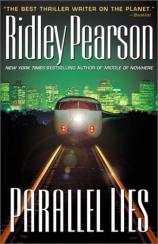


Read a Review CHAPTER 1
The
train charged forward in the shimmering afternoon sunlight,
autumn's vibrant colors forming a natural lane for the raised bed
of chipped rock and the few hundred tons of steel and wood. The
rails stretched out before the locomotive, light glinting off their
polished surfaces, tricked by the eye into joining together a half
mile in the distance, the illusion always moving forward at the
speed of the train, as if those rails spread open just in time to
carry her.
For the driver of that freight, it was another day in paradise.
Alone with his thoughts, he and his brakeman, pulling lumber and
fuel oil, cotton and cedar, sixteen shipping containers, and seven
empty flatbeds. Paradise was that sound in your ears and that
rumble up your legs. It was the blue sky meeting the silver swipe
of tracks far off on the horizon. It was a peaceful job. The best
work there was. It was lights and radios and doing something good
for people – getting stuff from one place to another. The
driver packed another pinch of chewing tobacco deep between his
cheeks and gum, his mind partly distracted by a bum air conditioner
in the bedroom of a mobile home still miles away, wondering where
the hell he'd get the three hundred bucks needed to replace it. He
could put it on the credit card, but that amounted to robbing Peter
to pay Paul. Maybe some overtime. Maybe he'd put in for an extra
run.
The sudden vibration was subtle enough that a passenger would not
have felt it. A grinding, like bone rubbing on bone. His first
thought was that some brakes had failed, that a compressor had
failed, that he had a lockup midtrain. His hand reached to slow the
mighty beast. But before he initiated any braking – before he
only compounded the problem – he checked a mirror and caught
sight of the length of her as the train chugged through a long,
graceful turn and down a grade that had her really clipping along.
It was then his heart did its first little flutter, then he felt a
heat in his lungs and a tension in his neck like someone had pulled
on a cable. It wasn't the brakes. A car – number seven or
eight – was dancing back there like she'd had too much to
drink. Shaking her hips and wiggling her shoulders all at once,
kind of swimming right there in the middle of all the others. Not
the brakes, but an axle. Not something that could be
resolved.
He knew the fate of that train before he touched a single control,
before his physical motions caught up to the knowledge that
fourteen years on the line brought to such a situation.
In stunned amazement, he watched that car do her dance. What had
looked graceful at first, appeared suddenly violent, no longer a
dance but now a seizure as the front and the back of that car
alternately jumped left to right and right to left, and its boxlike
shape disintegrated to something awkwardly bent and awful. It
leaned too far, and as it did, the next car began that same cruel
jig.
He pulled back the throttle and applied the brakes but knew it was
an exercise in futility. The locomotive now roiled with a tremor
that shook dials to where he couldn't read them. His teeth rattled
in his head as he reached for the radio. ``Mayday!'' he shouted,
having no idea why. There were codes to use, procedure to follow,
but only that one word exploded from his mouth.
The cars rolled now, one after another, first toward the back then
forward toward the locomotive, the whole thing dragging and
screaming, the beauty of its frictionless motion destroyed. The
cars tilted right and fell, swiping the trees like the tail of a
dragon, splintering and knocking them down like toothpicks, the sky
littered with autumn colors. And then a ripple began as that tail
lifted briefly toward the sky. The cars, one coupled to the next,
floated above the tracks and then fell, like someone shaking a kink
out of a lawn hose.
Going for the door handle, he let go of the throttle, the ``dead
man's switch'' taking over and cutting engine power. He lost his
footing and fell to the floor of the cab, his brain numb and in
shock. He didn't know whether to jump or ride it out.
He would later tell investigators that the noise was like nothing
he'd ever heard, like nothing that could be described. Part scream.
Part explosion. A deafening, immobilizing dissonance, while the
smell of steel sparking on steel rose in his nostrils and sickened
his stomach to where he sat puking on the oily cab floor, crying
out as loudly as he could in an effort to blot out that
sound.
He felt all ten tons of the engine car tip heavily right, waver
there, precariously balanced up on the one rail, and then plunge to
the earth, the whole string of freights buckling and bending and
dying behind him in a massive pileup.
He saw a flatbed fly overhead, only the blue sky behind it. This,
his last conscious vision, incongruous and unfathomable. For forty
long seconds the cars collided, tumbled, shrieked, and flew as they
ripped their way through soil and forest, carried by momentum until
an ungainly silence settled over the desecrated track, and the
orange, red, and silver leaves fell out of a disturbed sky as if
laying a blanket over the face of a corpse.
Six Weeks Later
Darkness descends quickly in December. In the flaming blue light of
a camp stove, a man's breath fogged the chattering boxcar as he
struggled to warm a can of Hormel chili, the aroma mixing with the
smell of oil and rust. The faint vapor of his breath sank toward
the planking and then dissipated.
Umberto Alvarez thumped his fist onto the floorboards, the feeling
in his fingers lost to the cold, and then cupped both hands around
the small stove, wishing for more heat. The train rumbled. The can
danced atop the stove. Alvarez reached out and steadied it, burning
himself. Be careful what you wish for, he thought.
The train's whistle blew and he checked his watch. Nearly ten
o'clock. The last significant slowing of the freight train had
occurred ten minutes earlier, in Terre Haute. Alvarez had taken
careful note of this, for at that speed, a person could get on or
off the moving train – important to know for any rider. His
reconnaissance almost completed, this trip, Indianapolis to St.
Louis, would be his last ride for a while. Thank God.
Behind him in the boxcar, Whirlpool dishwashers were stacked three
high, their cardboard boxes proclaiming Whisper Quiet as the
rattle of steel-on-steel shook his teeth.
Alvarez's fatigue-ridden eyes peered out from beneath a navy blue
knit cap that he had pulled down to try to keep warm. Still, unruly
black hair escaped the cap in oily clumps. A brown turtleneck was
pulled up over his unshaven chin to keep out the cold. It protruded
from beneath a rat-holed sweatshirt. Over that, a faded fleece vest
that had once been turquoise.
The stacked dishwashers occupied half the boxcar, secured by
tattered webbing straps held together by cast-iron buckle clasps.
The rhythm of the wheels on rail – two loud bumps followed by
whining steel, followed again by the two bumps – contributed
to Alvarez's pounding headache, a sound that would remain with him
for days, on or off the lines, a sound that lived in any rider's
bones: cha-cha-hmmmm, cha-cha-hmmmm.
Pale blue light from the fire ring limited his vision. He could
barely see to either end of the forty-foot boxcar. There was spray
paint graffitit here, if he remembered right, or maybe that had
been another car, another day, another line. It all blended
together – time, weather, hunger, exhaustion. He'd lost
track.
The train could move him physically from one destination to
another, but it couldn't change the way he felt. The weary darkness
that surrounded him had little to do with the dim flicker of the
stove. It lived inside him now. His grief was suffocating
him.
Minutes earlier the open cracks at the edges of the boxcar's huge
sliding door had flickered light from a small town. The train's
driver sounded the locomotive's horn on approach. Through the car's
rough slats, street lamps cast shifting ladders of light
throughout, reminding Alvarez uncomfortably of prison bars.
The train had clattered through the crossing, the warning bells
ringing and sliding down the musical scale, driving Alvarez further
into depression. Any such crossing was an agonizing reminder of his
past. The minivan carrying his wife and kids had been recovered
nearly a quarter mile from a similar crossing, flipped onto its
side and shaped like a barbell – flat in the center, bulging
at either end.
He felt only a sharp, unforgiving pain where he should have felt
his heart. Nearly two and a half years had passed, but still he
couldn't adjust to life without them. Friends had comforted him,
saying he would move on, but they were wrong. He'd lost everything
and now he'd given up everything. To hell with sleep. To hell with
his so-called life. He'd turned himself over to the grief,
succumbed to it. He had purpose, and that purpose owned him:
Payment for atrocities against him and his family would be made in
full. If not, he would die trying.
For the past eighteen months the media had reported a string of
derailments: a freight train in Alabama; another in Kansas; still
others west of the Rockies. Drivers were blamed. Weather
conditions. Equipment failures. As many lies as there were train
cars torn from the tracks. He had not begun with any grand plan,
but somehow one had evolved. He had not awakened one morning to
think of himself as a terrorist, although the description now fit.
He had a meeting with a bomb maker scheduled for the next day. He
had never followed a script, and yet he now found himself with a
clear mission: nothing short of destroying the huge Northern Union
Railroad would do. David versus Goliath: he'd assumed the role
effortlessly.
While one hand stirred the chili with a red plastic stir stick, a
shadow drew his attention. Shifting shadows were routine in a
boxcar; it was the shadows that did not move that attracted one's
attention. But this shadow was caused by something – someone
– on the outside of the boxcar; it – he- – moved
slowly, boldly negotiating on the outside of a moving freight.
Alvarez alerted himself to trouble – some drunken or crazed
rider, no doubt, catching a whiff of the chili. It was no easy
feat, what this man was doing – inching along the boxcar's
exterior; it implied someone strong, or hungry enough to risk life
and limb for a can of chili. Alvarez rose to block the door, but
too late. The heavy door slid open- – a one-handed move!-
– another near impossible feat.
Alvarez stepped back. The faceless visitor, silhouetted in the dark
opening, stood tall and broad, a big son of a bitch, with a
football player's neck. This man reached for his belt and a
flashlight came on, blinding Alvarez, who felt another wave of
dread: maybe not a rider but a security guard, or even a cop. The
feds had cracked down on riders since one recently had been
arrested for butchering people in seven different states. Hobo
Homicide! one of the headlines had read. The Railroad
Killer, on the TV news.
``Smells good,'' the visitor said in a friendly enough tone, the
voice low and dry. He did not sound winded by his effort.
The comment confused Alvarez slightly, lessened his anxiety. Maybe
this guy was just trying to invite himself to dinner. But then
again, that flashlight was oddly bright, too bright. Sure, some
riders carried penlights, even flashlights. But one with fresh
batteries? Never. Not once had Alvarez seen that. Discarded
batteries were scrounged out of Dumpsters, the last few volts eked
out of them. If a rider had two bucks in his pocket it went to
booze, cigarettes, reefer, or food – usually in that order.
Not batteries. The crisp brightness of that light cautioned
Alvarez. Heat flooded him. Finally warm.
``You alone?'' the visitor asked.
Alvarez had long since learned to keep his mouth shut, and he did
so now. Most of the time people tended to fill the dead air, and in
the process they revealed more about themselves than they
intended.
The bright light stung his eyes. Alvarez looked away, the chili
boiling at his feet.
``You Mexican?'' his visitor asked. The man's round face was now
partially visible. A white man, with the nose of a boxer and the
brow of a Neanderthal.
Riders beat the stuffing out of one another for the damnedest
reasons. Most of the time it had little to do with reason –
just the need to hit something, someone. Maybe this guy rode the
rails looking for Mexicans to pummel. Again, Alvarez glanced down
at the simmering chili.
``Or maybe,'' the visitor suggested, ``your father was Spanish, and
your mother, Italian.''
As a part-time rider, Alvarez had learned to live with fear, had
learned to compartmentalize it, shrink it, rid it of its power to
seize control. You couldn't be fighting fear and someone else
simultaneously, so you learned to let the fear roll off your back.
But what he felt now wasn't fear, it was terror.
He knows who I am!
There was little he could do about terror. Terror, once allowed
inside, owned you. There was no fighting off real terror. Survivors
could harness it, redirect it, but could never be rid of it. Terror
had to be dealt with quickly or it would freeze every muscle.
Alvarez bent down and launched the boiling chili into the visitor's
face. He charged, hoping to drive the man out the open door. But
behind the ghoulish scream, as his face burned, the man produced a
nightstick or a sap, connecting it with the side of Alvarez's face.
He felt his nose crack and he spewed blood. Alvarez faltered,
regained himself, and turned, diving for the small stove. Coming to
his feet, he waved it as a weapon, prepared to strike.
This would be a fight to the finish. Alvarez knew it before the
next blow landed.
Alvarez awoke to the jarring sound of a garage door being
hauled open, a pickup truck starting, and the sharp smell of engine
exhaust. He quietly moved a garden spade and peered down through
cracks in the garage loft into which he had climbed the night
before, weary and soaked in another man's blood. Dried blood, now
brown, caked and cracking. If he were spotted, it would mean the
police. He couldn't allow that. Not after working at this for
eighteen months.
He shook from the cold and from his memory of the night before,
realizing that he had probably killed a man, whether in
self-defense or not. By the time Alvarez had thrown the intruder
from the freight car, his attacker had lost so much blood that
under the glare of the flashlight he'd looked ghostly pale. Even
the man's lips had been white. And now...now he felt forced to
question his own motives. He'd been accused of killing his own
attorney, Donald Andersen – a phony accusation that had
caused him to flee in the first place. The thought that he now
indeed might have killed a man could add weight to that earlier
accusation. With their relentless pursuit of him, they may have
turned him into a killer. Now resentment and anger overrode his
initial self-questioning. Northern Union Railroad would cease to
exist. This, for their lies and endless atrocities.
His position up in the garage loft afforded Alvarez a view of the
truck's steering wheel and two large male hands gripping it.
Alvarez lay down flat just in case the driver happened to look up
as he backed out. As a precaution, he remained still, even after
the truck cleared the garage, and this paid off because the driver
left the vehicle to manually pull the garage door back down.
Alvarez listened to the truck pulling away, waited another half
minute, and then moved the ratty blanket and canvas tarp off
himself, grateful that the owners had left a hot lamp going all
night for the cat. The lamp had taken the edge off the cold and had
probably kept him from freezing. It was the glow from the lamp that
had called him to this garage: a beacon seen through the
woods.
A train whistle sounded, reminding Alvarez again of last night's
horror and that he had to keep moving. They might not find the body
for weeks – or perhaps as soon as that same day – but
whatever the timing, he needed to put as many miles as possible
between himself and southern Illinois, and fast. The man in the
boxcar had known his birth heritage – had teased him by
saying ``Mexican'' first, then waiting and identifying Alvarez's
Spanish father and Italian mother. It meant that Northern Union
Security was closer to capturing him than they'd ever been. He'd
obviously screwed up – had allowed himself to be seen or
recognized, or worse, he'd become predictable. Had they known which
train he was on, or had it been random chance, a lucky guess? Had
they determined his next target? Did they know he'd sabotaged the
bearings? Had they finally made this connection between the various
derailments?
He climbed down from the loft, all his joints aching, cold to the
bone, passing a small bicycle hung on the wall and catching a
glimpse of his own face in the bike's tiny rearview mirror. His
wife had claimed he looked more Italian than Latino, citing his
olive skin, thin face, and sharp features, but he saw his father's
face in the mirror, not his mother's. He gingerly touched his nose.
Bruised, but not broken as he'd originally thought. Like the rest
of him, his face was crusted in blood and dirt. He needed a shower,
or at least a facecloth. He had a small tear in the skin above his
slightly swollen left eye, the cut clotted shut. It would clean up
and eventually recede beneath his thick black eyebrows. His dark
skin would go a long way toward hiding the discoloration. Now he
needed to get back on schedule: he had a plane to catch. But he
couldn't even walk out in public looking like this, much less
hitchhike. He glanced around the dimly lit garage, the morning sun
just burning the edge of the horizon and sparkling off the fallen
snow. Panic struck him: snow. Footprints. A trail to follow.
Them – right behind him.
For eighteen months he'd been running, and though in a way he was
accustomed to it, he still broke out in a sweat at the thought of
capture. He clung to his purpose, confident that God would protect
him.
Ultimately he blamed William Goheen, CEO of Northern Union, for
killing his family. But his revenge was no longer focused solely on
Goheen. Not only did one life not equal three, but Goheen had not
acted alone. The institution, the corporation, had killed his wife
and children, intentionally or not.There was no halfway in
this.
A change of clothes – and fast! he thought, still
looking out at the carpet of fresh snow. Time seemed always to be
working against him.
He edged up carefully to the frosted window behind the cat's bed
and peered out at the two-story farmhouse not twenty yards away.
Gray smoke spiraled from a brick chimney. Icicles hung from the
gutters. A yellowish light glowed from the downstairs
windows.
The kid's bike hanging on the wall suggested a family, not a single
guy gone off to work in his truck. It meant there were others
inside: a wife, at least one child old enough to ride a bike. Maybe
others, too – perhaps a mother-in-law, more children,
houseguests. But he needed a closer look. He wouldn't get anywhere
in his bloody clothes. He could only hope that school might take
the mother and child away to catch a school bus, or that the wife
was still asleep, a heavy sleeper. He watched the house carefully
for ten long minutes, evaluating his chances of crossing the open
space unseen. If there was movement inside, he couldn't detect it:
he decided to make his move.
He elected not to crouch or sneak. He would run openly. If
confronted, he would act as if he were in shock. He would claim
there had been a horrible traffic accident, that he couldn't
remember where, or even how he'd gotten there, but that he needed a
telephone quickly. He needed help. He would play on do-gooding
Midwestern values. From there, he'd see.
He opened the garage's side door and started running. All kinds of
thoughts went through his head. How had he come to this point? He
didn't belong here. Eighteen months ago he would have laughed at
the notion that he would be running across a yard of freshly fallen
snow in bloody clothes, with the intention of stealing fresh
clothing from complete strangers. He'd been a schoolteacher –
eighth grade science and computer science; he'd loved his job, his
wife, the twins. To have told him then that the threat on his life
would be so high just a few years later; he would never have
believed it. And yet here he was.
He reached the house unnoticed. Perhaps he would not need any
elaborate story. He crept up the back porch. A forgotten withered
black pumpkin frowned monstrously at him, its jaw frozen, wearing a
crown of ice.
He saw someone inside. An attractive woman in her early thirties,
she wore green flannel pajamas, the top unbuttoned enough that she
wouldn't want a strange man gaping at her. Short, but not skinny.
Hearty Midwestern stock. Dull hair that hadn't yet been brushed
out. She left the kitchen and returned a minute later cradling a
pile of sheets. Alvarez ducked under the window and moved in tandem
with her to the far end of the small back porch where another
window looked in on a pantry, a laundry room. An ironing board
stood on all fours next to the window.
The woman bent over to remove a load of clothes from the dryer,
exposing her breasts to him, and he thought how there had been a
time when that might have had an effect on him. Now he felt no
stirring, no interest whatsoever. He thought of his wife, the
crushed car. It strengthened his resolve. He focused on a pair of
men's jeans strung over a clothesline rack in the far corner. The
woman lifted a pile of darks to the top of the dryer. He spotted a
flannel shirt, some heavy socks. Alvarez leaned back from the
window as the woman unloaded the clothes. He sensed that she was
about to look out, that she had felt his presence.
She moved some clothes from the washer to the dryer and then
stuffed the sheets into the washer. He glanced around, making sure
he wasn't being watched. He briefly considered entering the kitchen
right then – he felt certain the back door would be unlocked
– surprising the wife, perhaps tying her up, and stealing
some food and clothing. But any such encounter would put him at
greater risk. Cops would be called in – his trail would be
easier to follow. He began to feel impatient, but the cold in his
bones was gone, replaced by hot adrenaline.
She reentered the kitchen. Alvarez moved cautiously to another
window and took a position nearer the porch stairs but still with a
view inside. The woman measured out water into a pot and turned on
the stove. She pulled down a box of Cream of Wheat and set it on
the counter. Morning rituals. He recalled them with longing.
Then she hurried out, disappearing into another room.
He was guessing three to five minutes for the water to boil. How
accurately did she have such things timed in her head? His wife
would have known exactly. Three minutes would be plenty for
him to get in, grab the clothes, and get back out. He made his
move, pulling his hand into the sweatshirt's sleeve so as not to
leave fingerprints on the doorknob as he turned it.
The door opened. He stepped inside.
The kitchen smelled like a home. God, he missed that smell. For a
moment it owned him, the poignant feeling carrying him away, and
then the distant sound of shower water caught his attention. It was
warm in here, the first warmth he'd felt in days. Was she just
warming up the shower, or getting in? Each option offered a
different scenario. He crossed toward the laundry room. He wanted
to stay here; he wanted to move in. He pulled the jeans into his
arms, stepped to his left and reached for the flannel shirt in the
pile of dry clothes.
The buttons plunked against the surface of the dryer. He stiffened,
though he thought the noise from the washing machine would conceal
this much tinier sound. But in rising up abruptly he bumped the
ironing board and now watched as the iron, just out of reach, began
to rock, first this way, then that, teetering back and forth. At
that moment, the wife, her flannel pajama top now fully unbuttoned,
pants off and left back in the bedroom or bath, crossed the kitchen
to where, had she looked to her right, she would have seen a
panicked stranger reaching out to stabilize her iron, which was
about to crash to the floor.
The iron started to fall.
Alvarez caught it, reaching out just in time. He then remained
absolutely still, aware that the iron might have just presented
itself as a weapon, if needed. Could he bring himself to use it
that way? he wondered.
He couldn't hear her over the noise of the appliances. He pictured
her measuring the Cream of Wheat and carefully stirring it into the
boiling water. That was when he realized she had used hot tap
water, not cold, which had shortened the time it took to boil. He
moved a bit in order to remain hidden, all the while keeping one
eye on the kitchen.
The woman's pale bare bottom shifted hip to hip as she left the
room.
Alvarez returned the iron to the ironing board, grabbed a few more
pieces of clothing – a T-shirt, several mismatched socks
– and made for the kitchen.Here, he heard the shower water
still running. This woman had her morning routine all planned
out.
He took two steps toward the back door and changed his mind. He
returned to the pantry, deciding to take some canned food while he
had the chance. A clock ran inside his head; he had maybe another
minute or two.
``Mommy?'' a tiny voice called from behind him.
Alvarez flattened himself to the wall. Dead still.
``Mommy?''
He rocked his head to see, with great relief, that he was partially
screened from the kitchen by the open pantry door. Through the
crack he saw a small six-or seven-year-old boy with red hair,
freckles, and a blue stuffed dog tucked tightly under his arm. The
boy crossed to the fridge and pulled out a carton of orange juice.
He moved around the kitchen comfortably, reaching for a glass on
tiptoes and then filling it with the juice.
The plumbing pipes to Alvarez's left rumbled and went silent. The
shower had ended. He stood there with his bundle of clothes and
cans of tuna not knowing what to do next.
She'd be drying herself off now. Just from having observed her,
Alvarez knew she'd already decided what clothes to wear, if in fact
she hadn't already laid them out.
The boy gulped the orange juice. Alvarez felt himself tighten, not
over his predicament, but at the sight of the boy – a living,
breathing boy, in a joyful moment of drinking orange juice. A
child. Innocent. Loving. Waiting for his mother. Alvarez's vision
blurred. Nothing would bring his twins back. He'd revisited their
loss countless times. He pushed his anger deeper inside and locked
it away, though only temporarily. It owned him. Possessed him. But
he could not work with it in the forefront of his thought, he could
barely move. He had learned to tame it but feared he would never be
rid of it.
What to do? he wondered, silently urging the boy to seek out his
mother. The Cream of Wheat would burn in another minute or so. Mom
had to be just about fully dressed by now. His worlds were
colliding. He had to get out.
The boy seemed to be debating whether to leave the kitchen, but
Alvarez needed to take action, now.
The window...
There appeared to be some home-fix-it caulking plugging its edges.
Could he get out it with his arms full? Slip off this far end of
the porch? He could taste his freedom.
The boy remained in limbo, hugging his blue dog and staring off
into space, but he faced the laundry room, preventing Alvarez from
crossing the pantry's open door and making for the window.
``Nate, honey?'' called Mom, sounding close, though not yet into
the kitchen.
``Yeah?'' the boy called in response.
``Stir the cereal for me, would you? Turn it off first! Use a pot
holder! And watch out for the bubbles. They're hot! I'm going to
get your sister up.''
A second child!
The boy crossed to the stove.
Alvarez moved back to the ironing board. He set down his loot on
the dryer and gently moved the ironing board out of his way. Would
she remember how it had been sitting? If he could get out without
setting off any alarms in her, he might buy himself more time
– freedom.
He unlocked the window, the washer's motor and churning water
providing cover. One firm bang with an open palm jarred the window
loose. The weather stripping, long strings of soft caulk, pulled
from the jamb. He was in a full sweat now – hands, armpits,
brow, the back of his neck. He tossed his haul out into the snow,
slipped his legs out, and reached to pull the ironing board back
into place, dragging it.
His mistake was attempting to stand the iron itself back up as he
had found it. He stood it up fine, but in his final effort to get
out, he once again nudged the ironing board. This time, he took no
notice. As he ducked his head out the window, he heard the iron
strike the floor.
He pulled the window shut and scooped up his stolen
possessions.
The woman heard the noise. Sounded like something falling. With
Samantha cradled in her arms and Nathan standing on a chair
stirring his hot cereal, she stepped into the confined space. She
thought it felt cold, but this laundry room never heated well in
the morning. Northwest side of the house and all.
The iron lay on the floor. She stared at it, puzzled. Then the
washing machine shook, going off-center, as it was prone to do with
sheets and towels, and the room vibrated so much she was surprised
every shelf hadn't fallen down along with the iron. Just another
thing that needed fixing. Like most everything in this
place.
Excerpted from PARALLEL LIES © Copyright 2001 by Ridely
Pearson. Reprinted with permission by Hyperion. All rights
reserved.



