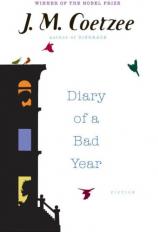
Diary Of a Bad Year


Review
Diary Of a Bad Year


DIARY OF A BAD YEAR begins with an essay about the formation of
the state and Hobbes’s social contract. By the end of the
page, the aging writer speaks for himself, and we meet the
protagonist who is writing the essay. On page two we’re back
to the social contract, which goes on to lament that such thought
is outdated. When was the last time that someone signed one
of these contracts by free choice? Then we return to the narrator,
who starts hungrily lusting after a sexy young tart in his
apartment complex with whom he flirts awkwardly. A few chapters in,
the girl, Anya, starts speaking for herself, and her loving talk
about the shape of her rear begins the third narrative in DIARY OF
A BAD YEAR.
The withered Senor C asks Anya to type his collection of essays,
STRONG OPINIONS. Bored and between jobs, she agrees, fully aware
(and reveling) that she is hired as eye candy. It’s not like
she needs the money: her boyfriend Alan --- a horny, insensitive,
greedy I-banker who only wants Anya as a trophy --- gives her all
the cash she needs so she may shop and look pretty for him.
So commences a chronicle of one man’s literary process: the
essays he writes, his conversations with Anya, and her criticism as
well as private diary-esque side of the story. In this last part, a
second plot develops: Alan seems obsessed with ruining C and
stealing his money, and has developed an elaborate scheme to do so.
It is here that Anya’s personal growth shows, as she
repeatedly defends the old man, someone she barely knows, from this
hawk.
At its best, the novel is a web of interconnections: Anya provides
her distinctly non-academic viewpoint on C’s essays as she
types them up, and so we read a discussion of an essay we saw a few
chapters ago. Sometimes the content of the essays relate directly
to the power plays and emotional development between C and Anya.
And as the characters primarily write about their interactions with
each other, we gain insight about them mainly through the eyes of
others. J. M. Coetzee has closed the gap between writer and written
product as we read a case study of a work in progress.
The essays themselves make for interesting reading. This style of
essay, which is neither academic nor journalistic, is more akin to
aphorisms, diatribes and bon mots. Many have no real
conclusion and some possess no definite form. This most
“literary” sub-genre of the literary essay is tiring if
read alone, as the topics wander and the voice becomes droning. But
when coupled with fiction, that which would be tiresome is now a
light and welcome addition to the text. This is not to say that the
essays have no value on their own. Many do and are insightful, if
you can get past some of the more obvious, preaching-to-the-choir
literary liberalism (guess what Coetzee says about Bush, Blair and
modern higher education?).
In the midst of this literary game, C and Anya impact each other at
distinctly different points in their lives. How much they change
each other is one of the more fundamental questions with which we
conclude. But at the end, we get little in the question of what
this novel is actually about. While well written and inventive,
what Coetzee is ultimately getting at remains regrettably unclear.
Literary games are all well and good, but it felt somewhat empty.
This may best have been remedied by lengthening the narratives and
shortening the essays, as well as giving C more of a voice so as
not to be drowned out by his essays or the other characters. While
the minimalism is obviously intentional, the result is that C
becomes less of a character and more of a device. This is a shame,
since he could have been the perfect nuanced character to offset
Anya’s admittedly predictable development.
All in all, DIARY OF A BAD YEAR is a worthwhile read for those who
enjoy playing with style and don’t mind a certain lack of
narrative depth. While the end product has some faults, the picture
of the novel as a process of its own is handled capably by a
stylist honed at his craft.
Reviewed by Max Falkowitz on December 29, 2010


Diary Of a Bad Year
- Publication Date: December 27, 2007
- Genres: Fiction
- Hardcover: 240 pages
- Publisher: Viking Adult
- ISBN-10: 0670018759
- ISBN-13: 9780670018758