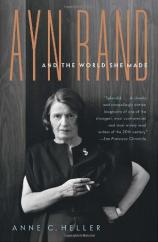
Ayn Rand and the World She Made


Review
Ayn Rand and the World She Made




Anne C. Heller acknowledges that “because [she was] not an
advocate for Rand’s ideas, [she] was denied access to the Ayn
Rand Papers at the Ayn Rand Institute.” By
“advocate” she meant “idolater” since that
is what is required of those who wish to gain access. But as well
as being able to read many letters and papers not possessed by the
Institute, she interviewed Rand’s still-living family and her
ex-lover/first great protégée, Nathaniel Branden (born
Nathan Blumenthal, a young man who at one time admired Ayn Rand so
much that he changed his name to incorporate hers within it, a kind
of marital custom in reverse), to discover much about the life of
the highly controversial author.
Ayn Rand (born Alissa Rosenbaum in 1905) immigrated to the
United States from Russia in her early 20s and quickly gained
employment as a Hollywood screenwriter. She was nothing if not
driven, believing she had a destiny as a great author. She used
amphetamines to stay awake night and day to write both her best
known books, THE FOUNTAINHEAD and ATLAS SHRUGGED. She sometimes
taped a needle to her thumb so that if she lost focus, she could
stick herself back to work. Rand espoused a philosophy that came to
be called Objectivism and was symbolized by a U.S. dollar sign.
Objectivism celebrated the total independence of all human beings,
yet Rand was devastated when ATLAS SHRUGGED was, for the most part,
panned by the reviewers. Paradoxically, it seemed that praise was
the food she most craved, yet when people merely liked her work
without espousing the ideas behind it, she was quick to label them
fools and weaklings.
Heller takes a dispassionate view of Rand and, in this detailed
portrait, seeks to reveal her as a whole person rather than the
cardboard cutout swathed in legend created by the great lady
herself. That Rand was Russian was known -- her accent proclaimed
that --- but that she was Jewish was less acknowledged, especially
since Rand made the claim that she had decided upon atheism by her
early teens. Heller seeks to illustrate by many examples
Rand’s “Russianness” and her cultural
“Jewishness.” The biographer took care to disentangle
the public image of Rand --- caped, clever and sometimes cruel ---
from the private person, an enigma wrapped in a mystery and
possibly driven more by personal fear than by public idealism.
No doubt, she was a genius who had many insightful ideas and
could write a whale of a sexual romance. Her plots thickened
exponentially, and even those who disagreed with her world view
tired themselves out turning the pages of her giant tomes, keeping
them on the bestseller lists despite critical disdain. Rand posited
a world in which only productive, capitalistic people truly matter,
the rest being slaves and underlings. She believed that only
fiercely independent people can truly enjoy sex; in her own way,
she was a proto-feminist and also anti-war, two banners that could
have won her some admirers on the left. But she caustically
rejected any devotion that was not total. Also, it is difficult to
feel warm towards someone who characterizes altruism as the
greatest possible evil, and that was Rand’s absolute
belief.
Reacting poorly to the world’s failure to fall at her
feet, and perhaps affected mentally by years of ingesting large
numbers of dexadrine pills, Rand gradually fashioned herself into
the legend she thought she deserved to be. Reading the book, I
found myself thinking she was, by turns, either a high-functioning
autistic, a psychotic, or a self-degraded drug addict, despite her
genius and her occasional acts of kindness. She vilified nearly all
of her early supporters (anyone who might have remembered her when
she was not famous), dropping them in favor of a coterie of young
admirers (who some would call sycophants). She never thanked
anyone. She handily forgot her own missteps and recalled only her
glory moments. Fiercely anti-communistic, she paradoxically played
the role of a petty Stalin at the center of a clutch of young
worshippers, staging psychologically destructive purges and lengthy
show trials of those she identified as disloyal.
Surprisingly, however, her longest relationship, with her
husband Frank O’Connor, exemplified, on his part, the quality
she claimed most to despise: generosity of spirit. Hardly the
sadistic, raging hero of her literary imaginings, he was passive
yet protective, the opposite of what a “goddess” like
Rand deserved. Frank defended her, cooked and cleaned for her, and
did not protest over her affair of many years with a man some 30
years her junior conducted twice weekly in Frank’s own bed.
Rand’s books have always sold well as each new generation
“discovers” her. Young people, usually in their teens,
take her philosophy to heart.
But, ultimately, her cold ideas lose their flavor, and most of
her avid readers become as indifferent to her seductive
speechifying as did her lover, Nathaniel Branden. By recanting his
once hot ardor for all things Rand, he was cast into outer
darkness, and an unknown young professor, Leonard Piekoff,
inherited all of the author’s considerable intellectual
property. That was the beginning of the Rand Institute, the end of
the open sharing of Objectivism, and the middle of what is proving
to be a long story. Though she passed away in 1982 from lung cancer
and loneliness for her dear, weak Frank, Ayn Rand’s
philosophy and the novels that proclaim it are getting more
attention since the current recession took hold. That and the right
wing’s perception of the imminent threat of government
takeovers comprise just the sort of scenario Rand would love to
have been alive to scorn and struggle against.
Reviewed by Barbara Bamberger Scott on December 22, 2010


Ayn Rand and the World She Made
- Publication Date: October 19, 2010
- Genres: Biography, Nonfiction
- Paperback: 608 pages
- Publisher: Anchor
- ISBN-10: 1400078938
- ISBN-13: 9781400078936