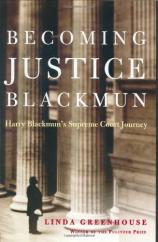
Becoming Justice Blackmun: Harry Blackmun's Supreme Court Journey


Review
Becoming Justice Blackmun: Harry Blackmun's Supreme Court Journey




Perhaps even before this review appears, but certainly within the
next months, President Bush will receive the opportunity to make
one of the most critical decisions of his presidency. A Supreme
Court vacancy seems almost definite, and it will offer the
President an opportunity to have a lasting impact on the future of
the law in America. The President probably has a name in mind, but
one can only hope that before he makes such a monumental decision
he would take the time to read BECOMING JUSTICE BLACKMUN: Harry
Blackmun's Supreme Court Journey, by Linda Greenhouse. It would be
time well spent.
Ms. Greenhouse has covered the Supreme Court for the New York
Times since 1978. In 1998, she was awarded a Pulitzer Prize for
her reporting on the Court. In March of 2004, under the terms of
Justice Blackmun's will, his personal and official papers were made
available to the public. Justice Blackmun served on the Court until
1994 with many of the Court's current members. The insights and
views he expressed in his papers offer a remarkable view of the
Supreme Court, its members and the rule of law in American society.
This book is not a biography of Harry Blackmun. More accurately it
is a portrayal of a journey that one man traveled over his 24 years
of service to the Court and to his country. Justice Blackmun grew
and changed during his court tenure. From Linda Greenhouse we learn
how and why the man who retired from the bench in 1994 was so
different from the man who wrote out a list of pros and cons in
1970 to help decide whether or not he should accept the position of
justice of the U.S. Supreme Court.
The current battle over judicial nominations has been a festering
sore in American politics since the days of Richard Nixon.
Blackmun, through no fault of his own, played a prominent role in
that imbroglio. Blackmun was Nixon's third choice for a vacancy on
the court that arose in 1969 when Justice Abe Fortas left the court
following a scandal that focused on fees accepted for work done
outside his judicial duties. True to his 1968 campaign pledge to
select "strict constructionists," Nixon chose two conservative
southern jurists. Both were defeated in bitter confirmation
battles. Nixon then turned to Minnesotan Harry Blackmun who was
serving on the Eighth Circuit United States Court of Appeals.
Blackmun also had been a lifelong friend of Chief Justice Warren
Burger. Their friendship and initial common decisions on cases
earned them the nickname of "The Minnesota Twins." Both the
nickname and the friendship would soon be shattered.
BECOMING JUSTICE BLACKMUN discusses a wide range of Blackmun's
jurisprudence. Two areas of the law warrant extended discussion in
this limited review. First and foremost is Blackmun's decision in
Roe v. Wade, the abortion decision that made him a hero in
the eyes of some and earned him the enmity of others. Roe
became Blackmun's bete noir in the same fashion as many
individuals whose lives are marked by one act. But Roe was
not Blackmun's decision alone. It was the work of several judges
whose thoughts, notes and suggestions are all documented by
Greenhouse. To read her account is to understand how Supreme Court
decisions are reached by discussion, compromise and legal give and
take. In contemporary society, where judicial decisions often
result in histrionic name-calling, the lesson of Roe should
be trumpeted; sadly it is ignored.
Blackmun became a defender of Roe and later in dissent he
would express a belief that showed how his court tenure had changed
him as an individual. He wrote, "There is a world 'out there,' the
existence of which the Court, I suspect, either chooses to ignore
or fears to recognize…. This is a sad day for those who
regard the Constitution as a force that would serve justice to all
evenhandedly and, in so doing, would better the lot of the poorest
among us." Sadly, our current Supreme Court seems not inclined to
deal with the real world and the impact of its decisions on real
people.
Decisions in death penalty cases also exemplified the journey of
Justice Blackmun. Originally he voted to support the reinstitution
of capital punishment in state courts across the land. But years of
confronting a legal system unable to fairly prosecute and sentence
criminal defendants to death ultimately forced Blackmun to confront
the fact that the system could not operate in a fair and just
manner. In 1994, Blackmun renounced support for the death penalty.
"From this day forward, I shall no longer tinker with the machinery
of death." Blackmun was a prophet. His concerns and quarrels with
capital cases are today being confronted in state after state, as
multiple problems with capital murder trials are unearthed on a
regular basis.
The exhaustive historical biography of Harry Blackmun is probably
years or decades away from publication. Nevertheless, Linda
Greenhouse has provided readers desirous of understanding judicial
philosophy and growth with a wonderful saga of a jurist who was not
afraid to reexamine his views and philosophy in an ever-changing
world. Our Constitution is a stronger document for having been
interpreted by Blackmun. Sadly, we will not see others like him
unless our politicians come to understand the importance of a
living judiciary.
Reviewed by Stuart Shiffman on December 22, 2010


Becoming Justice Blackmun: Harry Blackmun's Supreme Court Journey
- Publication Date: May 2, 2005
- Genres: Biography, History, Nonfiction
- Hardcover: 288 pages
- Publisher: Times Books
- ISBN-10: 080507791X
- ISBN-13: 9780805077919