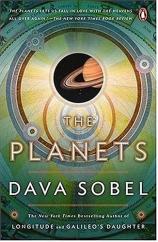
The Planets


Review
The Planets


Here's some comforting news from outer space, conveyed by science
writer Dava Sobel: Our sun, though a relatively small star, will
continue to warm us for another three to five billion years before
it explodes and reduces all nine of its satellite planets to
cinders. So, for a while yet, not to worry.
That's a sample of the kind of factual information scattered like
stardust throughout the pages of this quirky little book. Dava
Sobel starts with the sun, then progresses, chapter by chapter,
through the nine planets in our solar system in the order of their
distance from the sun. Her book is not a science textbook. It is a
kind of grab-bag of information, giving ample space to mythology,
poetry, music and folklore, as well as scientific fact and
speculation.
This is science as entertainment. Sobel does not, for example, draw
any conclusions concerning the current debates over Biblical vs.
scientific interpretations of the creation story. One reader, at
least, is grateful for that decision.
Most of Sobel's text is fairly straightforward. It is certainly
legitimate to delve into the mythological tales associated with
each planet's name, and to quote some of the eloquent things great
poets have written about our planetary neighbors.
Here and there, though, Sobel goes too far, as when she speculates
on the "horoscope" of the Galileo spacecraft based on the date of
its birth (read: launch) or when she allows a fragment of Mars rock
that landed on earth to tell its own story in the first person. She
also has concocted a fictional letter from Sir William Herschel's
sister to an American woman astronomer. The information it conveys
could just as well have been presented in Sobel's own well-informed
voice.
I would say in general that Sobel devotes too much space to
astrology, giving it more prominence in her narrative than such
mumbo-jumbo deserves. A number of noted astronomers were also
astrologers, but the two occupations parted company centuries
ago.
Aside from such unnecessary literary acrobatics, Sobel has produced
a very informative little book. We learn that Venus is so hot that
all 10 Russian spacecraft that visited it either quickly melted or
were crushed by atmospheric pressure. She tells us that our moon is
drifting further away from us at the rate of about one inch per
year, and that giant Jupiter has some 60 satellites of various
sorts whirling around it. A whole cloud of such facts whirl around
the reader like so many asteroids in the Kuiper belt.
Sobel is not very sympathetic to popular notions of Mars as a
possibly habitable place, pointing out that it is frigidly cold the
year round (average year-round temperature: 40 below zero). She
nominates Venus as the most earth-like of the planets in some ways
--- but it has no solid surface and the temperature of its gases is
a bit on the warmish side (about 800 degrees Fahrenheit). Better to
think Florida for your retirement haven.
Uranus and Neptune earn from Sobel the designation of "ice giants"
--- but their ice is comprised of water, ammonia and methane, and
neither one has a solid surface. Their "ice" cores are buried deep
within layers of atmospheric gases. So don't pack ice skates for
your trip.
Astronomy being such a highly technical subject, Sobel does her
best to avoid technical jargon and explain things in layman's
language. It is a tough assignment, but she succeeds often enough
to earn high marks for readability. There is also a helpful
glossary for the astronomically challenged. I learned from it the
meaning of "regolith," a word she uses in her text without
explanation.
Even her bibliography has entertainment value: among all those
scientific tomes we find Edgar Rice Burroughs, Norman Mailer, C. S.
Lewis, H. G. Wells and a trio of musicians (Dane Rudhyar, Stuart
Isacoff and Imogen Holst), as well as Christopher Columbus and
Ptolemy. Quite a fascinating crew for a space voyage!
Reviewed by Robert Finn ([email protected]) on January 18, 2011


The Planets
- Publication Date: October 31, 2006
- Genres: Nonfiction, Science
- Paperback: 288 pages
- Publisher: Penguin (Non-Classics)
- ISBN-10: 0142001163
- ISBN-13: 9780142001165