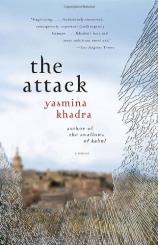
The Attack


Review
The Attack




As the hostilities between Israel and the Arab world grind on with
ever-greater loss and blame, it's not difficult to see how the
perceptions of an outsider can often fathom both the broad and
intimate gestures of a raging civil and cultural conflict. Most who
do glimpse the relentless insanity rampant across the present-day
Holy Land (with the additional complications of Lebanon) either
recoil in horror or exploit its afflictions with cheap and
incendiary journalism. Another suicide bombing in the news; today a
restaurant, tomorrow a bus, next week...who knows?
In THE ATTACK, which viscerally details the prolonged detonation of
just such a bombing, Yasmina Khadra has taken the brave (perhaps
even brazen) approach of turning the wretchedness of
generations-old enmity into very personalized fiction. He ---
former Algerian army officer Mohammed Moulessehoul, who until
recently used a female alias for protection --- leaps the cultural
and geographical gap between North Africa and the Middle East with
little awkwardness, compared to the immense challenges of
accompanying and revealing the deep psychological trauma of his
protagonist.
Dr. Amin Jaafari, an eminent surgeon, is among more than one
million Arabs who, in real life, are full citizens of Israel. They
rarely make news headlines, for they live in a peculiar kind of
shadow land; never fully accepted by Jewish society, but accorded
all the rights, privileges, resources and opportunities that their
brothers and sisters on the other side of the cultural (and now
very tangible) Wall both admire and envy --- and for which all too
many are willing to die seemingly senseless deaths. Jaafari
represents those who (like some dear friends of mine) have worked
long and hard to attain skills that make them grudgingly
indispensable to the Israeli infrastructure.
Jaafari comes across as a convincing composite of many such unsung
heroes of this long war, who routinely stitch up Israeli and Arab
alike, making no distinction between them when it comes to
preserving life and doing no harm. His patients, even in extreme
pain, don't always feel the same way, but he's used to that
too.
By the time the scenes of yet another suicide attack at an Israeli
restaurant begin to resolve into distinct visual and statistical
elements of death, dying and survival, Khadra has set up the
intense emotional context for an abrupt left turn that takes us
into the deepest hell an individual of Jaafari's profession can
imagine. His own Palestinian wife has been identified by police as
the latest suicide bomber to randomly kill dozens of Jewish men,
women and children.
From that point of numbing disbelief on, Jaafari becomes an
intensely empathic study in the tortuous journey of human grief.
And grief, as any good pastoral or religious counsellor can attest,
is perversely messy. Despite its famous "stages" as defined by
luminaries like Elisabeth Kubler-Ross, this particular form of
spiritual agony follows no textbook ordering, no predictable
degrees of intensity or duration. As difficult as it is to follow
Jaafari's descent into a maelstrom of self-hatred, denial, anger,
confusion, fear, apathy and myriad other shades of emotion that
assail the human psyche in the wake of catastrophic loss, this is
the real substance of Khadra's story and he handles it with
brilliant pathos. (Translator John Cullen must have been tested to
the limit in capturing the passion and color of Khadra's original
French text.)
Khadra uses the distance of his outsider's eye with sensitivity and
intelligence to portray the individual and collective personalities
that ebb and flow around Jaafari's erratic quest for understanding,
making THE ATTACK a surprisingly even-handed treatment. Both Arabs
and Israelis are shown with their due proportion of graces and
failings, and both are allowed to reflect on the evils of war and
subjugation that have been the story of Israel and Palestine since
their modern beginnings.
It's almost redundant to comment that there is no happy ending to
this story. And Khadra has offered only the most tentative threads
of hope, doling them out at painfully long intervals. Like so many
clear-eyed observers, he appears to see few avenues to any
long-term structural solution --- at least, not the kind imposed
from without --- in this bleeding pocket of the Middle East.
But by focusing on one victimized individual, he has illuminated a
few patches of the spiritual ground on which people of vastly
different ideologies can (and do) still walk together. They are the
ones, Arab and Israeli alike, who work side by side to pick up the
pieces, even as bombs and bullets rain around them. Unfortunately,
they don't make many news headlines, but Khadra has told their
story with unforgettable power and immediacy.
Memo to George W. Bush, Condoleezza Rice, Ehud Olmert, Tony Blair,
Stephen Harper and that whole gaggle of folks "at the top" who
still seem to think there's a fast, simple, one-size-fits-all
solution for a situation of gargantuan complexity and sadness: get
a copy of THE ATTACK now, and set aside an evening to read it cover
to cover. I'm not kidding!
Reviewed by Pauline Finch ([email protected]), an Anglican seminary student who has traveled in Israel and Palestine. She works as a national media consultant/researcher and copy editor for the Canadian Islamic Congress. on December 22, 2010


The Attack
- Publication Date: April 25, 2007
- Genres: Fiction
- Paperback: 272 pages
- Publisher: Anchor
- ISBN-10: 0307275701
- ISBN-13: 9780307275707