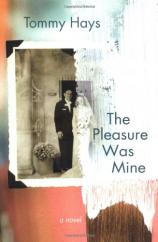
The Pleasure Was Mine


Review
The Pleasure Was Mine


Pardon me if I'm sentimental, when we say goodbye
Don't be angry, don't be angry with me, should I cry
When you're gone I will dream a little dream as years go by
Now an' then, there's a fool, a fool such as I
- Bob Dylan
The trick in writing a book like THE PLEASURE WAS MINE is not in
making it sentimental. Anybody could have done that, if that was
all there was to be done. The subject matter --- the winding down
of a fifty-year love affair due to the ravages of Alzheimer's ---
lends itself all too well to sentimentality, as it wanders down the
perfumed pathways of remembrance, memory and regret, heading slowly
but inevitably downhill.
So the trick is not to screen out sentimentality. It's not
possible. When you have a character like Irene Marshbanks, former
South Carolina Teacher of the Year who is losing her ability to use
the language, piece by piece, it's impossible not to feel the loss.
And it doesn't even take firsthand experience with the disease to
feel the anguish as memories and the love tied to them fade. Add to
that the untimely death of a young wife and the mourning of her
husband and son, and you have a plot that has sentimentality
included as part of the standard equipment.
The trick, then, is to have a way to iron out that sentimentality,
to present the story in a smooth and even way, like paint on a flat
surface. The way that the brilliant Tommy Hays accomplishes this is
by having Prate Marshbanks tell the story. Prate Marshbanks is a
housepainter, and proud of it. He's proud of his skills and the
life he's built with Irene and his son, the famous landscape
artist. When he dreams, he dreams of smooth surfaces ready for
painting.
Prate has a talent for self-deprecation, and he's painfully aware
of his shortcomings as a husband and father. He's old now, and
cranky, and torn up inside by his wife's illness and the inadequacy
of his response to it. He can't keep the aides from mistreating
her, or be by her side as often as he'd like, or take care of
himself. On top of that, he's saddled with his grandson for the
summer, while his artist son takes a break in a mountain
retreat.
Hays delicately balances the sentimentality of the old man ---
thinking about the past and mourning the overdevelopment of the New
South --- with the sentimentality of the grandson, who lets fish
loose off of stringers and can't bear to eat meat. This is not your
ordinary generational conflict, but a confluence --- the streams of
grief merge, crashing into each other with surface turbulence and a
powerful undertow.
THE PLEASURE WAS MINE is sentimental, and if that's problematic for
some readers, they should pardon Tommy Hays anyway. Now and then,
there is a fool such as I, but talented writers like him only come
around every so often. THE PLEASURE WAS MINE is an experience to be
savored, to share with those you love, and to remember.
Reviewed by Curtis Edmonds, who writes movie reviews at txreviews.com. on January 18, 2011


The Pleasure Was Mine
- Publication Date: March 1, 2005
- Genres: Fiction
- Hardcover: 272 pages
- Publisher: St. Martin's Press
- ISBN-10: 0312339321
- ISBN-13: 9780312339326