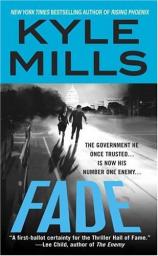
Fade


Review
Fade




The story told in FADE by Kyle Mills initially seems…well,
familiar. A Special Ops guy --- in this case, a Navy SEAL --- is
retired, quietly living his life and attempting to exorcise his
personal and professional demons, when Uncle Sam comes calling,
wanting to bring him in for one last mission. The ex-op, who is the
best ever at what he does, refuses. The government tries to force
him into it, and things go downhill from there, with the ex-op
taking on the Army, or a town, or whatever. Like I said, it sounds
familiar. At first. But FADE cannot be dismissed as another
Sylvester Stallone or Arnold Schwarzenegger vehicle. By the time
movies like Commando or First Blood end, FADE is just
getting warmed up.
Fade is Salam Al Fayad, an off-the-scale soldier who was forced to
retire as the result of a grievous gunshot wound sustained in the
line of duty. A bureaucratic snafu denied him the medical attention
he needed; as a result, the bullet lies buried in scar tissue near
his spine, causing him irrevocable nerve damage and bringing him
closer to paralysis with each passing day. When Homeland Security
decides to create a covert military surgical strike team, a career
bureaucrat named Hillel Strand thinks that Fade is just the man for
the job and assists on recruiting him, over the objections of Matt
Egan. Egan, who had worked with Fade in the field and was at one
time Fade's best friend, is well aware of Fade's bitterness toward
his former employer --- a bitterness that includes Egan, who Fade
blames (incorrectly) for the denial of his medical treatment.
Strand and Egan nonetheless approach Fade, who is living in
solitude, eking out a living by building and repairing furniture
while stoically awaiting the paralysis that will eventually result
from his injury. When Fade predictably rebuffs the pair, Strand
engineers a wrong-headed operation that sends a local police SWAT
team to arrest Fade on trumped-up charges, a maneuver that is
supposed to force Fade back into the fold of the U.S. government.
Fade, however, believes that the SWAT team invading his home is
actually an assassination squad, and successfully wipes out the
entire crew, save for one: Karen Manning, the SWAT team leader, who
is quickly taken hostage by Fade. Manning slowly begins to realize
that Fade was set up, but it is too late.
Strand, hoping to cover up his duplicity in the action that has
gone so horribly wrong, has set the might and majesty of the
Federal Government against Fade. Well aware that his days are
numbered, Fade has only his wits and planning abilities to aid him
in his final quest, which is to obtain the ultimate revenge against
Strand.
It would be easy to classify FADE as an extremely entertaining
novel; indeed, it is a fast-paced work, one during which the reader
never knows what will happen from one moment to the next. But Mills
brings an element of moral ambivalence to the work that places it
several steps above the garden variety explosions-and-karate one
normally encounters in the genre. Almost all of the primary
characters in FADE --- with the exception of Strand, and one other,
whom we do not meet until the end of the book --- are innocents,
cast against each other in a deadly dance where fates seem
preordained and no one escapes entirely unscathed.
FADE, in its way, is a modern re-telling of the Frankenstein myth,
done up in geopolitical dress and given a new relevance for our
times. While there is plenty of action here for fans of the
thriller genre, there is much for thoughtful, if disturbing,
reflection as well. Recommended.
Reviewed by Joe Hartlaub on January 21, 2011