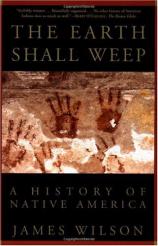
The Earth Shall Weep: A History of Native America


Review
The Earth Shall Weep: A History of Native America




 We
We
floated down the busy, murky rapids of the Colorado River on rubber
rafts, our only engines the strong bare backs and arms of our
guides. We slept in tents and ate food cooked over a fire. In the
late afternoons we hiked up narrow canyons and spied the mysterious
pictographs and petroglyphs left by ancient predecessors. In white
and black on the red rocks I saw waving arms, horses, goats,
spears, the squiggly spokes of wheels. In my early 20s, I envied
the simplicity of a life where all that was expected of me was to
follow the well-defined path of my ancestors.I've
since grown up and recognized those fantasies as naive and romantic
but I still have an enduring fascination and respect for Native
American history and culture. THE EARTH SHALL WEEP by James Wilson
is not only an invaluable reference work on these subjects, but
also a compelling narrative of the many different nations who lived
in this vast territory before the Europeans came and the
devastating effects of their contact with
"civilization."Wilson spent 20 years gathering information for this book from
Indian and non-Indian sources, and his attempt at a balanced
portrayal has paid off. He doesn't condemn the Europeans
specifically, nor does he idealize the Indians. Rather, he is
scrupulous about relating what is known of the world views of both
the settlers and the natives and putting the events he relates in
this context.The
descriptions of these cultural differences set you up for the
conflicts that follow, and one reads them with the tragic sense of
imminent doom more commonly found in a suspense novel than in a
historical account. "The trade with Europeans was, from the Native
American point of view, a form of ceremonial gift exchange which
allowed them to bind the newcomers into their world of mutual
obligation. Their 'generosity' was not naivete, as many Europeans
thought, but neither was it cynical opportunism."The
trading relationship actually worked to the advantage of both
societies on the east coast for several centuries, until the
English Pilgrims and others decided they not only wanted to remove
the wealth of the country from the Native Americans but they wanted
to occupy all of the land as well. In their view, the Indians were
not legitimate owners of the land, since they didn't farm in the
European ways. Therefore, the white settlers felt justified in
pushing those who survived the epidemics of disease further and
further west.The
book is divided into three main parts. Part I, "Origins," deals
with the fundamental differences between Native American origin
myths and the Western (white) man's belief system, and reviews what
little is known of pre-contact Native America.Part
II, "Invasions," separately covers the history of each major part
of the country since contact. I was surprised at how different the
experiences of some Native nations were from others. For instance,
Wilson shows how in the sparsely populated Southwest, the Pueblo
and Navaho nations have been able to maintain much more of their
culture than in other areas like the east coast, where disease and
intense competition for land completely eradicated or displaced
many tribes.Part
III, "Internal Frontiers," covers the widely differing policies our
government has adopted in the last 150 years to deal with "the
Indian problem," from assimilation, whose aim was to absorb Native
Americans into the predominant white culture, to termination of
many of the tribes special subsidies and programs under the Indian
Reorganization Act. In this final section, Wilson also recounts the
rise of Native American activism that began in the '60s, and some
of that movement's successes and failures.This
very complete and fair work deserves a place on the bookshelf of
anyone interested in Native America. My copy is festooned with
little blue sticky notes, marking passages that I will ponder for
years to come.
Reviewed by Eileen Zimmerman Nicol ([email protected]) on January 21, 2011


The Earth Shall Weep: A History of Native America
- Publication Date: March 3, 2000
- Genres: History, Nonfiction
- Paperback: 466 pages
- Publisher: Grove Press
- ISBN-10: 080213680X
- ISBN-13: 9780802136800