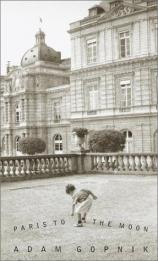
Paris to the Moon


Review
Paris to the Moon


Several times a year, when my stack of unread New Yorker
magazines threatens to topple off the coffee table, I tell myself I
should really cancel my subscription. How can anyone keep up with a
weekly magazine? Especially one that is so much like a huge,
excellent meal, compelling this reader to sample, and usually
finish, each essay or article or story. Then I pick up an issue and
turn to whatever Adam Gopnik has written and I know that as long as
he writes for them I'll continue to mail in those subscription
renewal forms every year.
Most of the essays in the book PARIS TO THE MOON were published
first in The New Yorker. Despite having read them there, or
maybe because of it, I coveted having them collected in book form.
I confess to being a Francophile but I'd probably be just as
delighted to read this author's musings on life in Normal,
Illinois. Mr. Gopnik possesses the rare skill of writing about
abstractions like culture and art in ways that are not only
painless to read, but fun. "It's true that French women's magazines
are as deeply preoccupied with body image and appearance as
American ones. But they are confident that all problems can be
solved by lotions."
It has been said that a writer is someone who sees differently. Mr.
Gopnik sees more. Who else would come up with an analogy between
the American obsession with working out and tangling with the
French bureaucracy? "Three or four days a week you're given
something to do that is time consuming, takes you out of yourself,
is mildly painful, forces you into close proximity with strangers,
and ends, usually, with a surprising rush of exhilaration: 'Hey, I
did it.'"
When he isn't musing about French politics or architecture, Mr.
Gopnik also writes winningly about more domestic concerns. His
second child is born in Paris, fueling wry comparisons between
French and American attitudes towards and modes of delivery of les
enfants. He cares passionately about food and writes about the
people who cook and serve it as well as the institutions where it's
served. In the essay, "The Balzar Wars," he finds out that his
favorite brasserie has been sold to a group likely to consolidate
and/or standardize it. "I felt as I imagined I would feel if I had
been stabbed: first surprise, then nothing, then pain." Of course,
in any book about Paris, essays about fashion are de rigeur, and
the ones here are as amusing and thoughtful as are all the
others.
This collection truly has everything: sensuous detail, fine
writing, lots of laughs, and stimulating, novel ideas. It's like
the window of a patisserie, an array of tempting confections
lovingly and artfully arranged. Warning: while this book can take
the sting out of not going to Paris this year, you'll probably be
perusing your vacation calendar before you finish.
Reviewed by Eileen Zimmerman Nicol on January 22, 2011


Paris to the Moon
- Publication Date: October 17, 2000
- Genres: Essays
- Hardcover: 352 pages
- Publisher: Random House
- ISBN-10: 0679444920
- ISBN-13: 9780679444923