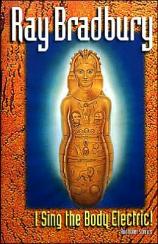
I Sing the Body Electric, and Other Stories


Review
I Sing the Body Electric, and Other Stories


In the late 1960s and early 1970s it became fashionable in some quarters to, as my sons would say, "dis" Ray Bradbury. This attitude had a bit of a range, going from taking him for granted to concluding that maybe this master, this craftsman, wasn't really as good as we had thought he was. What was especially stinging here was that some of the malcontents echoing this party line wouldn't have had careers if it weren't for Bradbury not only opening the door but also showing us all how it is done once we got inside.
If I were to look for the source of this attitude, I might reach the conclusion that it is the result of Bradbury switching track, veering away from horror a bit and going into pure fantasy, as well as topics more firmly grounded in the mainstream. Different topics, different venues, stories more often in Playboy, Life and McCall's than in Fantasy & Science Fiction, but still poetic, still magical, still able to leap tall buildings with a single keystroke.
The stories in I SING THE BODY ELECTRIC tend toward the more "mainstream" end of Bradbury's work, but there are still nods toward fantasy which mirror a reality uncomfortably like our own. "Downwind from Gettysburg," for example, is about the assassination of a robotic Abraham Lincoln. Actually, it is about the motives behind the robot's creation, assassination, and display (this is a Bradbury story, after all). You could easily see something like this happening in our world. Or, the classic-the-minute-it-was-published, "I Sing the Body Electric," which begins with the enigmatic words "Grandma! I remember her birth" and which is by turns one of the most beautiful and saddest stories ever written. And there is a Martian story which is an absolute gem, and a story entitled "Henry the Ninth" which Harlan Ellison wanted for his ingenious, groundbreaking never-to-be-equalled Dangerous Visions project. And there is "The Kilimanjaro Device" about the ghost of Ernest Hemingway that was published in Life.
Not as good as we thought? No --- better than we could imagine. That is Bradbury in I SING THE BODY ELECTRIC. It is the perfect collection, whether as an introduction to the man, or to fill out his bibliography on your bookshelf.
Reviewed by Joe Hartlaub on May 1, 1998


I Sing the Body Electric, and Other Stories
- Publication Date: May 1, 1998
- Genres: Fiction
- Paperback: 336 pages
- Publisher: Harper Perennial
- ISBN-10: 0380789620
- ISBN-13: 9780380789627