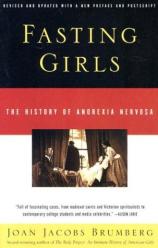
Fasting Girls: The History of Anorexia Nervosa


Review
Fasting Girls: The History of Anorexia Nervosa


I expected FASTING GIRLS: The History of Anorexia Nervosa by Joan Jacobs Brumberg to be a tedious read. After all, it is the newly revised and updated historical study of eating disorders. But this is a subject that interests me, so I prepared for a long, slow ride. I was quite pleasantly surprised to find FASTING to be a clearly written and fast paced book.
The death of singer Karen Carpenter was the first time many people learned of the eating disorders anorexia nervosa and bulimia. After that they became popular topics for the ever increasing number of talk shows. But it turns out that women obsessing about what they eat is nothing new. In fact, FASTING shows it is the sad phenomenon of history repeating itself.
For example, in 1873, Charles Lasègue wrote L'ANOREXIE HYSTERIQUE, "the first real glimpse of the pressurized family environment in anorexia nervosa." A member of early French psychiatry, Lasègue said that l'anorexie hysterique typically began between ages 15-20. He went on to identify three stages of the disease.
In the first stage, a young woman might express a general uneasiness after eating. She would use this discomfort as a reason for reducing her intake of food. During stage two, anorexia became the "sole object of preoccupation and conversation" for the patient, while the physician remained in the background. Finally, in stage three, the physical deterioration of the patient became so pronounced that if family and friends had not already done so, they sought the help of an experienced medical professional.
This doesn't really sound all that different from the cycle of people suffering from eating disorders as we hear it discussed today. But why would a young woman deliberately starve herself? Although there is some dissension as to what is the most important factor, the cultural environment is universally considered to be a contributing factor.
For example, in the Victorian Era (1850-1900) both mothers and daughters were concerned that their appetite for food not give the wrong impression of their appetite for sex. Spicy foods and meat were considered to stimulate passion as well as the palate. In addition, Victorian society considered it unfeminine for women to be seen eating or to be involved in the preparation of food. Since food and eating also led to digestion and defecation, women felt it was better not to eat at all. In fact, some women "boasted that the calls of Nature upon them averaged but one or two demands per week."
FASTING shows that in the Victorian age, "Careful, abstemious eating was presented as insurance against ugliness and loss of love." This doesn't sound much different from the messages of today's media. The drawings and photos in the book prove that fasting women are nothing new. Particularly haunting is the first published photo of an anorectic girl. The photo appeared in the October 5, 1932 issue of The New England Journal of Medicine. FASTING is a fascinating book whether you are researching the subject of eating disorders or just satisfying your own curiosity.
Reviewed by Michelle Calabro Hubbard on October 10, 2000


Fasting Girls: The History of Anorexia Nervosa
- Publication Date: October 10, 2000
- Genres: Health, Nonfiction
- Paperback: 400 pages
- Publisher: Vintage
- ISBN-10: 0375724486
- ISBN-13: 9780375724480