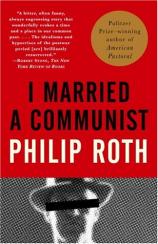
I Married a Communist


Review
I Married a Communist




It was a time of hoop skirts and sock-hops, drive-in theaters and rock and roll. The economy was booming, children were being born at an alarming rate, and a hero from World War II was comfortably ensconced in the White House. Yet, while most of the country was busy cheering for the red, white and blue, one Senator in particular had reduced that color scheme considerably: Joseph McCarthy was only seeing red.
"Thousands and thousands of Americans destroyed in those years, political casualties, historical casualties...But I don't remember anybody else being brought down quite the way that Ira was. It wasn't on the great American battlefield he would himself have chosen for his destruction. Maybe, despite ideology, politics, and history, a genuine catastrophe is always personal bathos at the core. Life can't be impugned for any failure to trivialize people. You have to take your hat off to life for the techniques at its disposal to strip a man of his significance and empty him totally of his pride."
The "Ira" in question is Ira Ringold, a radio theater actor, friend of Nathan Zuckerman and brother to Nathan's high school English teacher, Murray Ringold. Ira is a big, bruising man who got his break playing Abe Lincoln for local school programs and union rallies. The story of Ira's rise and fall comes to us through the reminiscences of Nathan and Murray over the course of six nights of conversation. Roth allows his storytellers the benefit of hindsight, and a country in political conflict proves a worthy stage on which this drama is played out.
Passionate and idealistic, Ira and a group of fellow actors and writers work on a radio show called The Free And The Brave. Ira marries former silent movie star Eve Frame, and they attain some degree of success when Eve joins the cast. As the personal politics of the group begin to creep into the scripts, unsavory rumors start to circulate. In the wake of similar controversies, people are being called before the newly formed House Un-American Activities Committee to discuss their questionable political motivations.
"Lists. Lists of names and accusations and charges. Everybody...has a list. Red Channels. Joe McCarthy. The VFW. The HUAC. The American Legion. The Catholic magazines. The Hearst newspapers...Lists of anybody in America who has ever been disgruntled about anything or criticized anything or protested anything...all of them now Communists or fronting for Communists or 'helping' Communists or contributing to Communist 'coffers,' or 'infiltrating' labor or government or education or Hollywood or the theater or radio and TV...All forces of reaction swapping names and mistaking names and linking names together to prove the existence or a mammoth conspiracy that does not exist."
Ira and Eve's life together suffers from more than the political upheaval going on around them. Ira despises Sylphid, Eve's daughter from a previous marriage. Sylphid is a whining, opportunistic young woman who rules her mother with an iron fist. Eve lacks the backbone to stand up to her daughter, and the stormy relationship between Ira and Sylphid leads to even further complications.
Betrayal is a word that crept into everyday use during the Red scare, and it is betrayal that finally does Ira in. Not betrayal of his country, as the rumors would suggest, but betrayal of his marriage. When Eve finds out that Ira has been having an affair, her first impulse is to seek revenge. She does just that in a tell-all book,
co-written by two political up-and-comers, entitled I MARRIED A COMMUNIST. The book and the events that follow its publication ruin Ira's career, but Eve, too, is sullied in the morass.
I MARRIED A COMMUNIST is a wonderful novel, full of heart and soul. Using the broad canvas of a troubled decade on which to paint the portrait of one man's fate, Roth has never been more compelling. His later works show a greater sensitivity to those around him. Always one to confront his own inner demons, Roth's focus now incorporates the bigger picture and the reader is the benefactor. Roth --- using Zuckerman as his mouthpiece --- gives us a clue as to the path which brought him from a young writer to this place and time:
"Occasionally now, looking back, I think of my life as one long speech that I've been listening to. The rhetoric is sometimes original, sometimes pleasurable, sometimes pasteboard crap (the speech of the incognito), sometimes maniacal, sometimes matter-of-fact, and sometimes like the sharp prick of a needle, and I have been hearing it for as long as I can remember...whatever the reason, the book of my life is a book of voices. When I ask myself how I arrived at where I am, the answer surprises me: 'Listening'...was I from the beginning...merely an ear in search of a word?"
Reviewed by Vern Wiessner on January 22, 2011


I Married a Communist
- Publication Date: November 2, 1999
- Genres: Fiction, Literary Fiction
- Paperback: 336 pages
- Publisher: Vintage
- ISBN-10: 0375707212
- ISBN-13: 9780375707216