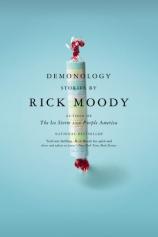
Demonology


Review
Demonology




Rick
Moody is best known in the popular mind as the author of THE ICE
STORM, which was made into a somewhat flawed, occasionally
brilliant film a year or few ago. Moody, however, is more renowned
in some circles for his short stories. He is somewhat difficult to
get a stylistic handle on, and while this can be occasionally
maddening, it is also quite interesting. One never knows what to
expect from Moody; he can be outrageous, funny, sorrowful,
depressed, or...moody.DEMONOLOGY is a collection of 13 of Moody's short stories
(although "The Carnival Tradition" is more accurately classified as
a novella) that run the gamut of styles, topics, and quality. Take
"The Double Zero," the story of a man's mental and vocational
breakdown in Bidwell, Ohio. The story is told through the eyes of
the son of a man who, after losing a decent factory job and
embarking on a series of failed financial ventures, opens a diner
near a railroad station. There are no big surprises here; you know
that the guy is gonna get squashed like a bug. The suspense is in
how it happens. What is also interesting here, as a parenthetical,
is that not only does Bidwell, Ohio exist, but also that Moody
nails the town (described by its own residents as a whistle stop)
perfectly. And that talent extends to Moody's descriptions of
different individuals as types. Whether he is writing about a
wedding planning service ("Mansion on the Hill") or an
almost-successful actress on the downside of a nonexistent career
("Carousel") or a couple whose relationship flounders on the shores
of sexual politics ("Ineluctable Modality of the Vaginal"), Moody
nails his protagonists dead-on.Moody also is not afraid to experiment with the structure of
the short story. "Surplus Value Books: Catalogue Number 13"
is...well, basically, it is a collection of descriptions and prices
of various books (almost all are almost fictitious) that ultimately
say more about the collector than they do about the books. There is
also the absolutely brilliant "Wilkie Ridgeway Fahnstock, The Boxed
Set." The story is a set of liner notes for a cassette collection,
commercially produced and offered for sale, of a schlemiel who has
reached penultimate failure in early adulthood and has nowhere to
go. The selections offered on the cassettes are real songs, and
taken together are the perfect hipper-than-you'll-ever-be overview
of the revealed and hidden history of rock music from the '60s to
the '90s. Impressive. "Boys," meanwhile, follows the lives of twin
brothers as they achieve and experience the milestones of life over
the course of sentences, paragraphs, a few pages. Moody, however,
occasionally needs to rein in his tendency to be cute; "Pan's Fair
Thong" is ultimately little more than an elegant time-waster, while
"Ineluctable Modality of the Vaginal" is narrated as a single,
16-page sentence, which is ultimately a stylistic distraction from
an interesting story.If
there is one unifying theme to the stories in DEMONOLOGY it is the
loss of family members. The impetus behind the actions of the
protagonist in "Mansion on the Hill" is his deceased sister; the
presence of a deceased wife and mother hangs over a neighborhood
party during "Hawaiian Night;" a dying boy is the cornerstone of
the uneasy reunion between two estranged brothers in "The Double
Zero." Though humor is interlaced throughout Moody's narrative, one
is almost afraid to laugh, or even chuckle; the humor is liable to
die in the next sentence. His work is certainly representative of
life, if one regards life as a series of small victories brought
low, suddenly and irrevocably, by tragedy.It
will be interesting to see where Moody's work takes him in the
future. His world view is somewhat reminiscent of Leonard Cohen's
prose work (though Cohen's humor, particularly in BEAUTIFUL LOSERS,
is much sharper). Whether Moody will continue to push the narrative
form constrictions of the short story or will present his
well-honed observations in a more traditional fashion remains to be
seen.
Reviewed by Joe Hartlaub on January 21, 2011


Demonology
- Publication Date: April 10, 2002
- Genres: Fiction
- Paperback: 320 pages
- Publisher: Back Bay Books
- ISBN-10: 0316592102
- ISBN-13: 9780316592109