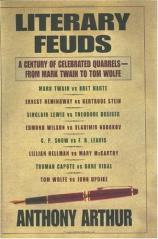
Literary Feuds: A Century of Celebrated Quarrels From Mark Twain to Tom Wolfe


Review
Literary Feuds: A Century of Celebrated Quarrels From Mark Twain to Tom Wolfe




There are two routes you can choose when authoring a book like
this: the sensational, gossipy Us Weekly tack, complete with
inflammatory cover lines, or the staid, straightforward
BusinessWeek approach, more proper research than primping
revelation. And there's certainly nothing wrong with that. In
LITERARY FEUDS, Anthony Arthur applies a fine formulaic approach to
his subjects. He introduces them (some better than others), deduces
the catalyst for their quarrel and shares a few fun bon mots along
the way. It's an interesting subject. The main problem is that a
little Us Weekly would have gone a long way to making the book more
digestible to the typical non-English major. And even to us English
majors, a few of the names are a bit obscure to get too worked up
over.
Arthur obviously possesses a clear understanding of the literary
landscape. He tinges his writing with knowledge, whether he's
describing Gertrude Stein's shortcomings pre-AUTOBIOGRAPHY OF ALICE
B. TOKLAS or deconstructing Tom Wolfe's criticism of ANNA KARENINA.
Arthur employs a smart if somewhat dry style that gives a fair
shake to both participants in the feud. He excels at explaining the
authors' literary legacies, why a Sinclair Lewis has become more
well known than a Theodore Dreiser. However, although blood pumps
through his characters (his description of Edmund Wilson's wardrobe
helps define his public and private characters), the feuds remain
relatively bloodless.
Perhaps it is the material that Arthur has chosen. After all, in an
age where our political candidates attack one another regularly on
TV and the local gossip pages print tales that would have made for
scandalous fiction 50 years ago, it's hard to be thrilled by a
run-of-the-mill tussle. Add to that the fact that many of these
"fights" have unclear roots, which Arthur does his best to uncover
satisfactorily but not overly convincingly and the book loses some
of the title's promised bite.
Many of the authors begin as friends, such as Wilson and Vladimir
Nabakov or Mark Twain and Bret Harte. The feud begins with perhaps
a bad review by one of the other. It seizes when the less famous
overtakes the more famous in literary reputation. It generally
never comes to a boil, instead fading into dusty apology (such as
Truman Capote's lame note to Gore Vidal) or death.
Most of the fights appear driven by the green-eyed monster. Stein,
for example, had no reason to fear Ernest Hemingway until the
latter eclipsed her spotlight. Then it became easy for a former
friend who had crowed about Hemingway's promise to publish a
damaging review. Yet the dilemma for Arthur seems to be that many
of these fights were simple sideshows. Authors are, by definition,
a class without hubris; you have to have at least some ego to think
other people should care to read your words. It's understandable
how many of the fights began, but unless they're about something a
little bigger than the participants --- like C.P. Snow and F.R.
Leavis' showdown over the scientific and literary intellectual
communities --- it's difficult to imbibe them with anything more
than an "as noted" quality.
With that being said, there are some barnburners in the book. The
final three chapters have the most verve, probably because there
are better records of what occurred through lawsuits and media
accounts. For sheer cattiness and juicy bad behavior, you can't
beat Mary McCarthy vs. Lillian "every word she writes is a lie,
including 'and' and 'the'" Hellman, as McCarthy characterized her.
Gore Vidal and Truman Capote's war of words was as delicious for
its cleverness as for its sheer duration and intensity. And while
it's unclear why Arthur chooses to pit Wolfe against only John
Updike instead of including Wolfe's two other "stooges," nee
tormentors Norman Mailer and John Irving, it's priceless to hear
Wolfe speaking in his own defense in a letter to the author.
Arthur has done an extremely competent, honest job with this book.
Although it isn't packed with fresh insights or lively writing,
it's an intriguing read, if only to trace some of the country's
literary history through its most well known voices. If Arthur
wanted to attract more readers, perhaps he could have dug a little
deeper, scandalized a little more, or chosen a different theme ---
say, writers with beefs against Hollywood. But as it stands now,
this book is certainly worth the price of a stack of Us
magazines. Just don't expect that type of guilty pleasure.
Reviewed by Toni Fitzgerald on January 22, 2011


Literary Feuds: A Century of Celebrated Quarrels From Mark Twain to Tom Wolfe
- Publication Date: December 1, 2002
- Genres: Fiction
- Hardcover: 224 pages
- Publisher: Thomas Dunne Books
- ISBN-10: 031227209X
- ISBN-13: 9780312272098