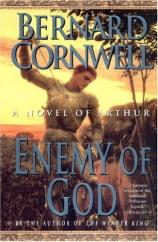
Enemy of God


Review
Enemy of God




In ENEMY OF GOD, Cornwell brings a dark and gritty element to
Arthurian legend that may startle readers unfamiliar with his
penchant for historical accuracy and period detail. But to longtime
fans, it's only what's expected from the British writer who's
successfully taken on the Napoleonic Wars, the American Revolution,
the Civil War, and contemporary thrillers.
Be prepared --- this is not your parents' Camelot.
With ENEMY OF GOD --- the second novel in the Warlord trilogy that
began with THE WINTER KING --- Cornwell continues to immerse us in
the sight, smell, and texture of the Dark Ages. Merging both Celtic
myth and burgeoning Christianity, Cornwell captures the essence of
Arthurian legend while putting his original spin on the
much-beloved lore.
Derfel, the name of his narrator, is one Cornwell came across in
some of the earliest versions of the legend. He was reputed to be
one of Arthur's soldiers who later became a monk. With that small
bit of information, Cornwell has crafted one of his most
interesting characters --- a complex and honorable man caught up
in, but not blinded by, Arthur's charisma. Derfel, once hostile to
Christianity, is now a monk under the supervision of one of
Arthur's former enemies, Bishop Sansum. Avoiding the Bishop's
certain wrath by pretending to write a religious text, Derfel, at
the urging of Queen Igraine, sets out to write the true story of
Arthur, Guinevere, Lancelot, Galahad, Nimue, Morgan, Mordred, and
Merlin.
And it is an unsettling truth. Arthur, once heralded as the scourge
of the Saxons, is now struggling to consolidate a divided Britain.
Pledged to hold the kingdom together until Mordred comes of age,
Arthur is a natural but unwilling warlord. Excelling at war, he
wants nothing more than peace. At times naive, Arthur also has a
merciless streak. His decisions often place him at odds with
Christians, earning him the moniker "Enemy of God." Cornwell's
vision of Camelot is wracked with conflict and political expediency
--- not ripe with brotherhood and chivalry.
Derfel's paints a Guinevere both ambitious and intelligent, witty
but cold, and a Lancelot who is more duplicitious coward than
unswerving hero. Merlin is old, cranky, and couldn't care less
about what happens to Arthur --- he only wants to collect the
Thirteen Treasures of Britain and drive Christianity from the land
of the Druids. Nimue, Derfel's childhood friend, is half mad.
Morgan has turned from the ancient religion to the new, thus
aligning herself against Merlin and Arthur. Only Galahad and
Mordred's characters are similar to other versions of the legend:
Galahad is loyal, good, and true, while Mordred is a snivelling
child-tyrant. But Cornwell manages to endow all the characters with
a fullness that makes even the unsympathetic ones
interesting.
Derfel's simplicity is precisely what makes this story so
compelling. He brings to the legend a freshness of perspective that
heightens our enjoyment, even though we know that tragedy will
still ensue. Derfel's bluntness offends the queen for whom he
writes --- she wants the romance and glory that bards have
perpetuated for so long while Derfel wants to write the naked
truth. When Igraine insists that he write about the Round Table
because "Everyone knows that it was a serious thing. An important
thing!," Derfel tells her "It was a cracked stone table that by the
day's end was cracked even more and smeared with vomit. They all
got very drunk." But she sighs and says, "I expect you've just
forgotten the truth."
If you are expecting just another love triangle sprinkled with some
of Merlin's magic, you may be disappointed by ENEMY OF GOD. But if
you revel in excellent writing, strong characterization, vivid
imagination, and most of all, the possibility that Arthur COULD
have existed and wonder what his era would really have been like,
then this is the tale for you.
No punches are pulled in Cornwell's vision of an age that just may
have been home to the greatest warrior in Britain's history. The
battles are fierce, the times violent, the enemies vile, and the
people brutally superstitious. Like real life everywhere, love
elevates, lust destroys, and loyalty only occasionally wins out
over betrayal. There are blinding moments of lightness and hope,
but it's still just a stone table smeared with the vomit of these
most human of literature's heroes and
anti-heroes.
And what a glorious sight it is.
Reviewed by BookpgXena on January 21, 2011


Enemy of God
- Publication Date: March 15, 1998
- Genres: Fiction, Historical Fiction
- Paperback: 397 pages
- Publisher: St. Martin's Griffin
- ISBN-10: 0312187149
- ISBN-13: 9780312187149