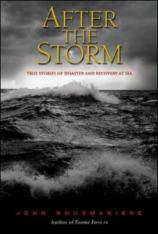
After the Storm: True Stories of Disaster and Recovery at Sea


Review
After the Storm: True Stories of Disaster and Recovery at Sea


Several times during AFTER THE STORM, John Rousmaniere has cause to
mention the terrorist attacks of September 11th, 2001, in which a
former shipmate perished. The pairing of these attacks with the
subject matter of the book --- an analytical look at ships at sea
facing great storms –-- may seem incongruous at first, but
the juxtaposition of these narrative elements is not only
reasonable but necessary.
AFTER THE STORM is not, strictly speaking, about storms; fans of
The Weather Channel will not find a great deal of meteorological
detail. It is not about ships, precisely; both the armchair sailor
and the veteran sea-dog can appreciate the book in relatively equal
measure. Instead, AFTER THE STORM is about the psychological impact
of storms at sea on the sailors, passengers, and those on shore
hoping for a safe return. Its focus is on the search for meaning
after disasters at sea and has equal application for
terrorist-driven disasters on land as well.
Rousmaniere spreads his themes over a wide historical range. AFTER
THE STORM tells seven distinct stories, spanning a time period from
the death of poet Percy Bysshe Shelley in the Mediterranean in 1822
to the sinking of an American warship off the coast of Newfoundland
in 1942. Rousmaniere then adds shorter narratives about other
famous and infamous storms, from the biblical tale of Jonah to the
stories of storm-chasers in the far South Pacific. The stories are
a combination of good, solid historical research along with honest
speculation about the fate of the ships involved, informed by
Rousmaniere's personal, intimate knowledge of storms, ships, and
sailors.
These stories are the result of the author's various searches for
meaning. First, Rousmaniere is searching for a historical meaning,
trying to reconstruct the last hours of these doomed ships. Here,
he does a masterful job. The last hours of the mysterious
Portland, a side-wheeler ferry that sank with all hands in
an 1898 storm, are documented in depth. Rousmaniere's explanation
for why the famous Mary Celeste was abandoned by her crew in
1872 is reasonable and compelling. The explanations of how and why
each of the ships involved in the narrative sank or escaped their
respective storms are lovingly told, with a great wealth of detail.
Rousmaniere is patient in his analysis, explaining his findings in
a way that can be easily understood by even the most landlocked
reader. Furthermore, the historical side of things is exceptionally
wide-ranging, including such diverse characters as Theodore
Roosevelt, Henry David Thoreau, Robert Louis Stevenson, and the
author of the hymn "Amazing Grace."
The search for the historical meaning of each of the disasters is
accompanied by a search for a forensic meaning. Rousmaniere takes
his analysis one step further, looking for the underlying reasons
as to why the ships in his narrative sink or swim. Shelley, for
example, was an incompetent sailor whose unrealistic romantic
notions were of no help in a demanding Mediterranean squall. But
veteran sailors too can make mistakes, and Rousmaniere points out
the problems that sleeplessness, post-traumatic stress disorder,
and other dangers can pose to sailors beset by storms. The most
dramatic story in the book concerns an accident aboard a small
pleasure yacht racing across the North Atlantic and how the
disregard of an essential safety rule led to the demise of three
members of an influential New England family.
But the true search for meaning lies outside the historical record
and the forensic assignment of blame. Rousmaniere finds the true
meaning of his storms not in the actual events but their
repercussions, which express themselves in unexpected ways. The
distant results of the storms --- an Academy Award-nominated short
film, a remarkable book about grief, a massive effort by a small
fishing community to rescue shipwrecked sailors --- are as
important to Rousmaniere as the details of seamanship and
weather.
Rousmaniere's search for meaning in storms at sea is important and
vital because it informs the reader about weathering the storms in
our own lives, storms caused by fate or weather or by malign
influences like terrorism. Despite an occasional wandering and
unfocused bit of narrative here and there, it is well-written and
extraordinarily insightful. AFTER THE STORM is a book that will
impress all of those who go down to the sea in ships as well as the
rest of us who go down to the sea in books.
Reviewed by Curtis D. Edmonds ([email protected]), a movie reviewer at www.txreviews.com. on January 20, 2011


After the Storm: True Stories of Disaster and Recovery at Sea
- Publication Date: April 17, 2002
- Genres: Adventure, Nonfiction
- Hardcover: 352 pages
- Publisher: International Marine/Ragged Mountain Press
- ISBN-10: 0071377956
- ISBN-13: 9780071377959