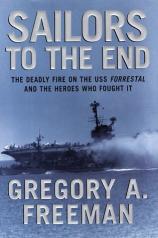
Sailors to the End: The Deadly Fire on the Uss Forrestal and the Heroes Who Fought It


Review
Sailors to the End: The Deadly Fire on the Uss Forrestal and the Heroes Who Fought It




Of all the strange episodes of the Vietnam War, none was more
improbable than what happened aboard the monster U. S. aircraft
carrier USS Forrestal in the Gulf of Tonkin on the morning
of July 29, 1967.
No enemy action was involved, and no ammunition was deliberately
fired off. Yet within a few hours, 134 American sailors died, 161
more were seriously injured, 21 airplanes were lost and 40 more
damaged, and damage to military property totaled $72.2 million
dollars.
The tragic sequence of events began with the totally accidental
firing of a small rocket from a plane waiting to take off as part
of a large bombing mission near the Chinese border. The rocket
struck another plane, igniting jet fuel, starting fires and soon
triggering a series of nine monster explosions, as 1,000-pound
bombs intended for Vietnamese targets blew up literally in the
faces of those on the carrier's crowded flight deck. The explosions
tore holes in the deck, allowing the flaming fuel to cascade down
into crew quarters, airplane hangars, ammunition storage areas, and
other dangerous places below decks. Most of the planes that were
lost were deliberately pushed overboard so that they would not
explode and make matters even worse. A total of 47 men either
jumped or were blown overboard.
The story of this horrendous accident is told vividly by Gregory A.
Freeman, a seasoned journalist and a skilled writer. He aptly
compares the Forrestal that morning to "a crate of fireworks
with a bonfire on top." The only problem with that metaphor is that
it does not take into account the 5,000 human beings who were also
on that "crate of fireworks."
Freeman has done his research well, interviewing as many survivors
as he could find, from the Forrestal's captain John Beling
down to lowly seamen, following the paper trail of investigations
and even spending some time himself on a comparable carrier to get
a firsthand look at how these enormous floating cities operate. His
writing conveys well the personal stories of many people directly
involved in fighting the huge fire; it also gives the reader a
sense of the size and complexity of a huge ship like the
Forrestal. He is also able to tell the story with only a
minimum of the mind-numbing military jargon and acronyms that so
often get in the way of lay comprehension in military
memoirs.
Freeman also seems to have a political agenda, though this is not
overtly stated. As the years have passed since the event, the Navy
has tended to blame the disaster on the Forrestal's crew,
even producing a training film about shipboard firefighting with
that message. At one stage early in the post-event investigations
there was an effort to scapegoat Capt. Beling; he was officially
reprimanded, but the reprimand was later rescinded. Nonetheless, he
finished his naval career at an obscure outpost in Iceland.
Freeman seems to want to do two things: Praise the crew as the true
heroes of the event and lay the blame on old, defective ammunition,
the source of those massive explosions that took most of the 134
lives that were lost. The ship's ordnance experts were enraged when
they were supplied with these ancient, defective and dangerous
bombs the day before the accident --- but they were told nothing
else was available. Lyndon Johnson had ordered a big escalation in
the bombing campaign, regardless of the fact that there was not
enough modern ammunition available to do the job. Freeman claims
this factor has been swept under the rug in official assessments of
what went wrong that July morning.
Another contributing factor in the debacle was the short-circuiting
of two separate safety precautions concerning the activation of
rockets on planes ready to take off on bombing missions. This is
one of those bureaucratic mix-ups that can happen in any large
enterprise --- and as any veteran can tell you, there is no larger
or more bureaucratic entity than the U. S. military.
The pilot whose plane was hit by that stray rocket that morning was
26-year old John McCain, who now sits in the U. S. Senate. McCain
is, however, just one among a large and appealing cast of sailor
heroes in Freeman's book. There are wonderfully affecting stories
of young sailors whose lives were spared --- or taken --- by sheer
chance.
Freeman has told this story well. Some of it makes gruesome
reading, but it is a tale that should not be forgotten.
Reviewed by Robert Finn ([email protected]) on January 23, 2011


Sailors to the End: The Deadly Fire on the Uss Forrestal and the Heroes Who Fought It
- Publication Date: July 15, 2002
- Genres: Nonfiction
- Hardcover: 320 pages
- Publisher: William Morrow
- ISBN-10: 0066212677
- ISBN-13: 9780066212678