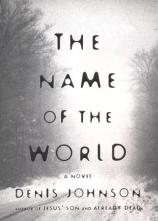
The Name of the World: A Novel


Review
The Name of the World: A Novel


 THE
THE
NAME OF THE WORLD is the story of a college professor whose wife
and daughter die in an accident four years before we meet him.
Michael Reed tells us early on, "Nothing was required of me. I just
had to put one foot in front of the other, and one day I'd wander
wide enough of my dark cold sun to break gently from my orbit." And
that will end what he thinks is his humdrum existence. In this
latest novelistic effort from Denis Johnson, not known for his
clear and lucid storytelling, a cliche subject is taken to a new
level, with the depths of despair for which his other famous work,
JESUS' SON, is well-known, but with a compassion that is not
usually found in his other work.Reed
meets a woman named Flower Cannon and becomes bewitched with her,
this student whose every attempt at living is fraught with the kind
of high emotion of which he feels no longer capable. In fact, he
begins to wonder if this girl hasn't been sent to him as a specter
of his late daughter. The novel then launches into a difficult and
imaginary state, not created by the use of drugs as his other
characters' endeavors were, but created by the dream world of grief
and horror with which he surrounds himself. "To let my wife and
child be dead. I didn't think I was cruel enough for that. Because
that is what the imperfections in Flower's skin invited me to do.
There was a sense in which Anne and Elsie had to be killed, and
killing them was up to me." The writing is sketchy and falls into a
shambles as Johnson tries desperately to bring us in touch with the
anger and horror of Reed's life in its new form.Johnson, born poet that he is, prefers obscure references to
emotional states than straight-arrow discussions of the
psychological situations that Reed is passing through on his way to
what we hope will be a redemptive period for him. Flower is just
something to hitch his wagon to, literally and figuratively,
because we never really get to know what kind of person she is
inside. All this vagueness may make people think this book is
profound, and in moments, it transcends its pomposity and reaches
for something real. But, ultimately, I think Johnson is a
scaredy-cat writer, a beatnik in sheep's clothing, the kind of
writer who wanders around the face of the language map without ever
really settling down and telling us everything. THE NAME OF THE
WORLD started out fine, interesting, even compelling, but
unfortunately, falls flat at the end.
Reviewed by Jana Siciliano on January 22, 2011


The Name of the World: A Novel
- Publication Date: July 1, 2000
- Genres: Fiction, Literary Fiction
- Hardcover: 144 pages
- Publisher: HarperCollins
- ISBN-10: 0060192488
- ISBN-13: 9780060192488