
There is that wrenching moment in Francis Ford Coppola’s Bram Stoker’s Dracula when Dracula, played with white-faced intensity by Gary Oldman, has reinvented himself so that he could pursue his lost love in a downtown nickelodeon. When he tracks her down and saves her from the ravages of what is essentially his “patronus,” a white dog snarling with its fangs out, he remarks, “I have crossed oceans of time to find you.” This specter of lost love, of looking and searching earnestly for that person to whom one was once so tightly attached, is fiercely and dramatically romantic.
"There is no fictionalized account of long-lost love that could be as compelling as this valentine to Leslie Maitland’s parents and the sad situations that threatened to ruin their moral compasses throughout their entire lives. Simply put, this is an unforgettable tale."
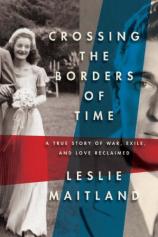
CROSSING THE BORDERS OF TIME has some of that same fervor --- the lost love, the war, the differences between the lovers (both cultural and religious). Leslie Maitland, a journalist whose mother this story is about, manages to explore all the romantic details with a daughter’s flourish, which shows both her love for her mother and her mother’s love for the man who got away, as well as a journalist’s eye for details.
Janine and her family go to Casablanca on their way to Cuba. Maitland creates a very resonant scene out of the reading of the letter that Roland, the French boy she loved, leaves her with when she departs: “Whatever the length of our separation, our love will survive it, because it depends on us alone. I give you my vow that whatever the time we must wait, you will be my wife. Never forget, never doubt.” This quote is being used to sell the book, and all I can say is “WHY NOT?” The fervent ardor with which this note was written and is read over and over again by Janine speaks to an ages-old world fascination: the star-crossed lovers. Put this against the horrific background of World War II and Nazi atrocities, and you have yourself one very fiery platform from which to send off a love story.
Maitland’s eye for details makes this a part romance novel and part adventure tale. It is inevitable, given the circumstances, that one would read this book and be torn between those two scenarios: the rosy moments during which the lovers are together and the whole lives that exist beyond them, or Janine’s time in America, living with an Ayn Rand obsessive who may or may not have the capacity to really love her. Nothing that happens to Janine gives her the freedom from her desire for that long-lost love. Later, a doctor gives Maitland advice on her own relationship with her husband: “Put up with it or leave him. Just don’t imagine for a second you can change him.” This is a wise note for anyone, but particularly enlightening once Maitland has discovered her mother’s secret yearnings --- her parents’ marriage is not all she thought it was, and thus, neither is her own.
It must have been weird for Maitland to write this book, as it is all about her mother’s search for a lover who is NOT her father. But later, she finds out that her father knew very well of her mother’s long-standing love, yet he stayed with her regardless. You might think that this would make us unsure of how we feel about Janine, but Maitland offers well-dimensioned character sketches of her parents so that we can see all sides of their story, and mourn and be amazed by them all at the same time.
If you are looking for a real-life love story filled with heartfelt romance, adventure, the drama of war, and the aftermath of a life lived when this love doesn’t work out, then CROSSING THE BORDERS OF TIME will bewitch you. There is no fictionalized account of long-lost love that could be as compelling as this valentine to Leslie Maitland’s parents and the sad situations that threatened to ruin their moral compasses throughout their entire lives. Simply put, this is an unforgettable tale.
Reviewed by Jana Siciliano on June 1, 2012
Crossing the Borders of Time: A True Story of War, Exile, and Love Reclaimed