|
BIO
Joan Silber is the author of three previous books. She won the PEN/Hemingway Award for her first novel, HOUSEHOLD WORDS, and has received grants from the Guggenheim Foundation, the National Endowment for the Arts, and the New York Foundation for the Arts. Her short fiction has appeared in the New Yorker, Ploughshares, the Paris Review, and other magazines. She lives in New York City and teaches writing at Sarah Lawrence College.
INTERVIEW
October 19, 2001
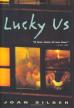
In her latest novel, LUCKY US, PEN/Hemingway award winner Joan Silber presents a love
story for the 21st century. She deftly crafts the complicated entanglements of Elisa and
Gabe, her May-December lovers, as they drift around the margins of the New York art and
drug culture scenes. Bookreporter.com writer Chuck Leddy interviewed Silber recently about
her decision to give voice to both the main characters and much more.
TBR: In LUCKY US two of the main characters are HIV positive or have full blown AIDS.
You handled the issue of AIDS quite beautifully and movingly, though never portraying
Elisa as a victim who deserves pity. How did you come to understand about what it's like
to live with the disease?
JS: I have a couple of answers to that question. As a
kid, I grew up with an ill parent, and illness has always loomed large in my imagination;
it's entered my fiction in previous books. In 1996, I started volunteering as a Buddy for
Gay Men's Health Crisis, which means I show up once a week to help someone with AIDS or to
just hang out. I had started writing LUCKY US before I was a Buddy, and both the book and
the buddying came out of a late-dawning sense of the epidemic's shadow over the times I
was living in.
There is an ethic of tough jokiness associated with AIDS. I've seen people be difficult in
all sorts of ways, but self-pity was not really one of them.
TBR: In essence, LUCKY US is less a book about a disease and more a book about a
relationship. Where did the characters of Gabe and Elisa come from? Do you have a
"Gabe" in your life or are you more like that character yourself?
JS: Both characters are inventions, pretty much.
Elisa, whose voice came to me first, bears a resemblance to certain students I've had ---
their mix of worldly nerve and full-hearted insight and the usual youthful vanity. In the
beginning, I just had her voice telling about a boyfriend who'd once been in prison. While
elements of Gabe came from different people I've known, he owes something to my being on
the PEN Prison Writing Committee, where we read manuscripts written by inmates. I have
ties to both characters --- Elisa is in some respects a brattier version of my younger
self, and I share some of Gabe's view that a bad outcome is never a surprise.
TBR: When we first meet Gabe, he is a rather stoic, father figure for the young and
flighty Elisa. As we learn more, we realize that Gabe had a rather reckless youth himself.
How does that history affect the relationship between Gabe and Elisa? Are they both
attracted to each other because they are two sides of the same coin? Do they feed off each
other?
JS: I have always seen these two as having a good
understanding, and certainly Gabe's past contributes to that. They have both loved some
degree of risk. But Gabe, who is so much older, is sobered by experience. In the beginning
Elisa says that no matter how depressed she and her friends complain they are, they always
sort of know a brighter day is possible, but not Gabe --- "Most of what kept me going
couldn't be said to him. A lot of his life was behind him already. He was chipper but
hopeless; that's how I described him."
I wanted these two, from their different spots in life, to naturally embody hope versus
no-hope. The news of an HIV diagnosis makes them switch parts, with Elisa hardening and
Gabe trying to be cheerful. The story is really about how this insoluble opposition is
worked out, in a situation without the usual forms of brightness.
TBR: Parts of LUCKY US, the parts where Gabe and Elisa discuss their prior
"significant others," reminded me of one of my favorite recent novels, Nick
Hornby's HIGH FIDELITY. Why did you spend so much time reviewing Gabe's and Elisa's
romantic histories?
JS: As it did for Hornby's character, the past
resounds quite loudly for these people. I originally wanted to call the novel HOW
DID IT HAPPEN, and the list of (mostly sexual) occasions on which Elisa might have been
infected is an important chapter to me. I'm generally interested in the way layers of time
operate in a story. One of my favorite writers is Alice Munro, whose stories loop through
time.
TBR: LUCKY US takes place in New York City, but the story of mismatched lovers is such
a universal one, Gabe and Elisa could really live in any large city with an art scene. Was
it important for you that this novel be set in New York City? What does New York City do
for the story? Is it a character itself? Is the city a reflection of Gabe's and Elisa's
inner workings?
JS: It's true that I love my city. The blasé cool
that we are famous for can also be a kind of stalwartness. This has recently been proven
to the world, after a disaster more staggering than any fiction writer could invent. In
LUCKY US, the characters try (not always successfully) to suffer their troubles while
keeping their wits about them; the city puts an interesting pressure on them to hold
themselves together. In New York, whining is okay but panicking is not. I'm attracted to
this sort of urban restraint, and I believe it helped keep the story from melodrama.
TBR: You take the rather unusual tactic of having both characters relate their side of
the story. What made you decide to write the novel in that way, rather than with a more
traditional one-sided or omniscient narrator?
JS: I can't remember when I first decided to let Gabe
speak for himself, but I'd written stories in which I'd taken a male point of view without
too much difficulty. I just got interested in him. And I wanted the couple's conflicts to
be seen fairly, and, in fiction as in life, one lover's version can too easily be a
self-righteous plaint or a recitation of longing; I wanted the wider view. And then I came
to like the occasional irony of one knowing things the other didn't. The book belongs to
both of them.
TBR: Tell us about your writing habits. Do you have a favorite place to write?
JS: I work in a corner of my loft, near a window that
gets a lot of street noise through it. People are sometimes amazed at how loud it is here,
but it feels normal to me. I work between lunch and dinner, and my dog has recently
started barking to be fed by about 3:30. I used to live with a composer who played the
same lines over and over on the piano, and that didn't bother me either. So I don't seem
to require perfect quiet, but I do try to show up every day that I can. I have a job that
I like, teaching writing at Sarah Lawrence, and on my teaching days I don't write.
TBR: What are you working on now?
JS: I'm working on a cycle of stories, tentatively
titled IDEAS OF HEAVEN. I keep saying, sort of jokingly, that they're all about sex and
religion and they really are about forms of devotion and forms of consolation. They're
linked a little oddly in that a minor element in one becomes major in the next. I've been
having a wonderful time working on them. Two of them have historical settings, and the one
I'm in now is told by a missionary wife in China in the late 1800s.
© Copyright 1996-2009, Bookreporter.com. All rights reserved.
Back to top.
|