|
BIO
Kyle Mills is the New York Times bestselling author of ten books, including DARKNESS FALLS and THE SECOND HORSEMAN. Growing up in Oregon as a Bureau Kid, Kyle absorbed an enormous amount of information about the FBI, which he incorporates into his novels. He and his wife live in Wyoming and enjoy rock climbing.
Back to top.
INTERVIEW
March 27, 2009
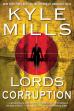
In this interview with Bookreporter.com's Joe Hartlaub, bestselling author Kyle Mills talks about what inspired him to set his 10th and latest novel, LORDS OF CORRUPTION, in war-torn Africa and sheds light on the extreme disparity between the continent's economic conditions with that of the U.S. He also explains his knack for penning books with very timely subjects, discusses what led him to pursue writing instead of following in his father's footsteps in law enforcement, and reveals how he would attempt to fix Africa's numerous problems if given the opportunity.
Bookreporter.com: Your new novel, LORDS OF CORRUPTION, is set in a war-torn region of Africa where a dictator is waging a genocidal campaign against a rebel tribe with the passive-aggressive assistance of an enigmatic charity. The idea for the book apparently had been percolating for a couple of years. How did it begin, and what jump-started you to complete the project?
Kyle Mills: I originally went to Africa about six years ago to scout for interesting locations --- not so much to research a book about the continent.
I was there for a month and at the end of that time, my wife had to drag me kicking and screaming onto the plane home. It was such a complicated and fascinating place that I wanted to stay and try to make sense of what I’d seen.
I thought the feeling would fade, but I just couldn’t get Africa out of my mind. The next fall I went back, this time for the entire winter. It still wasn’t enough time to fully grasp the place (that would take 10 lifetimes), but it was long enough to know that I wanted to try to write about it.
BRC: Once again, your timing is exquisite. Your previous novel, DARKNESS FALLS, concerned an attack on oil reserves and was published just as oil prices were reaching $100 a barrel. Now LORDS OF CORRUPTION has been released just as there is renewed interest in Sudan, an African nation with an abysmal human rights record. And the television program “24”hasits plot this year centered on the tumult within an African nation and how it comes to affect the United States. Given that your novels are written well ahead of their ultimate publication, what is the secret behind your timing? Do you have a crystal ball? Are you just smart? Or lucky? Or a combination of all three?
KM: I love thriller novels that feel real and current. The downside is that timing can be tricky. I finished a book about an al Qaeda rocket attack on U.S. targets a week before 9/11. It took me months to rewrite the book so it wouldn’t seem like I was trying to capitalize on that tragedy.
I think my success with prediction stems from the fact that I obsess about the world’s problems and use writing as an excuse to figure out how to fix them. DARKNESS FALLS is a perfect example of that. I wanted to know what would happen to the U.S. if our oil supply was suddenly cut off. The nonfiction books I’d read on the subject didn’t seem credible, so I decided to work through it myself. In the end, it turned out to be a lot more frightening a scenario than I expected.
My interest in Africa is similar. Because the world is becoming so interconnected, the continent’s problems have increasing potential to affect the rest of us. That made me want to understand what was going on over there and what could be done about it.
BRC: I understand that you spend your winters in Cape Town, South Africa. How did you happen to begin this practice? Have you traveled extensively throughout other parts of Africa?
KM: I needed a base in Africa for my research and a friend of mine once said “Cape Town is the only place in the world you can surf, rock climb, mountain bike, and go out to a really good restaurant all in one day.” It turned out to be that and much more.
We didn’t go this year and I feel surprisingly homesick for the place. Sometimes I wonder if I shouldn’t just move there permanently, but Jackson Hole isn’t a bad place to hang your hat either.
I have traveled around a fair amount. I like to just rent a car and point it in a direction that looks interesting, which means I’ve spent a lot of time lost in places like KwaZulu-Natal, Lesotho and Namibia. It’s amazing what you can see and learn when you’re lost.
BRC: Did the book begin as a result of your travels? Or did you begin going to Africa for book research and decide to make your residency more permanent (or at least longer) than you had originally planned?
KM: I originally went there for research and became convinced that Africa was the ideal environment for crime. In much of the continent, there’s no one watching the store at all. And some of the governments are so corrupt, they would be happy to cooperate as long as they got a cut. It’s a far cry from the U.S. or Europe where organized criminals are always having to look over their shoulders.
BRC: There is much to love in LORDS OF CORRUPTION. The story has a real-world feel to it; the characters are flawed but, at least as far as some of them are concerned, sympathetic; and the narrative contains some incredible twists and turns, particularly near the end. I wasn’t sure while I was reading it which characters, if any, would make it to the end of the book. Did you have the novel pretty well mapped out by the time you began writing it? Or did you surprise yourself when you saw who was left, and who was not, at the end of the book?
KM: I tend to be an obsessive outliner, so I have things pretty well mapped out when I start. The thing with writing a book about Africa is that you feel incredible temptation to just kill everyone.
Death is so much more tangible there than in the West. Our attitude almost seems to be that if we don’t live forever, it’s some failure of the medical establishment.
In Africa, death is everywhere. In many towns in Lesotho, the only permanent building is the funeral home. And if you go on a long driving trip in Africa, you’re almost certain to come upon at least one traffic accident where you have to weave through the bodies still lying in the road --- one of the downsides to putting 20 people in a van with brakes designed for six.
BRC: One of the other elements of the book that I enjoyed was a very subtle one. Josh Hagarty, the primary protagonist of the novel, is from a humble, almost Appalachian background who takes a job with an African-involved charity very reluctantly, and in large part on the promise that his younger sister’s college tuition will be covered. While Hagarty considers his own background to be somewhat impoverished, it is almost regal compared to what he finds in war-torn Africa. Even his own somewhat primitive lodgings in Africa are first-cabin compared to what he finds in some villages. Were you surprised by the level of poverty you discovered in your travels of Africa?
KM: I was very surprised. Not so much by the poor areas I visited --- I expected conditions to be pretty horrifying there --- but by the depth of the poverty in places that are touted as doing well.
That’s why I gave my character Josh a really disadvantaged background. He thinks he understands poverty and he’s actually been the recipient of charity in his life. But that still isn’t enough to prepare him for the reality of Africa.
BRC: Were you surprised by the disparity between rich and poor? Was the level of poverty, and the differences between the privileged and disadvantaged, more or less dramatic than what one would encounter in the United States?
KM: Wealth disparity is pretty much nonexistent in the U.S. when compared with Africa.
On paper, Bill Gates has a lot more money than the average American. But what does that really mean? The average American has a comfortable house, a car that runs, and enough food to make obesity a serious health threat. Is Gates’s life really that much better because he has a house so big he’s never been in half the rooms? Because he has a garage full of Ferraris that he doesn’t have time to drive? Because he can buy whole grocery stores full of food that he can’t eat?
Now consider the difference between a rich African and an average African. The rich African would have the same things as the average American. By contrast, the average African would be dealing with disease, malnutrition, a lack of access to education, violence, etc. The poorest person in America likely has a lifestyle that the average African would envy.
BRC: LORDS OF CORRUPTION takes place primarily in an unnamed emerging African nation. Is the country in your novel based on an existing African nation, or drawn from elements of several different African countries? Which one(s)?
KM: I purposely didn’t name it because I wanted to be free to use elements from many different countries. I borrowed mostly from Namibia, Democratic Republic of Congo, Zimbabwe and 1970s Uganda.
BRC: If you were given unlimited resources --- not just money, but manpower as well, and the opportunity to be a benevolent dictator for as long as it would take to get the job done --- what problem would you fix first in Africa? And in which nation?
KM: Someone once asked me this question, and after careful consideration I said I’d quit.
One of the main things plaguing Africa is that there isn’t just one problem. You can tackle AIDS, but you still have malaria and cholera. You can take on government corruption, but you still have tribal animosity. Everything is connected, and fixing any one thing is like fixing a single link in a weak chain and then using it to dangle over a pit of crocodiles.
But I don’t want to cop out on the question. I suppose I’d go after government corruption first. Good governance can have an enormous positive effect on a country. Botswana is proof of this.
As far as which country, I guess I’d pick Zimbabwe because it would be easiest. All you’d have to do is reverse all of Mugabe’s policies and you’d be well on the road to putting it back the way it was.
BRC: You have described yourself elsewhere as a “crook at heart?” What is your concept of the ideal caper?
KM: Big and complicated.
I once wrote a book about stealing a semi-truck full of cash and traveling from Las Vegas to the Federal Reserve in San Francisco. I spent days driving between the two cities --- scouting possible gas stops and air strips, cataloging law enforcement presence, timing how long it took to get from one blind curve to another. I even had my wife pose in front of the Fed’s loading dock so I could surreptitiously take pictures of their security.
How much more fun can you have than that?
BRC: You were employed in a number of different jobs before you began to devote your attentions to writing. Was there any particular reason that you did not follow your father into a career with the FBI, or another law enforcement agency?
KM: I actually went so far as to start the initial application process at the FBI.
After some serious soul searching, though, I decided it would be a mistake to follow through. I am, above all things, a freedom junkie. I’m not terribly enamored with authority, hate bureaucracy, and am easily distracted by this shiny object or that. Not necessarily qualities that make a good FBI agent.
BRC: If you weren’t writing, what do you think you would be doing for a living?
KM: The economic downturn has made me give this some thought recently, and I haven’t come to any conclusions. There was an ad in the local paper today for a bicycle mechanic. That wouldn’t be a bad gig…
BRC: Are there any authors in particular who have influenced you?
KM: Lots. Stephen King, Tom Clancy, George Orwell and Frederick Forsyth, to name a few.
BRC: What books have you read in the past six months that you could recommend to our readers?
KM: Not surprisingly, I’ve been doing a lot of reading on the subject of Africa.
I reread Rian Malan’s MY TRAITOR'S HEART recently and it’s still one of my favorite books. I’d also recommend William Easterly’s THE WHITE MAN'S BURDENfor an interesting (if fairly technical) take on African aid efforts. And try George Packer’s THE VILLAGE OF WAITING for a well-written account of an aid worker trying to come to terms with what he finds in Togo.
BRC: What are you working on now?
KM: I’m finishing the first draft of a novel about a doctor trying to find a cure for his terminally ill daughter. Just as he’s forced to admit that he’s going to fail, he discovers that a cure may already exist --- but that it’s being kept from the public by a group that no one know exists.
BRC: Have you had any temptations since the publication of DARKNESS FALLS to bring Mark Beamon back?
KM: I’m always looking for a good story for Mark. I miss him if I don’t write about him every couple of years. The problem is that I left him in kind of a strange place at the end of DARKNESS FALLS: a world with very little oil. I’m still working through the complications of that.
Click here now to buy this book from Amazon.
Back to top.
INTERVIEW
November 30, 2007
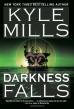
Kyle Mills is the New York Times bestselling author of eight books, including RISING PHOENIX, THE SECOND HORSEMAN and FADE. In this interview with Bookreporter.com's Joe Hartlaub, Mills explains why he prefers to write about realistic and timely subjects, and discusses some of the parallels between real-life occurrences and events that take place in his latest novel, DARKNESS FALLS. He also reveals what he has learned through his research on alternative forms of energy, shares his thoughts on environmental issues and describes what he is currently working on.
Bookreporter.com: DARKNESS FALLS deals with an energy crisis occasioned by a designer bacteria that is used to sabotage the world’s largest oil fields. Ironically enough, it is being published just as oil prices reach $100 a barrel. Given that books are written --- and scheduled for publication --- several months in advance of their on-sale date, how did you manage to hit so close to the mark with DARKNESS FALLS? Luck, coincidence, or a crystal ball?
Kyle Mills: A little bit of all three. I’ve always been attracted to thrillers that feel as though they could happen tomorrow, so I try to make up as little as possible and write a book that is nothing more than a twist on a realistic prediction for the future.
The dark side of that philosophy, though, is that sometimes your timing is off. On September 7, 2001, I turned in a draft of a novel about al Qaeda smuggling a rocket launcher into the U.S. A few days later, my wife called me from work and told me that my book was being played out on the news.
BRC: Erin Neal is one of the most compelling figures in DARKNESS FALLS. He is a bit of an environmental renegade, fully embraced by neither radical environmentalists nor the establishment. His book, ENERGY AND NATURE, as described here, sounds impressive in its advocating a moderate energy policy that strikes a balance between rabid conservation and current energy use. Did you have anyone in mind when you created this character? And is there a real world model for ENERGY AND NATURE?
KM: The character is loosely based on Bjorn Lomborg, the author of THE SKEPTICAL ENVIRONMENTALIST. After the release of his book he suffered some pretty vicious attacks, despite the fact that it seemed to be a sincere effort at good science. I just extrapolated that out --- what if he had made his living as an environmentalist? What if all his friends had been environmentalists? It wasn’t hard to create a scenario where everyone my character knew would turn their backs on him.
As far as there being a real-world model for ENERGY AND NATURE, it was kind of a composite of THE SKEPTICAL ENVIRONMENTALIST and a paper called The Death of Environmentalism (Shellenberger/Nordhaus).
BRC: Just about everyone has an opinion regarding the environment. How did your research for DARKNESS FALLS affect your viewpoint regarding energy use?
KM: Sadly, it left me with a sense of hopelessness. When Al Gore, the poster boy for the fight against global warming, owns three houses totaling 15,000 square feet and flies around on a private jet, it makes it hard to ask a poverty-stricken person in China to give up their coal plant.
Realistically, the climate is going to change and whether that’s good or bad is a matter of perspective. If California ends up underwater, it’s a bad thing for Californians but a good thing for fish. Humans have always been better at adapting than thinking long-term.
BRC: On a related note, did something in your own experience that affected you personally --- anything from running out of gas to receiving an off-the-scale electric bill --- provide the jumpstart for DARKNESS FALLS?
KM: It was more the war in Iraq making me think about how dependent we are on foreign oil and how destructive our pursuit of it has been. The comparison to a heroin addict is probably an insult to heroin addicts.
BRC: The most impressive element of DARKNESS FALLS for me was the manner in which you extrapolated what would occur in the event of a significant oil shortage. Most people think of lines at gas pumps and expensive prices. You took things a bit further, and your scenario was all the more frightening for being so realistic and well thought out. Did you take your evaluation step by step, or did you come across a similar scenario during the course of your research?
KM: There is a lot of scary Peak Oil speculation out there --- books that predict catastrophe for the world as the oil runs out. I used those general theories to create a detailed alternate reality that a reader could imagine trying to live through.
It was an eye-opening exercise. How would I feed myself if trucks stopped delivering food to my grocery store? How would I keep myself warm? And when people started getting cold and hungry, how would I protect myself from the chaos that would almost certainly follow?
BRC: Another impressive factor of the book is the internal discussion regarding the cost of alternative energy. Few people seem to be aware that producing alternative forms of fuel actually consumes more energy than they save. Considering all of the research you performed while writing this novel, what would you ultimately consider to be the most effective form of alternative fuel?
KM: Without a doubt, nuclear is the most effective, but with it comes a lot of baggage. Ethanol, as it’s currently produced, is probably the least effective.
Many people are looking for a magic bullet --- a technology that will solve all our problems quickly and cheaply. Realistically, it will be a number of different technologies combined with massive increases in efficiency.
But as long as the oil is flowing, environmental gains will continue to be measured in “raised awareness” as opposed to meaningful programs.
BRC: DARKNESS FALLS is also noteworthy for featuring the return of Mark Beamon in a strong secondary role. Considering the end of the book, will we be seeing Beamon in any of your future novels?
KM: Until someone posed a similar question a few weeks ago, I had never thought about the fact that it might be hard for Beamon to escape the universe I created for him.
I have to admit that I haven’t figured out what I’m going to do. But the thought of never writing Mark Beamon again is kind of depressing.
BRC: What lured you into becoming a writer? And what do you think you would be doing if you were not writing?
KM: Honestly, I can’t say that I had major designs on becoming a writer. I turned out my first novel as a labor of love, without any real expectation that it would be published. I think I’m one of the rare people who fell into the profession rather than pursuing it.
If I weren't a writer, I supposed I’d still be working in finance. If I had to guess, I’d say real estate developer. I think writing suits me better, though.
BRC: Given all of the research involved in writing DARKNESS FALLS, did you need to adapt your writing schedule accordingly? How do you normally schedule your time? And what do you do when life gets in the way?
KM: Most of my books demand a lot of research, so I’m used to it. I generally do research and my outline at the same time so that they can feed off each other.
My goal is to work a normal 40-hour week. When I’m outlining, though, I tend to work shorter days because I can only think that hard for a few hours before I get a headache.
When life gets in the way, I react by panicking about my deadline.
BRC: What are you working on now? Do you have any plans for an ongoing series? And given that DARKNESS FALLS could be considered the ultimate disaster novel, have you entertained any thoughts about writing at least one book in another genre?
KM: I’m writing a thriller set in the world of African aid. I spend a lot of my winters in South Africa and have become fascinated by the way the continent works --- or doesn’t, as the case may be.
I’ve never been particularly attracted to series --- they tend to narrow my ability to explore different subjects. Maybe another Beamon book, though, if I can figure out how to do it.
It’s always tempting to write something in another genre and, to some extent, I once did. My book SMOKE SCREEN leans pretty far toward general fiction.
At least in the short term, though, I think I’m going to stick to what I know.
Click here now to buy this book from Amazon.
© Copyright 1996-2009, Bookreporter.com. All rights reserved.
Back to top.
|