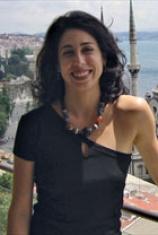
Ana Menendez
BIO
Ana Menendez, the daughter of Cuban exiles, was born in Los Angeles. She is the author of two books of fiction, the novel LOVING CHE and the short story collection In Cuba I was a German Shepherd, which was a 2001 New York Times Notable book of the year and the title story of which won a Pushcart Prize. Her second novel, THE LAST WAR, is scheduled to be published in May 2009 by HarperCollins.
Since 1991, Menendez has worked as a journalist in the United States and abroad, including the last three years as a prize-winning columnist for The Miami Herald. As a reporter, she has written about Cuba, Kashmir, Afghanistan, and India, where she was based for three years. Her work has appeared in a variety of publications, including The New Republic, The New York Times, and Gourmet magazine, and has been included in several anthologies, including, CUBANISIMO!, edited by Cristina Garcia, and AMERICAN FOOD WRITING, a Library of America anthology edited by Molly O’Neill.
Menendez has a BA in English from Florida International University and an MFA from New York University. She is currently teaching at The American University in Cairo, Egypt, as a 2008–09 Fulbright Scholar.
INTERVIEW
May 18, 2001
IN CUBA I WAS A GERMAN SHEPHERD is the hypnotic debut collection of linked
tales by Cuban-American Pushcart Prize winner Ana Menendez. Menendez charts the immigrant
experience from Havana to Coral Gables and beyond, and her stories beg the question: Can
you ever truly escape your past and heritage? Bookreporter.com Senior Writer Jana
Siciliano recently talked with Menendez about the work of writing, the art of the
short story and, naturally, that big island just South of Florida.
BRC: How much of a part in your upbringing did your parents' Cuban heritage play?
AM: A very big part. My parents, I think, raised my
sister and me with the thought that we would all be returning to Cuba as a family very
soon. So I spoke only Spanish until I entered kindergarten and during summer vacations my
mother taught us Spanish grammar and my father taught us to memorize Marti. And, of
course, they talked about Cuba and what they had left behind constantly. Growing up, I
always felt more Cuban, than American.
BRC: How aware were you as a child of what your parents left behind in their homeland?
AM: They talked about it very often. It loomed as
large in our lives as the expulsion from the Garden of Eden.
BRC: Why did you choose to write short stories instead of a novel about any of the rich
characters in IN CUBA I WAS A GERMAN SHEPHERD?
AM: The decision was completely arbitrary. In fact, it
was barely a decision at all. I just started writing short stories when I got
into the NYU program because thats what everyone else seemed to be writing. And
coming from newspapers, I thought the short form would be easier to handle. But I
didnt really set out to put the stories into a collection until they were almost
done. I was not thinking of a book as I was writing.
BRC: Are any of the stories related directly to your experiences or your family's
experiences in the United States?
AM: No, not really. Of course, as the daughter of exiles,
I have a certain understanding of the world and that informs what I write. And I do draw
on some of the emotions that Ive experienced or Ive seen relatives experience.
But the specific lines of the stories come mostly from my reporting days, and ---
unbelievable as it seems --- from my time in India. It was there that I was really able to
understand the universality of loss.
BRC: Have you ever been to Cuba?
AM: Yes, I was there in 1997 on a reporting trip for The
Orange County Register and I plan to visit again soon.
BRC: What do you think about the fact that all things Cuban are so much in vogue with
Americans now --- music, culture, cigars even?
AM: Are they? Its hard for me to notice because
Cuban things were always in vogue in the small universe that I grew up in! I dont
know, I suppose it should make me uneasy because the very idea of being in
fashion carries with it the inevitable falling out. Every author wants recognition.
But I wouldnt want to be part of a trend. Trends are fickle and the very best art
--- which we all strive for regardless of ability --- should be timeless. Thats the
ideal, anyway.
BRC: When did you first discover the seed which blossomed into this short story
project?
AM: I think it was when I was a reporter in Little
Havana. It must have been 1993 or 1994. I went to interview the Cuban-born sculptor Tony
Lopez, who is the most charming man youll meet. And I spent a lot of time with him.
He had a wonderful attitude about life, about exile, about everything. And he loved to
tell jokes. One of the jokes he told me was a version of the German Shepherd joke. The
punchline was so funny and yet so bittersweet and listening to this older man laugh after
he had told me the story of his life --- I just thought, there is so much truth in this.
And of course, it wasnt the kind of truth you could not really put in a quick
newspaper profile. But the punchline stayed with me for years before I finally decided to
construct a story around it.
BRC: What did you learn about writing at NYU's Graduate Writing program that you didn't
know before you got there?
AM: A lot, I think. Though one of the most important
things about the program was the sense of discipline. Coming from newspapers, I really
needed someone standing over me saying, Wheres your story. I dont
think I could have decided to do it on my own. I would have just sat in front of the
computer, gone shopping, eaten lunch several times a day. Im not terribly
disciplined on my own. And then I also got to work with great writers who were students
and teachers. Its a slow process of learning. Its not like going to school to
learn mathematics; there are no laws to memorize. But at the end of it, I did think I was
a better writer.
BRC: Did the faculty there help make you a stronger writer?
AM: Yes, definitely. I had wonderful professors. I was
very lucky, in my second semester, to work with Edna OBrien, who was a delight. I
think she really took my writing forward. She was very critical and I thrive on that. She
was not ever satisfied. As a writer, you can never be satisfied.
BRC: Do you recommend such programs to new writers?
AM:
Yes, though with reservations. You can't go in expecting to come out John Updike -
that takes a certain innate ability which very few of us have, and it takes years of
experience and trial and error. I also think it's not very good for very young writers who
might be unduly influenced by the sometimes stifling atmosphere of workshops. There is
sometimes a strong conformist attitude that prevails that you have to be mature enough to
ignore. You have to feel able to write quirky stuff.
BRC: What was the process you went through to get IN CUBA published?
AM: My thesis advisor, the South African writer
Breyten Breytenbach was the first person to suggest that what I had could be put together
in a book. He really pushed me, this was my last semester, and I was a little lazy. But he
helped me edit and gave me lots of feedback and suggested I send it to his editors at
Harcourt. They rejected it and I didnt do anything else for months --- I had
returned to India to be with my husband who was the New Delhi bureau chief for the Los
Angeles Times. Then when I was vacationing, I got an e-mail from Amy Williams, then an
agent at The Gernert Co. (shes now at ICM). I happened to be on my way to New York
and happened to be carrying a floppy with my stories on it. I met her for coffee, gave her
a printout and she had the book and a novel sold in two weeks. Shes amazing.
BRC: Who are your great literary heroes? What writers really move you?
AM:
Oh gosh. I don't think I've read enough to say. Growing up I loved Hemingway and then
I graduated to Faulkner. My biggest influence probably came from poets - my uncle Dionisio
Martinez is a poet and poetry is highly praised in my family. To this day I think I know
more poets than novelists - I loved the beats, especially Gregory Corso. And James Dickey,
Mark Strand, Adrienne Rich, Galway Kinnell. I could go on and on. Today, I really admire
the Cuban writers Zoe Valdes and Guillermo Cabrera-Infante. And of course Reinaldo Arenas,
who I think was one of the most inventive of writers and courageous of men. Cormac
McCarthy I adore. Harriet Doerr, Denis Johnson and the humorists Frank Davies and T.
Coraghessen Boyle.
BRC: What was the hardest story to write in this collection?
AM: They were all hard! I dont find writing
particularly easy --- its just like any other job. The one I revised the most was I
think Confusing the Saints which last time I checked the Word preferences had
been revised more than 1,000 times. I dont know why that story gave me more trouble
than the others, it just did.
What is your writing day like?
AM: I try to write from about 9 a.m. to 1 p.m. and
then from 2 to 4 Ill try to do some revisions or research. At four, I head off to
the gym to run and watch Oprah.
BRC: Who are your biggest influences in literature?
AM: All of the above plus the usual suspects. Growing up
the poetry of Jose Marti was very influential as was the poetry of Carl Sandburg (my uncle
bought me all his books). I was a huge fan of Robert Cormier who wrote I AM THE CHEESE and
read all the Nancy Drew and Trixie Belden books. As an adult, Ive found most of my
inspiration from poetry and the classics, especially (at the risk of sounding a ridiculous
bore) THE ODYSSEY and Proust (though Ive yet to complete REMEMBRANCE OF THINGS
PAST).
BRC: What was the first thing you ever wrote where you knew you were on the right track
to becoming a real writer?
AM: I always wanted to write --- I wrote a poem on a
butterfly in first grade that my parents, at least, were very proud of! I just never
really thought Id do anything else.
BRC: What is your best piece of advice for young writers?
AM: I think Im too young myself to be giving
advice! All I can say is read a lot and be disciplined in your work. Even as a journalist
I thought that the difference between so-so writers and great writers was the tolerance
they had for mediocrity. The trick is not to stop when you think its good enough.
BRC: What is your next project going to be?
AM: A novel set in post-revolutionary Cuba, and yes, I
have started it.
Click here now to buy this book from Amazon.
© Copyright 1996-2010, Bookreporter.com. All rights reserved.