|
BIO
Michele Martinez, a graduate of Harvard University and Stanford Law School, was a federal prosecutor in New York City for eight years. She lives in New Hampshire with her husband and two children.
2008 Suspense/Thriller Series Feature
2007 Suspense/Thriller Series Feature
Debut Suspense/Thriller Series Feature
Back to top.
INTERVIEW
February 29, 2008
Former lawyer turned suspense/thriller author Michele Martinez has written four novels --- including the newly released NOTORIOUS --- that revolve around Melanie Vargas, a New York City prosecutor who specializes in narcotics-related crimes. In this interview with Bookreporter.com’s Joe Hartlaub, Martinez explains how heavily this latest book was influenced by her real-life experiences and ponders the future of her protagonist, who may not make an appearance in her next novel. She also shares her recent literary discoveries, offers advice to struggling first-time authors and briefly discusses her return to the legal profession.
Bookreporter.com: In NOTORIOUS, your new Melanie Vargas novel, Melanie is preparing to prosecute Atari Briggs, a very high-profile rap artist, for ordering a murder. One of the pivotal moments of the book takes place when Melanie begins listening to one of Atari’s CDs for potential clues concerning the murder, as well as other crimes. What inspired your use of a rapper as a prosecutorial target for Melanie in NOTORIOUS? Have you been a fan of rap music? And, given the controversy surrounding the music, do you think it encourages more violence?
Michele Martinez: The choice of a rapper-defendant comes directly from my personal experience as a narcotics prosecutor in New York in the '90s. I prosecuted a fair number of guys who were pretty high-level in the narcotics trade while also pursuing hip-hop music careers. I literally had defense lawyers ask me to listen to their clients' demos, as if the fact that a person was a serious musician would somehow change the evidence in the case! In short, a decent number of the musicians whose work lays claim to insider knowledge about drugs, violence and murders aren't lying. Rap comes from the streets, which is what gives the best rap music its power and authenticity. (And yes, I like a lot of this music.) Does it encourage violence? It certainly glorifies it, but then, so does much of today's art, including film and video games.
BRC: One of the more interesting, and subtle, subplots in NOTORIOUS centers on the double lives that some of the characters --- defense attorneys, defendants and at least one federal prosecutor --- lead during the course of the novel. It makes for an interesting contrast throughout the book, taking it in intriguing directions. Did you begin writing NOTORIOUS with the idea in mind, or did it develop gradually as you were writing?
MM: The double life was planned for a couple of the characters you mentioned, but for the third, well, he surprised me as much as he surprised Melanie. (Hmm, not sure I can fully answer this question without getting into plot spoilers!) I wanted to explore the concept of double lives because the world of criminal law holds so much temptation, even for the "good guys." The "cartel lawyer" character featured in NOTORIOUS is a member of the bar, sworn to uphold the law, but can't resist the vast sums of money to be made by getting too involved with his drug dealer clients. Does this happen in real life? You bet! Certain vignettes about that character were directly inspired by things I saw as a prosecutor.
BRC: One of the most consistently enjoyable elements of your work in general and of NOTORIOUS in particular is the role played by office politics, particularly at the federal level, and the way that support staff is often the tail that wags the dog. How much of your own office experience informs what Melanie Vargas encounters in your novels?
MM: All of that stuff comes from my experience in a real-life prosecutor's office. Awareness of office politics is one of the things that I, as a former prosecutor in real life, can bring to my readers. Office politics is just a huge part of the working world. To me, fiction set in the workplace can't be authentic without at least some reference to it. Besides, it's a lot of fun to write (and read) about, being both humorous and down and dirty. The way that characters do (or don't) play politics can also reveal a great deal about who they are that wouldn't necessarily come out in other ways.
BRC: Another interesting, albeit minor, development in Vargas’s life in NOTORIOUS is the plan for her sister and mother to move to Miami. While there are elements in her life that would seem to mitigate against it, do you foresee Vargas leaving New York --- and possibly the federal prosecutor’s office --- in the future?
MM: You're right on --- I was toying with possible scenarios for Melanie's future as I wrote this book. She's not entirely happy during NOTORIOUS. Some major elements of her life are awry. Yet, by the end, I think she has found peace again and come to terms with the fact that she loves her crazy job despite how difficult it makes her life.
BRC: A small but very important part of NOTORIOUS is set in Las Vegas. Did you travel there to do research for that portion of the novel, or were you there and decided to incorporate it as a backdrop for it?
MM: I planned to do research during a trip to Vegas. It's just such a perfect setting for crime, isn't it?
BRC: Evan Diamond, the defense attorney for Atari Briggs in NOTORIOUS, was quite a character. In your own practice, did you ever encounter an attorney, on either side of the courtroom, who set such a low bar in ethical standards?
MM: In a word, yes.
BRC: On a related note, your characters always seem to be very realistic. I especially felt that way about Jennifer Lamont, who plays a pivotal, if tragic, role in NOTORIOUS. The episode involving Jennifer had the ring of truth to it. Did this spring entirely from your imagination, or were names changed to protect the guilty and innocent?
MM: Wow, your questions are showing me how much I drew on real-life experience in this book. I will say this much: there was a "notorious" incident that made the rounds of the office grapevine back in my day involving a female prosecutor and a rather shady male defense attorney. I've always thought that this incident would make an interesting subject for fiction. But in all fiction, the real-life kernel of inspiration ends up morphing into something completely different and independent. That happened here, so that what ends up on the page barely resembles its original inspiration. But do these general sorts of scenarios occur in real life? Yes. Rarely, but yes.
BRC: What are you working on now? Do you ever feel any urge to write about someone other than Melanie Vargas, or to perhaps focus on one of your other characters who recur in her books?
MM: Absolutely, and I am. I'm currently writing a stand-alone that bears little resemblance to the Melanie Vargas books, save for the fact that it's set in the world of the violent narcotics trade in New York City -- a world I know well.
BRC: Does your current writing schedule vary in any way from what you were doing when you first started writing? Does the writing get harder or easier? Have you changed anything in terms of how you conceptualize a prospective work?
MM: Honestly, I think the writing gets harder. It certainly gets more self-conscious. You get reviewed a lot. You meet a lot of talented authors and read their stuff and feel inadequate. It's hard to put aside all the white noise and focus on your own work. The only way I know to do that is to get sufficiently into the plot of a new book so that it takes over my brain. Luckily, that's happening now with my stand-alone. Sometimes it's hard to talk to people because I'm so in the book. I look like I'm here, but mentally I'm not; I'm with my protagonist, whose life is so much more compelling and dramatic than mine.
BRC: You balanced a legal career, as well as duties as a spouse and parent, while becoming established as an author. What advice would you give to those who are struggling to finish their first novel?
MM: You have to love doing it for its own sake. Otherwise, it will be very difficult to carve out the time.
BRC: What books have you read in the past six months that you would care to recommend to our readers?
MM: I've been totally absorbed in Diana Gabaldon's Outlander series. I'd call these books adventure sagas with elements of historical romance, and yes, time travel. I never thought I'd be able to love books that included time travel, but there are some truly extraordinary elements in them. The main relationship (between Claire Randall of the 20th century and Jamie Fraser of the 18th) is so flesh-and-blood real that I can't stop reading about them. (And the sex is great!) Plus, the details of everyday life in Scotland and America during the 1700s are rendered with such breathtaking clarity that I feel truly swept away.
BRC: If you weren’t writing, what would you be doing? Do you have any desire to go back to a legal career? And, if so, would you want to return to a prosecutor’s office on some level or do defense work?
MM: Yes, I miss law a lot and I'm going to be returning to it part-time, teaching a criminal law class.
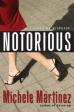
BRC: Finally --- and trust me, I am sure I am not the only one who is curious about this --- who is on the cover of NOTORIOUS?
MM: That's Melanie Vargas! Nice gams, huh?
Click here now to buy this book from Amazon.
Back to top.
INTERVIEW
March 16, 2007
Michele Martinez, who was an Assistant U.S. Attorney in the Eastern District of New York for eight years, is the author of MOST WANTED, THE FINISHING SCHOOL and the newly published COVER-UP, which feature Melanie Vargas and her exploits as a New York City prosecutor. In this interview with Bookreporter.com's Joe Hartlaub, Martinez talks about the struggles of trying to portray the events in her books as accurately as possible, based on her own experiences, and discusses the aspects of her former law career that have helped to shape her writing. She also ruminates on the possibility of spin-offs and stand-alone novels, and shares what readers can expect from Melanie in the future.
Bookreporter.com: In COVER-UP, your third book, readers encounter a new, more confident and self-assured Assistant United States District Attorney Melanie Vargas. She is out of her marriage and in another relationship, relying less on family and poised to make a professional --- and possibly personal --- jump, even while she is in the midst of investigating the violent murder of television investigative reporter Suzanne Shepard. One of the attractions of your Vargas books has been the way you have slowly but surely tinkered with Vargas's life while keeping certain aspects of it constant and familiar. Do you write general plots, including aspects of Vargas's life, far ahead of time, or do you wait to begin the plotting until you are actually ready to sit down and start writing a new book?
MM: I spend an inordinate amount of time thinking about Melanie Vargas. Yes, she's a fictional character, but to me she's more like a real person who lives in an alternate dimension. Her life goes on and unfolds to me almost in real time. I keep track of her relationships, who's getting promoted in her office, even what's happening in the careers and love lives of secondary characters. Much of this stuff never sees the light of day in a published book, but I still know it. So that part comes relatively easily, and does not require outlining or working out plot points.
The "crime" aspects of the plots are more challenging. When it comes to the twists and turns that we all love to see in crime novels, I need a detailed synopsis in order to start a new book. Once I begin writing, things do change, however. Clues and motivations are revealed and go on to influence events later in the novel, in which case I have to stop and revise my outline.
BRC: COVER-UP is a thriller/suspense novel, but possesses many elements of a classic whodunit. There is a gruesome murder at the beginning, a number of possible suspects and a trail of clues that keeps the reader, and Vargas, guessing. When you started writing COVER-UP, what was your jump-off point? Did you begin creating characters, or did you begin with the murder?
MM: COVER-UP was, of all my novels, the most difficult to write. I was a prosecutor in real life for many years, and at times I find the conventions of the crime novel frustrating. There's too much distance between the form of the novel and the reality of life in law enforcement. In COVER-UP as originally conceived, I started with both characters and plot, but they were wrong. They would've made for entertaining fiction, but were too far removed from the reality of life on the streets. As I wrote, I realized that I needed to bring the book closer to the truth. So, I revised and revised and revised. I wrote the first 200 pages over three separate times in three completely different versions. Ultimately, what worked was keeping these very fun characters (the dead TV reporter, the sinister plastic surgeon, the gangsta personal trainer) but plugging them into a different plot --- a more realistic and gritty murder investigation.
BRC: On a related note, all of your novels, including COVER-UP, contain elements of romance and lust, though they remain firmly ensconced in the thriller/suspense genre. In fact, you have been heard to describe your work as leaning toward romantic suspense. Did you envision this when you started writing Vargas, or has the nuance of your writing changed as the series has gone on?
MM: The romance and sex elements have been there from the beginning. I came to writing about a prosecutor from a career as a prosecutor, not from a career as some other kind of writer. My goal was to translate the reality of life on the job to the page. Law enforcement is a pretty sexy environment --- life or death stakes, type-A personalities, long hours at work. There's a lot of cursing and joking around and, frankly, a lot of office romance. As far as the bad guys I knew when I was a prosecutor, sex and money were their two great preoccupations. When I write criminal characters who are driven by sex, I'm just portraying realistic versions of the guys I met in the drug trade. Oh, and I suppose I should mention this --- writing sex scenes is fun!
BRC: COVER-UP includes two of my favorite literary scenes of recent memory. The first concerns the fund-raising party for Clyde Williams, a councilman who is on Vargas's suspect list for the murder of Suzanne Shepard. The party takes place in the Temple of Dendur Exhibit at the New York Metropolitan Museum of Art; I particularly enjoyed your description of this exhibit as I hope to see it in July during Thrillerfest. What research was involved in writing that scene? Were you able to take photographs of the exhibit for reference? Did you write the scene in COVER-UP while you were there?
MM: I used to live a few blocks from the Met, and we had a membership. We would take the kids to the museum on rainy weekends, and the Temple of Dendur is one of the best exhibits for restless little boys because there's plenty of space to run around. I've been there a hundred times, so it was in my file when I went looking for a good location to set a big party scene. When it came time to sit down and write, I went back and made some detailed notes to help my memory.
BRC: The second of my favorite scenes involved the climactic events that took place in LazerMania, a Times Square arcade. This scene, if anything, was more realistic than the Temple of Dendur vignette. Did you research this yourself, or did you have some help from your husband and children?
MM: Again, LazerMania grew out of my life raising kids in New York City. In my sons' school, which was all boys, the ONLY cool place to have your birthday party was this combination arcade/laser tag place near Times Square. The first time I went there, I nearly had a heart attack at seeing my innocent child in such a crazy environment. The real-life version is exactly like the fictional one --- dark and confusing and full of serious thugs of the type who were probably packing heat. Yet, all these fresh-faced eight-year-olds were running around like madmen, shooting each other with laser guns amidst the chaos. That place called out to be translated into fiction. One time when I was there for a birthday party, I whipped out my little notebook and took some detailed notes. After that, it was just a question of when --- not if --- I would set a scene there. Hence the climax of COVER-UP, which is probably the most over-the-top thing I have ever written.
BRC: Did you have the title for this book from the start, or did that evolve with your writing? Do you usually know the titles of your books when you start writing them?
MM: Hmm, with COVER-UP I don't remember when I got the title; fairly late in the process, I think. It's common to go through a number of titles before you get to the right one. For example, with the fourth Melanie book, which is called NOTORIOUS, I had the plot for a long time before I had any title. Then I thought of a title I really liked and slapped it on my proposal, only to discover a few months later that it was being used by another author at my publisher for a book coming out before mine. That happens a lot --- you'll think of something that you love, and find out it's been taken. Titles are hard.
BRC: You went from private law practice to the federal prosecutor's office and then on to writing. Lay persons often do not know that certain aspects of the practice of law require not only staggering amounts of reading, but also of writing, with all of it involving working under a deadline. What aspect of your law practice, in either the public or the private sector, do you believe has helped you the most with the craft of writing?
MM: Since you're asking about craft, I'd have to say that writing statements of fact for appellate briefs, and writing summations for trials were the two most helpful exercises. Both involved sifting through mountains of facts and presenting them in a way that made them come alive for the reader or listener. And yes, you go through a lot of practice, a lot of revisions, all under crushing deadline pressure. Now, if you were asking about what was most helpful in gathering material, I'd pick something entirely different. The best source of material was sitting down with the bad guys --- debriefing them, preparing them to testify, hearing their stories day after day, thousands of hours of drive-by shootings and packing drugs and dismembering bodies. Wow, it was an education.
BRC: In COVER-UP you give readers good insight into the backroom politics that go on in the prosecutor's office. How much of this was culled from your own career as a prosecutor?
MM: All of it. Office politics are huge in government offices. There's no money at stake; it's all about power and recognition. I couldn't write about a federal prosecutor without setting her against a backdrop of life in a realistic U.S. Attorney's Office: who's gunning for which promotion, who's poaching their colleague's cases, who has an "in" with a particular judge. It's all very rich and complex and, I think, one of the most interesting aspects to write about. The portrayal of office politics, along with the very vivid New York City setting, are the two main elements that give my series its texture.
BRC: You've engaged in the practice of law in the public and private sectors; you are an author; and a spouse and parent. Is there one occupation you have longed to work in and never had the opportunity to do?
MM: Great question! Yes, I've always wanted to run for elective office. Probably in order to do that, I'd need to go back and pick up the reins of my legal career first (which always remains a possibility for me).
BRC: Many writers occasionally hit a roadblock in their work. What do you do to avoid them, or, alternatively, to break through them?
MM: For me, the only answer is more writing, more "butt in chair" time. Usually, if a book isn't jelling, it's because I'm not spending enough time with it. I'm touring too much or too distracted by real life or whatever, and not "in the book" enough to get the traction. Conversely, when I'm living with the book day in and day out, my mind is always sifting and creating and revising. I'm much less likely to run into roadblocks in the first place and --- if I do --- more likely to see the solutions to them.
BRC: Will we be seeing more of Melanie Vargas? If so, when, and is there anything you can share with us about the next book?
MM: Yes! I'm nearly done with the fourth Melanie Vargas thriller, NOTORIOUS. As the book opens, Melanie is about to go to trial against the most famous rap star on the planet for a drug-related homicide he committed back in the day. It's a tough case, and she's taking a beating in the press because the defendant is hugely popular and has a well-oiled publicity machine. She's standing outside the courthouse conferring with the defense lawyer (a riveting character who has cameo in COVER-UP, and with whom Melanie and I are both smitten) when something shocking happens. Let's just say the book starts with a bang and never lets up. Melanie's personal life is in a place that readers won't expect either.
BRC: Do you have any stand-alone novels planned for the future? And do you have any recurring characters that you contemplate having a series of their own?
MM: Yes, I'm planning to write a stand-alone. I'm very pleased with how the first four Melanie novels have turned out, but creatively, I'd like to try my hand at something different. As for spin-off characters --- interesting question, but no. I once considered developing a chick-lit series about Linda Vargas, Melanie's sister, who's a fashion and entertainment reporter on TV and a very flamboyant, sexy Latina. I may still try my hand at that, but at the moment, it's not on the front burner.
Click here now to buy this book from Amazon.
Back to top.
INTERVIEW
February 18, 2005
Bookreporter.com's Suspense/Thriller Author Spotlight Team (Carol Fitzgerald, Joe Hartlaub and Wiley Saichek) interviewed Michele Martinez, author of MOST WANTED. Martinez discusses her transition from prosecutor to crime fiction writer, the significance of her protagonist's Hispanic roots, and the challenging and rewarding aspects of writing her first novel.
Bookreporter.com: What was your inspiration for MOST WANTED?
Michele Martinez: The opening scene of the book literally came to me in a dream --- I kid you not! It must have been my subconscious helping me out, because it happened at a moment in my life when I was agonizing about whether to quit my job as a prosecutor and stay home with my kids. I was greatly in need of inspiration and a new direction. Normally, like most people, I dream about myself or real people that I know. But in this instance, I had a dream about a fictional character --- a handsome, silver-haired lawyer who was murdered and set on fire because of a secret he was keeping. I woke up and wrote it down, and decided it would make a good opening scene in a novel, and that's how MOST WANTED was born.
BRC: Melanie Vargas, the assistant U.S. attorney who is the primary protagonist in MOST WANTED, struck us as being a true-to-life character. Given your background as a prosecutor, how much of you is in Melanie?
MM: We share many characteristics. Melanie, like me, is half-Puerto Rican, comes from modest roots but has an Ivy League education, loves being a prosecutor but experiences great stress juggling her demanding job with being a mommy. But Melanie is also NOT me. She has her own separate life --- a different office, boss, husband, baby, parents, sibling, apartment, etc., etc., than I have. She also faces much more extreme circumstances than I do. I've gone up against dangerous criminals in the courtroom, but never --- thank God! --- in a burned-out basement with a nine millimeter in my hand. I'm happily married, whereas Melanie's marriage is in deep trouble and may not last, meaning she'll face all the challenges of being a divorced mom. Despite the differences, I still like to think that if I were placed in Melanie's difficult (although stylish) shoes, I'd kick butt the way she does.
BRC: What was the impetus behind your career shift from prosecuting to writing?
MM: I was going through a total career vs. motherhood crisis. I think a lot of career-oriented women experience this when they have kids. I loved being a prosecutor --- loved it passionately --- and never thought I would leave. But when my kids came along, I suddenly found myself pulled in a very different direction. I felt guilty all the time --- not only because I wasn't home with my little ones, but also because I couldn't give my job 110% the way I once had. (This struggle very much plays out in Melanie Vargas's life in MOST WANTED) Writing novels about the career I had loved so much seemed like the perfect solution.
BRC: When did you become interested in writing fiction? Was MOST WANTED the first thing you wrote?
MM: Well, yes, MOST WANTED was the first serious piece of fiction I ever wrote, but that makes it sound a lot easier than it actually was. I've always been a very serious writer. In fact, I originally planned to be a journalist --- I was editor-in-chief of my high school newspaper, wrote for my college newspaper and had summer jobs in journalism. But then I got interested in politics and government, and went to law school instead. Law is completely writing-intensive. I wrote constantly. Being a clear and fluent writer was one of my great strengths as a lawyer. Not only did I have tons of practice, but after eight years as a prosecutor, I had the thing every fiction writer truly needs --- material. Then I still had to put in literally years at the computer honing my fiction-writing skills to translate all that great material into a novel that would actually be suspenseful and exciting to read.
BRC: Were you always interested in crime fiction, and did this have any bearing on your decision to become a prosecutor? Or did your career have an influence on the books you liked to read?
MM: I've always been fascinated by crime, and that fascination influenced both what I read and what I chose to do with my career. I read some unforgettable true-crime books when I was a teenager --- IN COLD BLOOD and THE EXECUTIONER'S SONG (Norman Mailer's book about Gary Gilmore) leap to mind --- in addition to tons of crime fiction. But my decision to become a prosecutor was about public service as much as a personal fascination with crime. I wanted to help people and give back to the community. I truly believe that eight years spent locking up major drug kingpins, violent gang members and killers made a difference in the world, and I'm very proud of the good I accomplished in those years.
BRC: One of the more interesting subplots of MOST WANTED concerns the multiple layers of office politics. In your experience, was what you saw in the prosecutor's office better or worse?
MM: I would say the office politics in the book are representative of real life. Office politics happens everywhere, of course, which is probably why readers have responded so strongly to that aspect of the book. But in private corporations, the maneuvering plays out more around issues of salary and money, whereas in law enforcement, that stuff just isn't at issue. Instead, what you see is infighting and turf battles over the big cases, over promotions, and sometimes, unfortunately, over personal animosities and feuds. Law enforcement is full of larger-than-life personalities, and while the vast majority are great team players, they're also very competitive. All of which provides terrific fodder for the novelist.
BRC: You undoubtedly encountered some bad actors during the course of your prosecutorial career. Did any of them inspire Slice in MOST WANTED, or did he spring from a nightmare of your own imagination?
MM: There was a guy who was as bad as Slice. He's doing thirty to life now. Is Slice based on him? No, Slice is a fictional character and different in every way. But doing that case, learning about that particular individual, taught me things that made me able to write a character like Slice.
BRC: What was the most challenging part of writing MOST WANTED? The most rewarding?
MM: The most rewarding parts were the moments when it just jumped into my head fully formed and flowed from my fingertips right onto the page. Lots of scenes in the book started out that way. Paul Simon once said about writing music that it felt like taking dictation --- and that's how I felt when I first "got" many of the scenes in MOST WANTED. The most challenging part, I think, was what I had to do with those moments of joyous inspiration to turn them into a suspenseful and exciting book --- edit, polish, discard, start all over from scratch, and rewrite, rewrite, rewrite. Now that was plain hard work.
BRC: Since you wrote this book envisioning a series did you do anything special to set up the future books?
MM: Oh, definitely. First of all, I gave Melanie an office and a personal life full of colorful characters who can appear again and again in future books. Everyone from her witchy boss Bernadette, to her sassy sister Linda, to the cops and federal agents who solve the crimes alongside her. I know a lot more about these characters than shows up in MOST WANTED. They all have childhoods and families and secrets and dreams that could fill whole books of their own. The other thing I did was to solve the Benson murder at the end of the book but leave plenty of unanswered questions in Melanie's personal life --- the biggest one being what will happen between her and the sexy-as-hell FBI agent Dan O'Reilly (see below).
BRC: Melanie's Hispanic background is something we have not seen in many mysteries or suspense/thrillers. Do you feel there is a void in the genre that needs to be filled? Did you have any concerns about confusing non-Spanish speaking readers by using Spanish dialogue throughout the book?
MM: I agree that there are not enough assimilated, English-speaking Hispanic crime-fighters represented in crime fiction given how many there are in real life, and given the huge population in the U.S. that would love to read about them. Certainly, I have personally missed reading about such characters myself. But having said that, Melanie Vargas is really a universal character who anybody of any ethnic background will identify with. Her life is a classic American story. She comes from modest roots, grew up in a tough neighborhood and witnessed violence as a child, but has worked hard all her life and achieved great things. She brings tremendous personal commitment and something of an outsider's perspective to her work as a prosecutor. As to the Spanish dialogue, it's really just a sprinkling here and there to give a flavor, and I think its meaning can be pretty well understood in context even by people who don't speak the language.
BRC: As you are part-Hispanic did writing your character like this mean something to you personally?
MM: Yes, it meant a great deal to me to show a strong, professional, Latina character who is not a stereotype. I am very excited to report that MOST WANTED will be published in Spanish in the U.S. and Puerto Rico this fall under the title "Se Busca" by the Rayo imprint of HarperCollins, so Melanie will reach Spanish-speaking Americans as well.
BRC: How have your colleagues in the prosecutor's office responded to your new status of novelist?
MM: It varies. The vast majority have been thrilled for me and think it's just the cat's meow. A few have been somewhat cooler --- I'm not sure why. Most people who leave that line of work go off to white-shoe law firms or the bench, so maybe they think writing fiction is (sniff, sniff) unseemly. Or maybe they have an unpublished novel of their own in the desk drawer, and they're envious. Who knows. The one thing that's been universal is rampant curiosity about who the characters are based on. (They're all fictional!)
BRC: Who are your favorite authors? And who has had the most influence upon your work?
MM: Crime fiction today is so rich and varied. I have many favorite authors: Michael Connelly and Dennis Lehane for sheer brilliance and gripping suspense; Laura Lippman and S.J. Rozan for craft and consistency, and developing a great heroine over a long series; and Janet Evanovich and Lisa Scottoline for the sheer delight and laugh-out-loud pleasure of reading their books. Authors who've had great influence on my work --- the groundbreaking prosecutors-turned-novelists, of course, Scott Turow and Linda Fairstein, who made it all possible by creating this sub-genre.
BRC: Inquiring minds need to know. What's the future for Dan and Melanie?
MM: The moment Dan and Melanie met, lightning struck. They're made for each other and they both know it. But they're also complicated people with unpredictable lives, and whether they'll end up together for good --- married and having babies together --- is anyone's guess. I can honestly say I don't know the answer to that one. What I can tell you, though, is that Dan is definitely in the next book, and he's hotter than ever.
BRC: What can we expect to see from you in the future?
MM: Lots more books. The second book in the Melanie Vargas series is already written, and I'm working on the third. And I have other characters and ideas in my head as well, some of which could work in the context of Melanie's life, and some of which might need their own books.
Click here now to buy this book from Amazon.
© Copyright 1996-2009, Bookreporter.com. All rights reserved.
Back to top.
|