|
BIO
Glen David Gold received his MFA for creative writing at the University of California at Irvine and has written for newspapers, film, and television. He currently lives in Southern California.
INTERVIEW
September 21, 2001
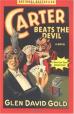
Glen David Gold's first novel, CARTER BEATS THE DEVIL, is wildly ambitious in scope,
weaving the world of vaudeville magicians into the big picture early 20th century history.
Read on as Bookreporter.com writer Bob Ruggiero talks with Gold about his work, pop
culture and all kinds of hocus pocus.
TBR: CARTER is your first novel. Can you give us some information on your writing
background?
GDG: Sure. I wrote several very bad novels that
weren't --- because there is a God --- published. Finally beaten into a sort of humility,
I wrote journalism and memoirs for the East Bay Express, the late, great weekly of Oakland
and Berkeley. In 1995, I started at the UC Irvine MFA program in fiction --- the first
half of Carter was my thesis. Or my dissertation. I seem to have repressed the correct
term. I also wrote a thing or two for television, and because the cops in LA will
pull you over and give you a fix-it ticket otherwise, I have written a few screenplays
that were optioned numerous times.
TBR: This is such a unique idea for a book. How did you form it?
GDG: How many gigabytes can your site hold? The
short-ish answer is that I'm obsessed with the 1920s. Around 1991 or so, I read about
Harding's funeral train leaving San Francisco, which was quite a colorful scene, and at
the same time I discovered a Carter Beats the Devil poster in a poster shop. I started
wondering what kind of life a magician had...and here we are, only ten years later.
TBR: Because many of your "characters" are in fact real-life people, as are
events, how did that challenge or constrict you as a novelist having to keep their
behavior within certain parameters?
GDG: That's a good question. I've been staring at it
for a while now. I have two diametrically opposed answers. One is that I did as much
research as possible into what someone was like and tried to stick with it. Harding is
very much, down to his diction, mannerisms and concerns, the Wurr'n G. of biography. The
other answer is that if I could get away with something far from shore, I tried it.
Geoffrey Wolff, who runs the UCI program, gave me a major permission slip in the form of
"The Public Burning" by Robert Coover, which ends with a scene involving (as I
recall) Richard Nixon and Uncle Sam having sex while Julius and Ethel Rosenberg were
electrocuted. I figured that if no one called him on *that*, perhaps there was a little
wiggle room with the strict truth.
TBR: What kind of research did you do specifically into the life and work of Charles
Carter who, unlike Houdini, does not have mountains of material already written about him?
GDG: That is, in part, verging on the old trade secret
area. I sat in quite a few libraries. I had to buy an enormous number of magic books that
weren't that easily available.
TBR: While some of the historical characters will be familiar to readers, others may
not (Jessie Hayman, Tulang, Borax). Did you ever consider adding some sort of factual
appendix for those whose curiosity is stoked?
GDG: That would be geometrically opposed to my
intentions. A few weeks after I started writing, I began making margin notes on a draft to
keep everything straight for myself --- fact vs. fiction --- but there were two problems
with that: 1) the line between those terms was blurry indeed. There are a dozen caveats,
and if-then statements, and such, but you get my drift, right? 2) I started lying to
myself in the margins about what was real.
TBR: Why do you believe stage magic was so popular as entertainment in the pre-TV and
radio days, and has society become too knowledgeable or jaded about illusions for it to
ever be hugely popular again?
GDG:I have quite a few opinions about that. I think
the answer is overdetermined. Magic is best performed in person. It's intimate. The
greater the distance between you and the performer, the less immediacy, and the duller the
thrill. Magic was especially potent from 1890 to 1920, which was also the rise of the
assembly line and the explosion of technology in every day life. I don't think that's a
coincidence. The current take on Houdini (to use a familiar bloke) is that he railed
against the increasing discontent and sense of confinement that civilization bred.
Magicians certainly blow the doors off reality, and that's still great fun to see, when
you see it done well. (I think crowds today are, frankly, used to bad magicians.)
On the other hand --- and I get into this in the book --- there's an interrelationship
among magic, science and faith that's quite complex. As a society, we really wanted
science to improve our lives, to dazzle us. And if science could create ways to talk to
someone who wasn't in the room, then why not a device to talk to the dead? We really
didn't know what was or what wasn't possible. But that also made people insecure, and what
they really wanted, at the end of the day, was a marvel that science still couldn't
explain. The type of impulse Barnum took such wonderful advantage of. And to see someone
sawn in halves or disappearing or immolating --- well, that looked like it was punching
technology in the eye. Even if it really did rely on physics.
Oh, and they've been predicting the death of magic since 1913 (it's in Carter, in fact).
Somewhere out there, I'm betting there's a six-year-old kid, and maybe she's just getting
her first deck of cards, and she might be a resurrecting force for magic, the way Nirvana
was for rock bands. Go, Kid! I'm rooting for you!
TBR: You say that all the magic in the book was actually attempted. Does this include
the last show with Farnsworth's globes?
GDG: I don't want to ruin the 3rd act, as management
has signs posted warning against that. Suffice to say, next time you're in San Francisco,
pay a visit to Green Street, right about where it intersects with Broadway, and look for
historical markers. You'll be stunned.
TBR: Have you ever attempted to learn magic yourself?
GDG: Yes. I am a clod. There are, perhaps, ways to
dress that sentiment in silk finery, but there is simply no way to hide the bones beneath
it: clod clod clod. Finally, I struck up a deal with Mister Carter. His part is that
he wouldn't try to write a novel.
TBR: What has been the reaction to this book from those in the magic community?
GDG:Magicians have been particularly wonderful and
welcoming. My favorite reaction has been, from several professionals, a head-shake, a
half-sentence of praise, and then, "How did you DO that?" That makes me feel
like dusting my hands together, checking my nails and then (sotto voce) "My work here
is done."
TBR: After such an original and successful debut, where to from here?
GDG: Hey -- thanks for that. Original and successful.
That goes into the scrapbook. Frankly, I'm spending a couple of weeks grinning ear-to-ear.
I spent about five years in a cinderblock basement working on this book, surrounded by
stacks of 1920s magic magazines and wondering if anyone else would ever feel the same way
I do. I've had a great number of happy exchanges with people who truly dug Carter, and
it's the greatest blessing in the world to realize the story touches people.
When the old facial muscles begin to get worn down, I have a new novel to work on.
© Copyright 1996-2009, Bookreporter.com. All rights reserved.
Back to top.
|