|
BIO
Tess Gerritsen is a physician and an internationally bestselling author. She gained nationwide acclaim for her first novel of medical suspense, the New York Times bestseller HARVEST. She is also the author of the bestsellers THE BONE GARDEN, THE MEPHISTO CLUB, VANISH, BODY DOUBLE, THE SINNER, THE APPRENTICE, THE SURGEON, LIFE SUPPORT, BLOODSTREAM and GRAVITY. Tess Gerritsen lives in Maine.
- Visit her website at www.tessgerritsen.com.
Back to top
INTERVIEW
September 12, 2008
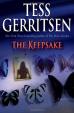
Tess Gerritsen's latest novel, THE KEEPSAKE, marks the return of Dr. Maura Isles and Detective Jane Rizzoli, who investigate a series of present-day murders in which the victims are subjected to ancient methods of burial and preservation. In this interview with Bookreporter.com's Joe Hartlaub, Gerritsen explains how she first became fascinated with archaeology and discusses the real-life inspiration behind her eccentric characters and chaotic settings. She also offers words of advice for first-time writers and speculates on the future of her protagonists in upcoming series installments.
Bookreporter.com: THE KEEPSAKE may be your most chilling novel to date. It begins with the discovery of what is believed to be a mummy --- dubbed “Madam X” --- that actually turns out to be the preserved body of a long-missing woman. As more bodies are discovered, preserved in similarly unusual and grisly circumstances, Dr. Maura Isles and Boston homicide detective Jane Rizzoli attempt to uncover the link among them and the ultimate motive for these crimes. Did you base THE KEEPSAKE on a “true crime?” If not, what was your inspiration?
Tess Gerritsen: THE KEEPSAKE was based on my own fascination with Egyptian mummies and other bizarre ancient death rituals from around the world. I'd read about Egyptologist Bob Brier's experience of mummifying a modern cadaver. When he'd completed the process, the mummy looked very much like an ancient specimen. I'd also been corresponding with an Egyptologist who has been studying mummies using modern CT-scanning techniques, and I wondered: what if a CT scan of an "ancient" mummy turns up a shocking surprise? What if the dead woman is a far more recent murder victim? It allowed me to delve into macabre facts from the archaeological world.
BRC: How did you research ancient and primitive burial practices, particularly bog preservation, that figure so prominently in THE KEEPSAKE?
TG: I have an extensive home library that's focused on just such interesting subjects. It includes shelves and shelves of Egyptology books, plus books on bog bodies, mummies and shrunken heads. I started my research with textbooks and have also visited the British Museum at least half a dozen times. New England (where I live) happens to have a number of bogs, so we also have our own local experts on bog biology and I was able to draw from some of their published research.
BRC: The background story in THE KEEPSAKE indicates that you have more than a passing interest, and familiarity, with archaeology. Has this been a long-time interest of yours, or something that you came to more recently? How did you initially become interested in this? Do you have any thoughts on what might be the most significant archaeological discovery of the past 10 years?
TG: I was an anthropology major in college. My senior project involved the examination and cataloguing of human remains found in North American burial sites, so I spent many lonely hours in the basement of the Stanford University Museum, surrounded by boxes of bones. Although I subsequently went on to become a medical doctor, I've never lost my fascination for all things archaeological. As for the most significant discovery of the past 10 years, I know I'm going to get into trouble with Biblical archaeologists for saying this, but I have been utterly fascinated by the Talpiot tomb, which contained a number of ossuaries bearing inscriptions with the names of Jesus's immediate family. Although the tomb was discovered in the 1980s, only recently has anyone really tried to analyze the tomb findings --- so I suppose that qualifies as a "rediscovery" within the past 10 years. The question of whether that particular cluster of names is significant --- or merely coincidence --- will probably never be answered. Still, it was enough to shake up the Biblical archaeology world.
BRC: Some of the more eccentric characters in THE KEEPSAKE seem amazingly true to life. Are they based after real-world models?
TG: I confess, I often use eccentric people I meet in real life as models for my characters. Perhaps that's why they seem real!
BRC: The Crispin Museum, which figures so prominently in the book, is quite an interesting place, a disorganized, poorly catalogued and maintained collection that nonetheless contains some fascinating specimens. In THE KEEPSAKE, it is located in Boston. Did you create it specifically for the novel, or does a similar place actually exist?
TG: Several archaeologists have told me that museums are often disorganized institutions where items can get lost over the decades. We may be talking about collections that are over a hundred years old, and during that time curators retire or die, and information doesn't get passed on to the next generation. Records and field notes are lost and no one recalls just what's in all those boxes. That last scene in the first Indiana Jones movie, showing a government warehouse filled with forgotten crates, is not all that far from the truth. The Crispin Museum isn't a real place, but it has the characteristics of many an old private museum that's fallen onto hard financial times.
BRC: In THE KEEPSAKE, readers see the return of Anthony Sansone from THE MEPHISTO CLUB. Do you see Sansone playing a more prominent role in your novels in the future? And do you have any plans at this point to perhaps begin a second series of books featuring Sansone and/or the Mephisto Club?
TG: I was fascinated by Sansone in THE MEPHISTO CLUB, and I wanted to see him back onstage in the series. His arcane knowledge of evil and Satanism makes him both a mysterious and somewhat frightening character. So yes, I do see him playing a prominent role in books to come, as another temptation for Maura, but perhaps also as the core of a spin-off series featuring the work of the mysterious Mephisto Club.
BRC: On a related note, the ongoing romance between Maura Isles and Father Daniel Brophy continues in THE KEEPSAKE. What prompted you to start this plot thread in one of the earlier books? And do I sense, perhaps, a triangle forming, with a potential relationship blooming between Maura Isles and Anthony Sansone?
TG: These subplots always seem to start all on their own, without any planning on my part! Maura Isles is a brilliant woman who seems to have it all, but underneath she's lonely and she makes some of the same romantic mistakes that many other intelligent women make. She's fallen in love with an unattainable man. In THE KEEPSAKE, Maura is coming to the realization that her love affair with Daniel may be a dead-end relationship, yet she's having trouble making a decision to break it off. I do think that a triangle could be forming, because Sansone is so darn fascinating --- and a little scary at the same time.
BRC: Writing is said to be a solitary act, yet many authors have a de facto team of “go-to folks” who are the first readers --- “after the author and before the editor” --- to see the manuscript. Did you vet THE KEEPSAKE with others while you were writing it? If so, can you share with us what some of the early feedback was and how it influenced the final manuscript?
TG: I don't vet my manuscripts with anyone until it's in final form. When I think it's polished to the point of being publishable, I send it simultaneously to my editor and agent. At the same time, my husband reads it for typos (he's good at catching those). I've always worked this way, and in some ways I feel that showing a manuscript to someone before it's ready places a jinx on it!
BRC: THE KEEPSAKE, from first page to last, is primarily a thriller, yet there is also a tantalizing mystery --- or two --- at its core. What mystery authors do you feel have most influenced your work?
TG: I'm a big fan of science-based thrillers, and writers like Michael Crichton and Aaron Elkins really showed me how to weave in facts with the thrills. I also have to give a nod to writers that inspired me early on --- Stephen King for his character development, and Patricia Cornwell for demonstrating that a book can be graphic and fascinating without being gratuitously violent.
BRC: Some of our readers may be in the process of writing their first novel. What advice would you give them? Is there anything that you wished you had done differently when you were starting out? And what do you think was the best thing that you did at the beginning?
TG: I would advise them to write the first draft all the way to the end, without any attempts at revising. Too many first-time authors get stuck with repeated revisions of the first few chapters, and they never get beyond it. I find that I don't know what my book is about until I finish the first draft. Only then do I go back and start revising, because only then do I know what needs to be fixed. I wish I had known this when I was just starting out. I ended up writing a number of partial novels that were never finished because they seemed so utterly wretched halfway through. I've since learned that first drafts are always wretched --- and that you just have to ignore their defects and forge ahead. Because they can be fixed.
BRC: What are you presently working on? Do you work on one novel at a time, or are you constantly writing a number of works as they proceed in various stages?
TG: At the moment I'm taking a much-needed sabbatical and mentally preparing myself for a very long book tour. I've written a few chapters of a fun project, something I won't be showing to anyone for a while. When it's further along, maybe I'll be ready to talk about it!
Click here now to buy this book from Amazon.com.
Back to top
INTERVIEW
September 15, 2006
Tess Gerritsen is the author of such bestselling thrillers as THE SURGEON, THE APPRENTICE, THE SINNER, BODY DOUBLE and VANISH. She recently spoke with Bookreporter.com's Carol Fitzgerald and Joe Hartlaub about her latest book featuring Jane Rizzoli and Maura Isles, THE MEPHISTO CLUB, which explores pre-Christian mythological notions of the origins of evil. In this interview, Gerritsen describes her own fascination with the Old Testament and shares rumors of secret organizations similar to the one featured in the novel. She also discusses the complex relationships of her characters and muses on what is in store for them in future installments.
Bookreporter.com: What spurred you to write THE MEPHISTO CLUB?
Tess Gerritsen: I've had a lifelong fascination with ancient cultures and mythology. I came across pre-Christian religious texts that described humanoid demons known as the Nephilim, who are the descendants of fallen angels. The Israelites believed that the Nephilim still live among us, committing acts of violence, and causing misery for mankind. I wondered: What if the ancient belief is actually correct, and there really is a subspecies of violent human beings? What if there's a biological basis for the myth of the Nephilim? It would be a unifying theory of evil! I wanted to write more than just another crime thriller --- I wanted to explore the truly creepy subject of demonology.
BRC: THE MEPHISTO CLUB obviously involved a great deal of historical and Biblical research. Do you do your own research, or do you have a research assistant? Do you research as you write, or complete the majority of this work before you begin?
TG: I do all my own research. I learned how important this is, back when I wrote my thriller GRAVITY, which was set aboard the International Space Station. I tried to hire a NASA engineer as my researcher, but he told me something that I've since learned is very true: that the only way to really understand a subject is to make the discoveries yourself. And while doing the research, I discover facts that often become new and unexpected plot twists.
I do the bulk of my research before I start writing, partly because I want to get the "language" right, and understand the milieu or the time period, and the way characters in that setting would think. Then while I write, I'll also look up facts as they become relevant to the story.
BRC: Have you had a long-standing interest in the interpretations of the Book of Genesis?
TG: I have an interest in all world religions, but I find Genesis and Exodus particularly fascinating, because the stories seem like such wild tales. Burning bushes? Rods that turn into snakes? Plagues of frogs and boils? It's only now, after having been educated as a physician, do I wonder about a scientific explanation for all these unnatural phenomena.
BRC: One of the more interesting aspects of THE MEPHISTO CLUB for me was Dr. Maura Isles and her continuing --- and evolving --- relationship with Father Daniel Brophy as well as her introduction to, and attraction toward, Dr. Anthony Sansone, who plays such a pivotal role in the novel. Both men, in their somewhat different ways, combat evil, while Dr. Maura also fights against the evil that is a part of her genetic heritage. Will you be exploring more of these interesting relationships in future novels?
TG: Oh, yes! Ever since I introduced Father Daniel Brophy in THE SINNER, I've struggled (as Maura has) with his role in her life. It seems like a doomed relationship -- or is it? I just don't know. As I write the books, I'm watching their love story unfold, but I have no idea how it's going to turn out. I'm as much in the dark as they are about their future together. Anthony Sansone is another complication, because I find him incredibly attractive and intriguing, but also a little scary. As the author, I'm torn between these two men, just as Maura is.
BRC: A subtle shift in focus takes place in THE MEPHISTO CLUB, away from Maura Isles and Jane Rizzoli and toward The Mephisto Foundation. Do you have any plans for future novels that will feature The Mephisto Foundation? Have you thought of writing any historical suspense novels that deal with what the foundation has done in previous centuries?
TG: Wow, you must have read my mind! While I was writing THE MEPHISTO CLUB, I kept thinking: "I'm dying to write a prequel!" I'd love to see other members of the Sansone family, in earlier centuries, and how they each struggled with evil. Isabella's son, for instance, in the 1500s. How did he establish this secret society? What agonies did he endure, knowing what sort of blood he was cursed with?
Then there's also the temptation to take THE MEPHISTO CLUB forward, and follow it through the eyes of Lily Saul, the newest initiate. What will be their next battle? I'm salivating at the idea.
BRC: To your knowledge, does such a club like The Mephisto Foundation exist under this name or a similar name?
TG: I have heard rumors that there's a secret organization called the Sons of Jared, who are dedicated to identifying and tracking down the Nephilim. But I have yet to make contact with any of them.
BRC: THE MEPHISTO CLUB is a complete novel in itself, but you leave a number of subplots hanging to be further developed and hopefully resolved over the course of your next several novels. I'm referring to Rizzoli's parents and to the Isles - Brophy relationships. Do you have these resolved in your own mind, or are these plot threads that you still are working on?
TG: I haven't resolved either of these plot threads in my mind. When I write a book, it's as much a journey of discovery for me as it is for my readers, so I don't know what the future holds for either Maura, or for Jane's parents. That's what makes writing so much fun for me. I keep getting surprised!
BRC: One of the elements that I enjoyed the most in THE MEPHISTO CLUB was the use of Italy as a beautiful, yet menacing, backdrop to parts of the story. Did the authenticity and familiarity that you demonstrated in the narrative come from hours in the library or from a boots on the ground visit?
TG: I've been to Italy a number of times. I'd live there if I could. What you describe --- beautiful yet menacing --- is exactly how I see the place. When I walk in places such as Venice or Rome, I'm always aware of the history of violence that still lingers in those streets, those ancient buildings. Terrible things happened there, over the centuries, and I still feel the ghosts.
BRC: A personal question: Rizzoli does not seem to believe in either good or evil as a force unto itself. Isles, although not thoroughly convinced, seems to lean toward a belief in divine goodness and, partially as the result of events in THE MEPHISTO CLUB, a satanic evil. You, as manifested by the arguments laid out in THE MEPHISTO CLUB, seem to be thoroughly acquainted with both positions. What do you believe? Or is your jury still out?
TG: I left the conclusions up in the air, didn't I? I don't know which is the actual reality in the book. Do demons exist? Or are they fantasy? Even my characters can't agree. While I don't believe in demons, per se, I do believe in a biological basis for violence. I believe that murderous behavior can sometimes be passed on. I keep going back to the stories of the Nephilim in those ancient religious texts, and I wonder if maybe the Israelites were closer to the truth than we give them credit for.
BRC: When you are writing, do you only work on one book at a time, from beginning to end, or do you work on two --- or more --- at various stages of completion?
TG: I only work on one book at a time. It takes my complete focus.
BRC: What are you working on now and when can readers expect to see it?
TG: Right now, I'm taking a brief detour from Jane Rizzoli. I'm working on a stand-alone historical thriller, set in Boston in the 1830s. I want to explore what it was like to be a physician back then. It was a really horrific time before anesthesia, when a medical student would have to secretly dig up corpses from graves, just to have a cadaver for anatomy class. The era was already a scary place. Throw in a serial killer, and the story becomes even more frightening!
Click here now to buy this book from Amazon.com.
Click here to get the audiobook from Audible.com.
Back to top
PAST INTERVIEW
August 15, 2003
In this special interview with Bookreporter.com's Suspense/Thriller Author Spotlight Team (Carol Fitzgerald, Joe Hartlaub, and Wiley Saichek), Tess Gerritsen discusses the inspiration behind her latest thriller, THE SINNER, and talks about research methods, fan encounters, and her next book.
BRC: In your essay on our Suspense/Thriller feature you explained that you always had wanted to write about leprosy, and that you saw it was possible to do this in THE SINNER. How much of the book's plot was developed before you added leprosy to the storyline? Or did you start with the concept of leprosy?
Tess Gerritsen: I started out with several different threads I wanted to include in the story. First, I wanted to write about nuns. I've always been fascinated by why a woman would choose to devote her life to a religious order, and I wanted to explore life inside the convent. I knew, right off the bat, that the mystery would open with an attack on a convent --- I just didn't know who the attacker was, or what his motive might be. Second, I wanted to weave into the mystery something to do with leprosy. I had in mind that something the medical examiner discovers on autopsy would provide the key to solving the mystery --- but I just didn't know how that clue would point her in the right direction. So you can see, I really didn't have much of a game-plan to start off with. Just two rather vaguely sketched out elements of the story. In a sense, I worked backwards, building the mystery around the clues, rather than the other way around.
BRC: From leprosy, to environmental issues, to the religious aspects of the story, THE SINNER required an enormous about of research. How do you conduct research for your books?
Tess Gerritsen: I almost always start off simply by reading everything I can get my hands on concerning the topic. For THE SINNER, I read books about women in religious orders --- memoirs, academic studies, and a few historical texts. Next, I spoke to women who had been postulants in various religious orders. I also found several fascinating websites put up by convents, describing their daily routine. For the leprosy information, I relied partly on my own medical experiences, since I've examined leprosy patients in the course of my training as a doctor. I also relied on medical textbooks and historical accounts of leprosy through the ages. I find that research is perhaps the most exciting part of writing a novel, because it's not really work --- it's exploration, and for someone who's as curious as I am, it's like a treasure hunt. You never know what little fact will set off a whole flood of new story ideas.
BRC: THE SINNER is your third novel to feature Jane Rizzoli. What are your plans for the character? Will we be seeing her again in a future book? How about Maura?
Tess Gerritsen: Jane Rizzoli and Maura Isles will both appear in my next novel, BODY DOUBLE. I feel I haven't yet fully explored their characters and I'd love to watch how they grow and develop through several more books.
BRC: You have written that you like to "try to tap into a vein of fear - some premise, some situation, that raises the hair on the back of my neck or gives me a chill." Looking back over the books you've written, which book gave you the biggest chill? Why?
Tess Gerritsen: I think BLOODSTREAM's premise was the one I found personally most chilling --- because it dealt with my fears as a mother. At the time I wrote it, I was having a lot of conflict with my older son, who was a teenager at the time. And I realized that my greatest fear is having my own child turn into some unrecognizable creature. I amplified that into a storyline where the fear is even greater --- that the one you love transform into someone who is out of control and actually dangerous. Yes, of course, I'm afraid of the standard personal danger scenarios --- plane crashes, drowning, etc., --- but the most complex fears, the ones that really play into our emotions and make the best stories, are those that involve love as well.
BRC: Staying on the "fear theme," what other authors and titles have given you chills?
Tess Gerritsen: Mo Hayder's book, THE TREATMENT, was utterly chilling. And Preston and Child's THE RELIC scared me to death. Another scary book that comes straight to mind as super-chilling was Jeff Long's THE DESCENT. I'm not easily scared by novels, and I really do shy away from books that have too much blood and gore. I don't find that nearly as scary as the suspense of wondering: What DOES that monster look like? Once the monster appears, the tension melts away. The most frightening part of a book is before the evil is sighted --- yet you know it's there, and waiting for you.
BRC: Some of your scenes are so intense. While you are writing do you ever need to get up and walk away from the story to get your emotions under control if you are writing something that you know will jar or shake your readers, or can you shrug off what you are writing very easily? How do you relax?
Tess Gerritsen: The odd thing is, when I'm writing scary, intense scenes, I want to just stay at my desk and write. Those are the scenes that keep me moving ahead, keep me focused. It's the in-between scenes, where there's not as much happening, or where I'm building on the story, working toward the next climax, when I find myself taking breaks. I take walks, I read a magazine, I snack. I play my fiddle. I can find plenty of ways to relax. But I'm always hunting for that exquisite moment of tension in a story that will keep me writing.
BRC: West Nile Virus and SARS are two of the current health crises getting a lot of media attention. How closely do you monitor press coverage of medical stories for potential storylines for your future work? Do you contemplate writing about SARS or West Nile Virus in a future novel?
Tess Gerritsen: I read a lot of newspapers and science news, not necessarily for story ideas, but because I'm just curious about what's happening in the world, particularly in the field of medicine. Every so often, though, I'll encounter a news item that will make me think: "Now what IF..." For instance, the stories about Mad Cow Disease a few years ago inspired my book, LIFE SUPPORT. And a news story about creatures called Archaeons, single-celled organisms that live near volcanic vents, was partly what inspired GRAVITY. But I certainly don't restrict myself to science-based stories. Every odd news article, every strange event, makes me wonder how I can use it in a book. At the moment, I have no plans to write about SARS or West Nile virus. But ... you never know.
BRC: You are about to embark on an extensive book tour for THE SINNER, which will take you to Australia and New Zealand as well as U.S. locations. Can you share a favorite fan encounter from your travels over the years?
Tess Gerritsen: Yes! The time a fan practically handed me the premise for my next book. I was on tour for GRAVITY, which is about a biological disaster aboard the International Space Station. This fan said, quite bluntly, "I'm not interested in space stories. I want you to write a book about what I AM interested in." I was pretty taken aback. Imagine a reader commanding you to write something she wants! I asked her, "What are you interested in?" Her reply: "Serial killers and twisted sex." I had no intention of writing any such book. But I kept thinking about those marching orders she gave me, and weeks later, I came up with the idea for THE SURGEON --- all because a reader demanded it.
BRC: There are a number of novelists with medical backgrounds. Why do you think someone trained in the medical field, which is so reality based would be drawn to writing fiction? What authors of medical fiction do you enjoy reading?
Tess Gerritsen: I'm not sure that medical doctors are any more drawn to writing fiction than are, say, lawyers. What doctors do have, though, is a wealth of personal anecdotes and experiences with people. We see so much personal crisis as part of our medical practices. We deal with the dying and the grief-stricken. We watch families trying to cope. We experience the excitement --- and the panic --- of trying to save lives. It's a deep well of material to draw upon that makes doctors uniquely positioned to write fiction. As for which medical writers I like to read, my favorites are Michael Crichton, just for his imagination and creativity in coming up with stunning premises, and Michael Palmer, because he really knows how to thrill.
BRC: Do you watch CSI or other crime or forensics shows? If you watch, do you typically solve the case as the clues are unfolding, or do they catch you like the rest of us?
Tess Gerritsen: I'm sorry to say, I've never watched CSI! Maybe I should one of these days. Much of my forensics information comes from reading scientific journals and articles in the field.
BRC: When can readers expect to see your next book? What can you tell us about it?
Tess Gerritsen: My next book after THE SINNER will probably be released next year. The title is BODY DOUBLE, and it features Maura Isles, who comes home from an overseas trip to find a crime scene in front of her house. A woman has been shot to death in a parked car, and the detectives investigating the homicide are stunned when Maura turns up ... because the dead woman looks exactly like Maura.
Click here now to buy this book from Amazon.com.
Back to top
AUTHOR TALK
August 8, 2003
Tess Gerritsen talks about: THE SINNER
When I sit down to write a book, I try to tap into a vein of fear --- some premise, some situation, that raises the hair on the back of my neck or gives me a chill. With HARVEST, it was the fear of children being harmed. With GRAVITY, it was the fear of being trapped and dying in the claustrophobic confines of a space station. With THE SURGEON, it was the utter terror of waking up in your bed at night and hearing someone walking into your room.
In THE SINNER, I write about something that has terrified mankind for centuries. It was first described in 1550 BC in Egyptian writings. In 326 BC, it was described in Ancient Greece. It is mentioned numerous times in the Bible, where it was thought to be a punishment from God. What was this thing that so horrified ancient man, and continues to terrify us even in this modern age?
Hansen's Disease, otherwise known as leprosy.
Why did this disease --- rarely fatal, and not very contagious --- so horrify the ancients? Why were lepers so feared that in medieval times they were forced to wear a special cloak and ring a warning bell so that others might flee? It's because leprosy destroyed the face and hands. It could transform the most beautiful woman into a monster. Disfigured, cast out from society, the leper experienced the hell of a living death.
I first learned about leprosy when, as a child, I watched that old classic movie Ben-Hur. I was too young to understand what this disease was that the characters were talking about, but I distinctly remember the scene where the Roman guards open the door to a prison cell, peer inside, and recoil in absolute horror. I didn't need to see the object of their horror --- I could hear the fear in their voices, and knew that what they were gazing upon must surely have been frightening. They were looking at the mother and sister of Ben-Hur, now afflicted with leprosy.
Years later, while I was working as a physician in Hawaii and the South Pacific, I examined a number of elderly leprosy patients, irreversibly deformed by their disease. And even though I know leprosy is now treatable with antibiotics, it still gives me chills to think of what it must be like to watch your own fingers and toes melt away, to watch your face slowly collapse.
As a suspense writer, I've long wanted to weave this disease into one of my stories. But only when I sat down and began writing THE SINNER did I suddenly come up with a way to do it. The mystery opens in Boston, where Detective Jane Rizzoli and medical examiner Dr. Maura Isles are appalled by a shocking crime: two cloistered nuns have been brutally beaten by an unknown assailant. Rizzoli and Isles are about to discover that this seemingly senseless crime is in fact the work of a coldly logical mind. And that the disease leprosy will prove to be a vital clue to the killer's motives.
© Copyright 1996-2009, Bookreporter.com. All rights reserved.
Back to top
|