IndieBound Independent Bookstores
Bookreporter.com
Click Here For Librarians Submitting a Book Become a Reviewer FAQ Contact Us About Us
Home Reviews Features Authors Quote Books Into Movies Book Clubs Awards Coming Soon
Search Contests WOM Bestsellers New in Paperback Newsletter Bibliographies Blog


Books by
John Colapinto


ABOUT THE AUTHOR

John Colapinto

BIO

John Colapinto's articles have appeared in Vanity Fair, The New Yorker, Esquire, Mademoiselle, Us, and Rolling Stone. AS NATURE MADE HIM is based on a landmark article published in Rolling Stone, that won the National Magazine Award. John Colapinto lives in New York City with his wife and son. He is at work on a novel.


INTERVIEW

September 5, 2001

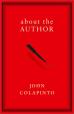
It's a brave man, and an even braver writer, who suggests his reader go check out Grisham if they want a tidy, happy ending; who reminds us that fiction is of "absolutely NO use to anybody"; and who insults Rick Moody, The New Yorker and Yaddo in one, foul swoop. That man, dear readers, is debut novelist John Colapinto, author of ABOUT THE AUTHOR. Read on as Colapinto and Bookreporter.com's Chuck Leddy discuss the wonders of professional jealousy, the coincidental similarity between ABOUT THE AUTHOR and Tolkin's THE PLAYER, the futility of "nailing jello to the wall" and much more.

TBR: Why does Cal describe himself as a "writer" when he can never seem to write anything? Is he just assuming a false identity?

   
JC: Cal is doing what thousands --- perhaps millions --- of people do around the world every day. He tells himself that he's soon going to write some scintillating fiction, and thus flatters himself with the title of "writer."

He has grown the necessary beard-stubble. He has donned the necessary thrift-shop jackets and smokes the requisite unfiltered cigarettes. He drinks in the right bars and is spotted at the correct hipster cafes. And he talks and talks and talks about all the writing he's going to do. You see countless pretentious frauds like this every day of the week in downtown New York. So Cal isn't really too unusual. What makes him unique is that he is confronted with the perfect opportunity to finally become a published writer, despite the fact that he can't actually face the task of writing.

TBR: Is writing harder than people like Cal imagine?

JC: Cal knows how hard it is, and that's why he's so careful never to try.

TBR: Where did you get the inspiration for the fast-talking, rapacious literary agent, Blackie Yaeger?

JC: Blackie is an amalgam of literary agents I've met and heard about and read about. I'd be disingenuous if I didn't admit that he bears certain resemblances to a man named Andrew Wylie, whom I've never met but who got much publicity for being a shark in the 1980s and mid-1990s. But mostly he's a figment of my imagination and bears no real resemblance to any agent that has ever lived. And if you believe that...

TBR: Much of what motivates Cal is envy. What's the source of this literary envy?

JC: Literary careers are so incredibly precarious. To get published is greatly against the odds; for your work to be considered good is equally unlikely, and for you to sell enough books to become "successful" is virtually unheard of in all but the tiniest percentage of people who write. So given the fundamental insecurity of trying to exist as a writer in a deeply competitive industry, it stands to reason that writers view their potential rivals with all the slitty-eyed fear and aggression of primitive beasts battling for survival on the Darwinian veldt.   

TBR: Cal steals his dead roommate's novel and then his identity, yet the book is a black comedy that ends happily for him. What do you tell readers who think Cal has gotten off too easy?

JC: I tell them, "Tough luck" and that if they wish to read a book that flatters their conventional moral scheme and that metes out the "proper" punishments to its characters then they should read some Harlequin romances or perhaps some Grisham.

TBR: How have your own experiences as a writer prepared you to write about Cal as a "writer"?

JC: Like Cal, I know all about procrastination, and all about the fear of setting words on the page. In creating Cal, I drew on my own experiences as a 23-year-old bookstore stockboy who yearns to write. The difference is that I actually did so, once in a while --- though I was, as Kingsley Amis once said of himself, "abnormally unpromising" for a long time.  

TBR: Do you classify your book as:  A thriller? A satire? A twisted How-To Guide to publishing?

JC: It's all of the above, really. To be honest, I actually thought of myself as using the thriller format to smuggle in a bunch of things I would have wanted to put into a more "serious" work. I'm not a reader of thrillers, except for a select few of Patricia Highsmith's novels, and I don't think of ABOUT THE AUTHOR as a genre novel. I also don't really think of it as a satire. Obviously it has some sardonic observations on the state of publishing in America, but I hope that my novel is more than that dull old chestnut, the "insider book satire."

TBR: Your first book, AS NATURE MADE HIM, was a critically and commercially successful work of nonfiction. How was writing ABOUT THE AUTHOR different?

JC: I actually began writing ABOUT THE AUTHOR over ten years ago, so it is actually the first book I ever wrote, even though it is being published second. It was a completely different experience from my nonfiction work. With journalism you're always able to steer by the facts --- you never really lose the thread of the story, and you know how it all works out in the end. Sure, you can get blurred in your focus, or lose the tension in the narrative line, but with some judicious editing and a closer look at your interview transcripts, you can always haul the thing back on course. With a novel, you're completely out of luck. You have only your dreams and fantasies and imagination to go by --- and we all know how mutable and ephemeral those things are. You're trying to nail jello to the wall, or sculpt clouds into a cathedral. Plus, of course, there is always the hovering realization that what you're writing is of exactly no USE to anybody. So the spectre of futility haunts all those hours at the desk, as your bank account slowly dwindles...

TBR: ABOUT THE AUTHOR is filled with literary references --- Dreiser, Dickens, Nabokov, Shakespeare, etc. Who do you read for pleasure?
   
JC: I read Nabokov, Updike, both Amises (though mostly Martin, these days), and have lately discovered how good Julian Barnes is. I'm reading Flaubert's SENTIMENTAL EDUCATION and am amazed how much better it is than the overrated MADAME BOVARY. I don't read popular fiction and I find it impossible to read the hipster novelists of the day --- your Rick Moodys and so on. Oops! There goes my invitation to Yaddo. Or to publish in The New Yorker...

TBR: Several people have said ABOUT THE AUTHOR is reminiscent of Robert Altman's film, The Player. Were you conscious of the similarity while you were writing or was this just a coincidence?  

JC: I was about half-way through the actual writing of my novel when I realized its affinities with THE PLAYER --- specifically the notion of my hero meeting and marrying the woman who had been the lover of the deceased person who haunts his conscience. But I had dreamed up the plot and written down the outline of my novel in March of 1987, some five years before Altman's movie was released in 1992, which is when I also read Tolkin's book. So for me, there was disappointment and chagrin to discover that someone had already used a plot device I had dreamed up, but luckily I did not have to suffer any Cal-like feelings of guilt that I had lifted someone else's idea. And since I had come up with the notion independently of anyone else, I felt no hesitation about using it.  

TBR: Now the inevitable, and final, question: Any advice for the unpublished author who yearns (as Cal does) to break into print?

JC: There's no trick to it whatsoever. You simply sit all by yourself in a room, staring blankly into space, until you come up with a story and characters and theme and setting that will hold your interest for the several years of trial and error scribbling that goes into writing a novel. No one cares if you ever finish it --- or indeed, if you ever start it --- but you must persevere against the world's total indifference, as well as your own feelings of bucking panic as your bank balance dives toward zero, as your parents demand to know why you're screwing up your life, and as your friends proceed confidently and lucratively up the corporate ladder, marrying and having kids, while you sit in hunched and lonely despair in your crappy apartment, all alone, growing old. Come to think of it, if you do happen to find yourself in Cal's situation, with a fat manuscript to steal from a deceased writer --- grab it. That's probably the best advice I could give.

© Copyright 1996-2009, Bookreporter.com. All rights reserved.

Back to top.