IndieBound Independent Bookstores BRC Facebook Fan Page
Coming Soon Page
Bookreporter.com
Click Here For Librarians Submitting a Book Become a Reviewer FAQ Contact Us About Us
Home Reviews Features Authors Quote Books Into Movies Book Clubs Awards Coming Soon
Search Contests WOM Bestsellers New in Paperback Newsletter Bibliographies Blog

Mark Bowden

BIO

Mark Bowden is the author of BRINGING THE HEAT and DOCTOR DEALER, as well as a reporter for the Philadelphia Inquirer. He has also written for Men’s Journal, Sports Illustrated and Rolling Stone. The original series of articles which became BLACK HAWK DOWN earned him the Overseas Press Club's Hal Boyle Award. He lives in Philadelphia.


INTERVIEW

November 12, 1999

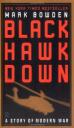
What would it be like if you decided to write a story about an epic battle in which you were not involved? How would you go about navigating the convoluted (and potentially dangerous) political and military channels to get the facts? Veteran writer and reporter Mark Bowden, author of BLACK HAWK DOWN, offers his views to TBR Writer Adam Dunn. This retelling of one awful night in 1993 in Mogadishu during Operation Restore Hope won Bowden the Overseas Press Club's Hal Boyle Award, and made him a finalist for the NBA in nonfiction. Read this interview to discover the story behind the author of this thrilling award winning book.

TBR: Tell us a bit about your decision to write this book, considering your distance from the battle both physically and temporally.

MB: I explain in more detail in the epilogue how I got started on it. But in summary: I'm a writer; I look for good stories. When I read initial newspaper accounts of this battle, I was struck by the image of 99 American soldiers trapped and surrounded and fighting for their lives over a long, long night, and I thought what an amazing story it would be if I could talk to those men who were in that situation and write about that experience. And that idea was the germ of BLACK HAWK DOWN.

TBR: How did you decide on the interviewees who appear in this book?

MB: I started by trying to find the men who were there, the American soldiers who were there, and my first twelve interviews were with twelve Rangers down at Fort Benning, Georgia, arranged for me through the Special Forces Operations Command media affairs office. Each of those twelve guys gave me the names and numbers of friends, some of whom were in the Army still and some of whom were out of the Army, and I took off from there. I was amazed and delighted by how many soldiers who fought that day I was able to track down, and how eager they were to talk to me. And from there it was a logical next step to try and find some of the Somalis who fought against Americans so that in writing about the battle, ideally you'd like to be able to tell the story from both sides. And I was able to convince the Philadelphia Inquirer to send me to Mogadishu to find Somalis who had fought that day, which I was able to do, and interview them. From there, after I got back from Somalia, there was a lot of interest in talking to me, by higher-ranking people in the Clinton administration and also in the military, because they were curious about what I'd found when I went to Somalia, because to my knowledge no one had gone back to study this battle since it happened. So I ended up gaining access to very high levels of military and government decision-making which at the outset I never foresaw.

TBR: How did you get interviews with the "D-Boys" (the super-elite Delta Force operators), let alone those who revealed their identities?

MB: Well, a couple different ways. The big breakthrough for me came when one high-ranking military officer was kind enough to give me a list of Delta operators who were no longer in that unit, who he said I was free to contact to see if they would talk to me. Because apparently when they leave the unit, the restrictions on their talking about it are somewhat more relaxed. So I began calling down these names, and every one of these guys, when I found them, would say: "Sorry, buddy, I can't help you," or "You got the wrong guy." But I got to Sgt. Paul Howe, a master sergeant who is now teaching in the ROTC program in Texas, and working on his master's degree, who decided he wanted to help me. So he got permission from the Army to be interviewed, which is why I was able to use his name, and we talked on the record. I visited him out in Texas, we talked at length on several occasions, so that was really the most important thing. And then I also was able to obtain the written accounts of six or seven of the Delta operators who each sat down in the days after battle and wrote out fairly extensive accounts of their own actions during the fight. So I was able to draw on that material, so some of what you read in BLACK HAWK DOWN comes from their own written statements which have their names right there. And thirdly, some of those guys in that unit found ways of communicating with me because I think there was such an overwhelming desire to set the record straight. In the Army the battle of Mogadishu had come to be seen as a catastrophe and had become a kind of black mark on the careers of some of the men who'd been involved in it, mostly out of ignorance about what actually happened there. So there was a very strong desire on behalf of these men, which in some instances overcame their commitment to total secrecy.

TBR: How did you get interviews with the international military commanders overseeing the operation?

MB: For the most part, they were very eager to talk about this. What I've found with the military is that they have a great deal of suspicion and distrust for the media. But if you demonstrate to them that you know what you're talking about, and that you're willing to go to great lengths to find the truth, and you don't have any apparent agenda in doing so; I found a great willingness to trust me and give me information to ensure that my story would be accurate.

TBR: How did you get interviews with American politicians, considering the sensitive and embarrassing nature of the material?

MB: I think that any responsible public figure or leader in this country wants to know the truth about what happened and, if you're going to make decisions about these things that affect people's lives, I think you're primarily concerned with what decisions were made, rightly or wrongly, so that you can learn from them. There is a certain kind of person who would place his own career over and above a desire to better understand what happened, but most of the people I met in the military and in politics seemed genuinely interested in learning what exactly happened there so that when we face these kinds of situations in the future, they can make better-informed, wiser judgments.

TBR: How did you get interviews with the Somali fighters who appear in the book?

MB: I contacted a fellow in Washington named Ali Gulade who purports to be the ambassador to the US from Somalia. He's a member of the Habr Gidr clan and I interviewed with Ali in an effort to find someone who could act as my guide, provide security and translate for me, which is no easy thing. You can't just buy a ticket on an airline and fly in there. And you don't want to charter a plane and fly in yourself, because it's a very dangerous place with armed factions everywhere and lots of mercenary outlaws roaming the country. Just going in with cameras would make you a target for kidnapping or worse, so you need to provide some sort of security for yourself. So I made those arrangements. My avenue into Somalia was on a khat plane. Khat is this plant that looks like paisley or watercress that Somalis buy by the fistful and chew the stems, which has a mild amphetamine-like effect. If you chew it long enough, I imagine you get the equivalent of four or five stiff espressos coursing through you. It's a very popular drug over there. I paid my weight in khat, meaning I diminished the khat supply that day by about 200 pounds, because what they did was offload 200 pounds of khat so I could sit in the plane. I paid for myself as if I were khat in order to get into the country--I don't want to be accused of pushing khat!

TBR: What sort of vetting process did the manuscript undergo prior to publication?

MB: I wrote it initially as a series for the Philadelphia Inquirer, so it went through editing and copyediting and legal review that all major projects go through before they publish it. At the same time that it ran in the paper, it was also published daily on the Internet.  So for 30 days, during the lifetime of the newspaper series, I would be getting daily e-mail responses from readers, many of whom were members of the units that I was writing about. So from day one I was getting peppered with suggestions, corrections, arguments, whatnot, so in the cases where I'd made mistakes I was able to correct those right on the Internet site. In the cases where suggestions were made, like additional people I needed to talk to, a number of people surfaced whom I had not yet interviewed.  Through the discussions we had online over the life of the newspaper series, I learned a great deal. It was probably the most thorough and effective vetting process that any story I'd ever written had ever gone through. It was only at that point that I began to expand the newspaper series into the book BLACK HAWK DOWN, which subsequently went through more editing and copyediting at Grove Atlantic before it was published in book form.

TBR: Were there any attempts to block publication?

MB: No. None.

TBR: Since publication, have you or the publisher received any threats, or had any trouble from intra- or extra-governmental sources?

MB: No, to the contrary. Personally, I've received nothing but an outpouring of enthusiasm and gratitude from the military and also from Somalis who have phoned or written me. I have yet to hear an angry word from anyone.

TBR: Have you remained in touch with any of the surviving Rangers since you began your research?

MB: Many of them.

TBR: Would you say they've healed since the battle, physically and mentally?

MB: I'm not qualified to say mentally, but physically yes. It seems to me that most of those that I know are doing remarkably well in adjusting. I think the airing of the book has been tremendously helpful to a lot of the guys. I say that because they've communicated that to me in person and in letters and e-mail about how grateful they are that people acknowledged that this happened, and that when they talk to people about what they went through now, there isn't the same kind of blank stare that they used to get. More people are aware now what these men went through and what they lost. In all honesty I suspect that a lot of these guys will continue to wrestle with memories and trauma as a result of having been through this experience for the rest of their lives, just as soldiers have always had to do.

TBR: What writers and books have inspired you?

MB: John Hersey. His book Hiroshima is one of the early examples of powerful nonfiction writing; I probably read it when I was in high school. I first became acquainted with George Orwell's writing through his essays, and only later read his journalism, like Homage to Catalonia, which was his account of the Spanish Civil War, which was an amazing book. I was very much influenced, though not stylistically in the case of BLACK HAWK DOWN, but in terms of the kind of nonfiction storytelling that I like to do, by Tom Wolfe, Norman Mailer, Guy Talese, John McPhee, I'm probably leaving out four or five important writers. Peter Mathieson is someone whose nonfiction writing I've greatly admired. Those are some of the most important.

TBR: In terms of writing as an act, can you explain how you first envision a project, plan to structure it, and then think about the sort of language you like to use, the tone you like to strike?

MB: That's a really good question, and it's one of the most important first steps you take when you first decide to write a book. In the case of BLACK HAWK DOWN, I tried to adopt a narrative style appropriate to the subject matter I'm writing about. So for instance my previous book, called BRINGING THE HEAT, is about a professional football team. I was writing about the lives and careers of the players, coaches and owners of the Philadelphia Eagles. I felt I'd spent three years with the team and spent a lot of time with these characters and had a lot of personal observations and so the appropriate way to write that book, I felt, was with a strong personal narrative presence. So I wrote it much more in the style of Tom Wolfe, so that the voice of the narrator is an important part of the telling of the story. In the case of BLACK HAWK DOWN, I think that because of the importance and dramatic nature of the material, as well as the fact that I was not there personally, so I had no observations of my own to add that were of any consequence.  I made the decision very early on that I was going to withdraw myself completely from the narrative of this story and tell it through the eyes of the men who were there. So I chose a very stripped-down, simple narrative style where I let the prose be influenced by the way that the Rangers or the D-Boys speak, because I wanted the book to capture this experience through them, not them filtered through me. The book was criticized in some quarters because it wasn't written in the style of typical journalistic commentary interspersed throughout, with the material filtered through my own narrative voice. But I'm very comfortable with that decision.   I think it was the right one, and I think it's a big reason for the success of BLACK HAWK DOWN.

TBR: What is your next project, can you tell us about it?

MB: It grew out of my reporting of BLACK HAWK DOWN, and it involves the effort to track down and kill Pablo Escobar in Columbia in 1993. It is one of the great outlaw stories of the 20th century, because you had in Pablo Escobar the richest and most successful outlaw probably in history; someone who'd become so dangerous and powerful that he'd become bigger than the country of Columbia. They were no longer capable of bringing him to justice. My book will involve the effort the US made in cooperation with Columbia to kill Pablo Escobar.

TBR: Will that be published by Grove Atlantic as well? Are they doing the paperback of BLACK HAWK DOWN?

MB: The paperback is being published by Penguin in March 2000, and the new hardcover, tentatively titled Killing Pablo, will run as a series in the Philadelphia Inquirer, and then be published by Grove Atlantic like BLACK HAWK DOWN.

TBR: What are you reading now?

MB: An advance copy of a book by John Katz called GEEKS, which is an account of an emerging subculture of young people who are experts at computers, the Internet and the whole cyber-world. I just finished reading Roddy Doyle's new novel, A STAR CALLED HENRY, and I just started a book titled THINK, which is about issues in modern philosophy, which is by Simon Blackburn. It's an extremely well-written and concise collection of essays and lectures on some of the more interesting and central issues of our time.

TBR: What are your thoughts on the millennium?

MB: I think it will take some getting used to --- writing "2000" after spending 48 years writing "19-".

© Copyright 1996-2010, Bookreporter.com. All rights reserved.

Back to top.