IndieBound Independent Bookstores BRC Facebook Fan Page
Coming Soon Page
Bookreporter.com
Click Here For Librarians Submitting a Book Become a Reviewer FAQ Contact Us About Us
Home Reviews Features Authors Quote Books Into Movies Book Clubs Awards Coming Soon
Search Contests WOM Bestsellers New in Paperback Newsletter Bibliographies Blog


Books by
Julia Alvarez


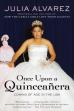
ONCE UPON A QUINCEANERA: Coming of Age in the USA

Julia Alvarez

BIO

When she was ten years old, Julia Alvarez's family had to flee the Dominican Republic because her father had been involved in a coup against dictator Trujillo. Four months later, most of her father's co-conspirators were killed.  

These dangerous times and her experience of exile were formative for Alvarez as a writer: "What made me into a writer was coming to this country . . . all of a sudden losing a culture, a homeland, a language, a family . . . I wanted a portable homeland. And that's the imagination." Exile became the basis for two of Alvarez's best-selling novels: HOW THE GARCIA GIRLS LOST THEIR ACCENTS (1991) and its sequel ¡YO! (1997). Her father's revolutionary ties inspired IN THE TIME OF THE BUTTERFLIES (1994).  

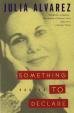
Those novels have won many honors, including the PEN Oakland Josephine Miles Award, ALA Notable Book of the Year, American Bookseller's "Top 10 Books to Discuss" and finalist for the National Book Critics Circle Award. They have been translated into nine languages. SOMETHING TO DECLARE, Julia Alvarez's first nonfiction book, a collection of her best and most influential essays, was published in 1998.  

She has also published several volumes of poetry: THE HOUSEKEEPING BOOK (1994), THE OTHER SIDE / EL OTRO LADO (1995) and HOMECOMING: NEWSELECTED POEMS (1996). In 1997 she was featured in the New York Public Library's exhibition "Original manuscripts by 100 Masters, from John Donne to Julia Alvarez."  

Her writings have been published in a great range of periodicals, including The New Yorker, The New York Times, Hispanic Culture Review, Latina, Conjunctions, USA Today, The Washington Post Magazine, and The American Scholar. She is featured in The Norton Anthology of Contemporary Fiction. Julia Alvarez graduated from Middlebury College and received an MA in creative writing from Syracuse University. She teaches English and creative writing at Middlebury College.  

Among her many honors and awards are a Doctor of Humane Letters, honoriscausa, from the City University of New York and the Alumni Achievement Award from Middlebury College in 1996. The Dominican Republic's Annual Book Fair of 1997 was dedicated to her work. For the 1997-98 term, she was elected to the Member's Council of the PEN American Center.  

Her latest work of fiction is called IN THE NAME OF SALOME.

INTERVIEW
September 22, 2000

Julia Alvarez' latest book, IN THE NAME OF SALOME, is based on fact but spun with her talented fictional fingers. The book follows Camila Ureña to Havana where she meets up with her brothers and revisits memories of her mother, Salome, whose poems during the Dominican Republic's revolution made her a literary and political legend. Alvarez did extensive research for this ambitious novel, even making a sly journey to Cuba. Find out about the priceless gift she was given by the city historian in Santiago, her life growing up in D.R. and the United States, how she became so intrigued by Salome, and much more in this in-depth interview led by Bookreporter.com's Jana Siciliano.  

TBR: IN THE NAME OF SALOME is the story of a mother and daughter and the legacy that they share, which intersects in many places, to the upheavals in the history of the Dominican Republic. It's also based on a real woman poet, Salome Urena, whose poems were an inspiration to the Dominican Republic in the late 19th century. What was it about Salome that inspired you to write this book about her and her daughter?

JA: I think it's any number of things. I initially became interested in the life of this woman, Salome, because here she was the first person ever to win a national medal in poetry in a country where machismo is STILL rampant. In those days women weren't even taught how to read and write, so they couldn't even respond to love letters. A woman of humble origins, a woman of color, a woman who would become the national poet! This was like the voice that was giving identity to the country. The country was only six years old when she was born. I was really interested in what she might have been like; and the way that you do a novel, you become interested in a character, you don't know if it will hold for the two or three years that it takes to write a novel. And then the discovery that she had a daughter who was her opposite --- very restrained, seemingly apolitical --- a woman who was not a woman who went out and expressed her passions, and lived a life of caution and safety, and had been a professor in the United States teaching Spanish for many years. It seemed to complicate the story and made it more interesting for me. And it was a time in history which also interested me --- 1850 to 1973 when Camila died, more than a century in which that other America, "nuestra" America, was struggling to find itself. There were so many revolutions, so many changes in government, so much going on and here were these very different types of women whose lives intersected with this history. It was a combination of things. I am very interested in mothers and daughters and daughters who have problematical histories with their mothers. Camila had an icon for a mother!

TBR: Camila, Salome's daughter, is a lesbian: closeted, unfulfilled in love. Your characters are usually active heterosexuals engaged in various stages of romance --- what was it about a woman whose love life was full of loss and secrecy that you wanted to explore? Was it difficult for you to investigate such a guarded life?

JA: Oh, very difficult. It was very difficult for a number of reasons. You don't like to say that you are compelled to write about a character because they're gay or not gay, heterosexual or not heterosexual. You tend to get involved inside this character who captivates you and these things...it's like falling in love with a person and finding out all kinds of things about them. Camila never made commitments to male or female --- she was so involved with her imagination, with a figure she had lost that had become so huge in her mind. It was hard for her to connect with anyone. My theory is that Camila's real orientation was asexuality. She played with the possibilities and certainly her most passionate connection was with Marion, a woman, but she doesn't clearly come down on one side or another.

TBR: It seems very tragic. She has such a rich inner life for herself but doesn't feel the ability to share it in an intimate way.

JA: She made a connection at the end in a way to the same thing. This is what startles me --- a connection very much like her mother's. The structure of the novel is like they are mirror images but they're reversed. She finds her voice later in life, like Grace Paley's ENORMOUS CHANGES AT THE LAST MINUTE. Camila was affected by so many things: by her color (she is white enough to pass and yet she had this other heritage in the America she came to), the enormously big void she was left with by Ancho, who was the Matthew Arnold of Spanish letters, making her like Shakespeare's sister. She was hemmed in so many ways that she was closeted and to just focus on the sexual closeting is just one of the many ways in which she was contained --- like a woman of the 19th century world coming into the 20th century world, a long time to come forward to who she really was. I think that bothers my readers --- I've heard it criticized that people get impatient with her.  

TBR: It's a very human story but you see a potential for her to live a certain kind of life and you know you can't help them, but at the same time you can't help that urge to push them forward. While visiting Cuba to discuss Camila's life when she returned to Havana, what was the most fascinating thing you learned about her?

JA: A number of things. I went there because there was so little that she left behind, unlike her mother who was a writer, and there were commentaries and memoirs and everyone's memories of that time mentioning Salome Urena. Camila was very invisible. At one point towards the end of her life her students wanted her to put together her lectures and she said, "There are enough writers in my family. The world doesn't need one more book." The only thing I knew about her was references to letters and things in the national archives in Cuba. The interlibrary loan people at Middlebury tried to get them for us --- but why should Cuba send their treasures to the US who has them under embargo? There was no response. [One of the librarians] made a kind of joke and said, "You know, Julia, you're just going to have to go there." And I thought, why not? I didn't know how hard or easy it would be. I know I could go through the D.R. because they won't stamp your passport. But I knew [it could be trouble] if you were caught. There are monetary penalties and it's considered a crime [by immigration]. I applied for permission from the state dept. My husband got to come along, too, as a photojournalist. At the National Archives, I was lucky enough to discover a notebook of hers with poems that she had written and under each one little initials, the initials of two of her brothers who she had sent them to in order to get response from them, and written in a neat little hand in pencil their little capsule response to the poems. In the back there were letters her brother had written her, with URENA on the letterhead in big letters, obviously responding to some question she had asked about whether she had promise; and he said she wasn't a good enough poet for her to continue writing on her own pleasure. And I thought how hard would that have been. Here's a brother who's got the clout and renown of being a big critic of the time so that was quite a discovery for me: a way in which Camila had been silenced in her efforts to discover a voice when she was younger.

TBR: When you went to Santiago, Cuba, the city historian Ricardo Repilado supplied you with not only great information about the Urena women, but he also surprised you with a special gift? Can you tell our readers about it?

JA: First of all, I was taken with the fact that he was willing to meet me. He explained over the phone that he was lisping badly because he didn't have any teeth. They had been removed and, because of the embargo, he was promised teeth but he had been waiting for months now for a set of teeth. He was very good-natured about it but he didn't want to be seen publicly without his teeth. I had to explain that I only had a week in Santiago and I would love the chance to meet with him because I discovered, as we spoke, that he had been one of Camila's first students in Cuba. He had a perspective of Camila that was from when she was much younger, which I had no sense of; so I met with him and he had a book of Salome's poems, a 1920 edition [there had been an 1880 edition while Salome was still alive and right after she won the national medal and after that there was nothing]. In 1920 her son put together an edition of her poems and [RR] gave it to me. I felt so moved but I didn't want to take it. In a country that has so little of everything, including books, that he would give me that --- I felt I couldn't take that. He said, "I am an old man" --- he's in his eighties --- "I am going to die soon and there is no one around that I can leave this book to who will appreciate it as much as you. So take it with you." It was sitting here next to my computer as I worked as a kind of talisman. That's so typical of the Cuban people --- a country where there is so little and there is such a generosity and ability to survive and endure and still be resilient. It reminds me of the [20th century Russian poet] Akmatova poem where she writes that she never left Russia: "I am not one of those who left the land to the mercy of the enemy." From 1922. And she said about the people who stayed behind in a difficult situation: "We are the people without tears. Braver than you. More proud." Are you familiar with her work?

TBR: No, but that's very chilling.

JA: She makes the point that she was not one of those to desert her country. And that's the sense I have of a lot of the people I met in Cuba. Even with their complaints about the present regime, they have a real connection to the process, which I really discovered about countries and nations --- it's a dedication to the process of unfolding an identity, more than a dedication into a person or icon, which is what patriotism is to me.  A lot of people ask me how I can be writing about these women who were nationalists at a time in history when we're all so weary of ethnic cleansing and borders. I think that that is precisely what they were dedicated to, the process of discovery of what a people are and how they shall be ruled --- it's a constant process, not an answer.

TBR: That's a far more progressive definition of patriotism than we are used to thinking of in the US. Speaking of that sense of national pride, who is now the national poet of the Dominican Republic? How does this artist's impact on society differ from the explosive impact that Urena made on her world at the time of her position?

JA: I don't think there is one anymore. When I saw that question, I wanted to find an answer to it. But I think there are things now like a national prize in poetry every year and a book fair that is dedicated each year to one particular writer. There isn't that sense of a national forum. Salome got that medal by subscription --- they had to pay for her to have this position bestowed on her and then support it. Pedro Mir, who lived many years in exile and recently died, was a voice during the dictatorship. He kept the faith and wrote out of a certain historical period trying to understand the people without falling into a patriotic rant or polemics. A difficult line to walk. There have been figures like that, but I think there are too many poets and no one person who you could say has that national voice. It's more in music now --- lyrics that would be considered more like the popular voice. Like in the 60's --- with Bob Dylan and the Beatles.

TBR: On the subject of dictatorship, did you mean for IN THE TIME OF BUTTERFLIES and most of your other work to illuminate the tragic, historic events of the dictatorships in the D.R. and Cuba for American readers who have been closed off to all but the most basic details about life under those circumstances?

JA: To be honest, I am a storyteller and my first commitment is to tell a good story and tell the story that is in me to tell. But because of who I am, where I come from, what my heritage is, the stories I have to tell come out of a certain history, background and a certain spot on this earth which is to say that it is coming out of my own Dominican, Dominican-American background. Just like Hamlet is not about what it means to be Danish. It goes down into those regions that all of us experience --- what does it mean to be a human being. For my characters, it's just played out on a different landscape. It's still for me the human experience.

TBR: What about your return to the Dominican Republic most shaped your work as you were growing up?

JA: I left the D.R. when I was 10 and by the time I was 15 we were going back regularly during the summers, my sisters and I; and when we got older, we went back to work on projects. I am running an organic coffee farm, growing organically and getting out of the agribusiness grid, so we spend a lot of time down there because we have gotten involved in this project; we have land in the cooperative. My formative years were spent in the United States and, as a child, I didn't grow up thinking I was going to be a writer. I grew up in the D.R. very poor in culture --- I didn't know any readers; it was sort of an antisocial thing. We had two readers in the extended family --- our culture is out there, social, and to go read in a corner was considered strange. I didn't grow up with a lot of books around or readers around and I think my love of storytelling came from the oral culture around me. When I came to this country, I became a reader. When you become a reader, many times you have the desire to write as well, to tell your story. I came to reading late but I came to the profession early and by the time I was 15 or 16, I wanted to write down stories and create these things with language that made meaning. For me, the imagination had become a portable homeland, a place you didn't have to lose, a place that was set for everyone. It wasn't a nation that some people were welcome at and some weren't. We experienced a lot of prejudice in those years --- and reading was a place I was welcome in.  

TBR: You've said that Emily Dickinson and Jane Austen are some of your favorite English language writers. Who else kicked you into gear as a teenage reader?

JA: It's been different people because I started out wanting to be a poet. So I was reading mostly poetry. I was totally taken with Walt Whitman. He was the most Latino-American (laughs) voice I ever heard, wonderfully florid and musical, and [he was] a man of expressive gestures to me. I was taken in by his voice. The opposite voice was enthralling --- Emily Dickinson, with her probing and sassiness, linguistically anyhow --- and discovering Neruda, someone in my native language who was really a wonderful model for me. In terms of prose, I went to college during the early 60s before the multicultural literature and women's studies [were popular] --- I read the canon and got a very limited education but I learned the tradition. Out of college, I had to educate myself in terms of what books had been missing ---discovering African-American literature --- Toni Morrison, Alice Walker, Zora Neale Hurston --- the fact that these other voices and other experiences could be part of American literature and not just sociology. Maxine Hong Kingston's THE WOMAN WARRIOR was such an eye-opener to me. Oh, my God! The realization that you could make American literature out of [experiences that were] not mainstream literature like I had been led to believe was the subject of sociology. It gave me a great sense of permission. So many Latina writers will tell you that that was the book that did it.

TBR: How do you feel about there being a "multicultural" literary canon with your books as an essential part of that in the United States?

JA: As a person who grew up with a canon that left who I was out, I am very wary of canons in general. I don't feel comfortable with the sense that there are these iconic works and some are worthy and some are not. It's always problematical for me --- I would rather think of the work, a story in process to which we are all contributing. But Jean Rhys said to a young writer, "Feed the sea." We are all feeding that. Even someone whose work may be considered minor or may not turn out to be some great writer over time, maybe that's allowed someone else's work which will be a work carried down over generations to exist. A canon means something is being left out, but a lot of things left out have to do with politics and who is in control of the opening and closing of those doors. It's like that Indian story in which a woman wants to touch the sky and, when she finally touches the sky, the sky asks, "How did you get to be so tall?" And she replies that she is standing on a lot of shoulders. That's the way I see it. There is a lot of gratification being included but when I hear people say 'canon,' I just want to run. [That sense of inclusiveness] is problematic to me.

TBR: In SALOME, Camila seems to have enjoyed her long career as a teacher because of her love for her students. As a teacher and a writer, what do you learn from your experiences with students?

JA: I think that young, inquiring minds that have not bought into one canon or another in terms of their minds keep you honest. They ask you questions, they challenge, they sort of force you out of the things that you have set in your mind. And it's refreshing. Working on someone else's work, trying to enter into it to fix the problems of vision and tone that they encounter is a way of working on your own work. That certainly happens with my students and more and more I am interested in less traditional kinds of classrooms. What we're doing in the D.R. is to form a foundation with the profits of the organic coffee we're going to sell to fund a literary and arts center for the people up in the mountains. Working on this, I took a group of students from Middlebury there, working on the organic farm, doing composting and the other half of the day they took a workshop with me. It was wonderful because teaching nontraditionally in that way can be great. I feel like I learn so much --- working with a campesino who doesn't know how to read or write but has a Ph.D. in the soil. Exchanges that can happen and the excitement that there can be when these two realities meet --- I love it! I find that especially now with the nontraditional classes there is a real renewing of the spirit and a way to cycle what you have and receive new types of things.

TBR: It's a true sense of a cultural exchange. Teaching each other things and sharing important information that you can really use in practical ways. Good luck with that program. It's very exciting.

JA: We started three years ago and this is going to be our first harvest of coffee beans. It was abandoned land that we got but there were some abandoned coffee trees and, by taking care of those, we had a really small harvest of those beans. Our other trees are just starting to produce this year. It's a specialty coffee, organically grown, at a price that will benefit the whole cooperative and then everyone will be able to sell to us. The little bit of coffee we had from our older plants sold out on Oprah's website through Oxygen. But I hate that people call it a plantation --- it goes against what we're trying to do as a cooperative. [That smacks too much] of colonialism, the word 'plantation.' Let's see if we can get some more coffee and do even better with it.

TBR: How do you see the Internet affecting the future of fiction? Talking about there being room for all writers, with the publishing companies all becoming these massive conglomerates, it seems like it is harder for a new writer to try to think of themselves as fitting into that world, which is squeezed in terms of time, money and support. The Internet offers this whole expansive world of publishing opportunities, but do you see it as something that has a real benefit to those just starting their careers?

JA: It's a way to have the option or possibility of a connection of people who aren't limited by being in the same place, all having to come together under the auspices of someone else, like in a school or a writers' conference. In some ways, it opens up the possibility of people making connections --- like the first time I went to the Bread Loaf Writers' Conference, I was 19 and it blew my mind. Here were all these people who were passionate about what I was passionate about, wanted to talk about it, had writing to show to me that I could respond to --- I could be here. The Internet has a wonderful ability to put you in touch with all those people out there. By the same token, it seems overwhelming to me, too. It's so big, there are so many people out there, how do you look [for stuff]? There's no index to it! It's like trying to choose a college without having a catalogue to tell you about them. We haven't even learned how to work that on the web. I think that still a writer becomes a writer word by word and by somebody in contact with a mentoring spirit. You pick up a book you love and read it sentence by sentence to figure out how the writer did it. Those tiny increments make a writer. We are at a moment in time where we are just discovering this thing, but how do we learn how to use it? It takes time. I slowly migrated to the other side of my study where the computer was, after working by hand. Then I would type into it what I had done by hand. And eventually I was composing on it as well and printing out a hard copy to look at --- I have to see what it looks like --- but I have learned a lot about how to use the technology. It's exciting for young writers accessing this type of world, but at the same time it can throw you off.  

TBR: I just went through a period where I was without a computer for weeks and I was shocked by how dumbfounded I was when confronted with the prospect of writing again by hand, which I used to do all the time and couldn't quite get into the swing of now. I couldn't believe how dependent I was on the computer.

JA: I know. I go periodically to the Dominican Republic where I use a gas lamp and write by hand and I can't do the writing there that I do here. I find that I do need a certain level of technology in order to get the writing done. The single most important thing I can help writers to do is to acquire the habit of writing. It becomes a way of life; it's what you do. You have a lot of good skills and some days everything you write you will throw away, but it's a matter of how you live your life. It's hard to change that. It's good when you're not choosing that today you don't feel like it.

TBR: Do you make sure you do some work every day?

JA: I do some writing every day. When I was teaching full-time, that's how I earned my living. Unfortunately, for my writing, I don't have the personality to blow off my teaching, so I was totally devoted to my students. Some people say you've been so lucky with your publications, but [HOW THE] GARCIA GIRLS [LOST THEIR ACCENTS] didn't get published until I was 41. But that doesn't mean I wasn't working on it. I was so busy with my teaching that I could only do my writing in the summers. Often I was moving to wherever I could get a teaching job so I had about 15 different addresses in about 17 years. So I was moving around, trying to make a living so I could write and would have time to write but the writing was very slow, very, very slow; and it was only about three years ago that I gave up tenure...  

TBR: That must have been tough.

JA: Hard times. They won't let you keep tenure at Middlebury unless you teach full-time. All my life I've been a teacher who writes on the side and now I am a writer who teaches on the side. It was terrifying, are you kidding? To say to myself, I am going to stretch my wings, I'm a writer, and do that. But the primary way I earned a living ---once you've gone up the tenure grid and you're an adjunct professor, you don't really make a living at it. You are not getting all the perks of your health benefits and those security issues. You get paid by the course. It was scary.

TBR: And even with all the success that you've had and all your achievements, you still felt insecure about giving up that security?

JA: Are you kidding? (laughs) Of course! You can never be too sure that the ground under your feet is going to break open and you'll lose everything.

TBR: But your talent is so evolved and . . . I guess it's naive of me to think that you wouldn't have those [fears.]

JA: I think that a writer never knows --- every book you have to learn how to write it! You have the experience behind you and the faith that you toiled and troubled and felt like you would never get it right so the older you get, someone breaks your heart, you think you're going to die and never get back on your feet again, but you still have this when you're 45 and 50 but you know you've been through it before. As a writer, you don't know. You are at the mercy of a market. For many years I lived on [republished] pieces-magazines calling saying they wanted to publish something that years before they had rejected outright. It was so capricious.

TBR: Is GARCIA GIRLS ever going to become a movie?

JA: BUTTERFLIES is being made into a movie. It's being shot in October. Those rights were sold about five years ago. GARCIA GIRLS was sold a while back and they could never come up with the script and the ones they came up with were so redundant and I would say, "This isn't it." I didn't want to become a screenwriter but I didn't want something ridiculous made out of something I had my name on. So finally after so many years of going on and on about it we decided not to renew the contract, but an Argentine woman who is a producer here has bought the rights to YO! and she is going to make a movie of it. So several things like that are happening. Who knows? People want to know if I want to get involved, like John Irving did with CIDER HOUSE RULES, but I don't have enough time to do the writing I want to do. Life is too short and I can't be a master of every genre --- I'm not that interested in Hollywood. It's not for me.

TBR: At least someone had the good sense to pick up a good story to tell so I hope those work out.

JA: Thanks for everything.

TBR: Thanks for talking to us and good luck with all your projects.

© Copyright 1996-2010, Bookreporter.com. All rights reserved.