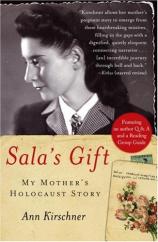
Sala's Gift: My Mother's Holocaust Story


Review
Sala's Gift: My Mother's Holocaust Story


Ann Kirschner always knew that her mother, Sala, was a Holocaust
survivor. She was aware of the bare facts of her mother's story:
that she had lived in Poland and that most of her family had been
killed in the camps. But Sala did not talk much about her
experiences or share the details of her story. Ann learned growing
up that some survivors felt the need to talk at great length about
what they lived through while others rarely spoke of the trauma, if
at all. She learned to respect Sala's silence.
Then, before Sala went into the hospital for surgery, she gave Ann
a box of letters and journal entries chronicling her life, and the
lives of many other Jews, during the war. Ann learned that her
mother had been a slave in one of the labor camps, and it was her
hard work that enabled her to survive. The stories of Jewish slave
labor during World War II traditionally has received less attention
than life in the ghettos and concentration camps. But in SALA'S
GIFT, Ann Kirschner, using those letters, tells her mother's story
and of other men and women forced into labor under the Nazis.
Sala Garncarz, the youngest of Rabbi Garncarz's 11 children, grew
up in Sosnowiec. In 1940, when she was just 16, the family
received a letter stating that Sala's older sister, the studious
Raizel, was being called up for six weeks of mandatory
labor. Sala, the stronger, more adventurous sibling, offered
to go in Raizel's place. After much discussion, the family agreed
to let her go. Sala was sent to Geppersdorf, a labor camp
supporting the construction of Hitler's autobahn in Germany. Sala
was assigned work as a seamstress. And soon it became clear that
she would not be allowed to return home after the promised six
weeks.
Luckily, even before she leaves on the train for Geppersdorf, Sala
is befriended by an elegant and kind woman named Ala Gertner. Ala
takes Sala under her wing and tries to protect her both physically
and emotionally from the harshness of life in the labor camp.
Conditions were awful and many laborers became quite sick. However,
unlike Jewish prisoners in other types of camps, the labor camp
inmates were allowed to send and receive mail.
And it is Sala's collection of received letters, kept and hidden at
considerable risk, that tells the real story of Jewish life under
Nazi tyranny. The majority of the letters is from Sala's older
sister Raizel, who tries to encourage Sala, especially in matters
of religious faith, while protecting her from the truth of what is
happening back home. Other letters are from girlfriends left behind
in Sosnowiec; Ala, after she is moved to another position outside
Geppersdorf; and male admirers and beaus Sala had in the camp. All
paint the picture of misery and violence, tinged with hope and
faith.
Sala lives and works in various labor camps for five years,
ironically contributing to the Nazi destruction of Jews and other
people. After liberation at the end of the war, she travels through
Europe with friends searching for family members and trying to
determine where she will make her home. Of her immediate family,
only she and two sisters have survived. Sala falls in love with an
American soldier, and it is her marriage to him that brings her to
the United States and gives her the chance to put her brutal past
behind her. Safe from harm's way, Sala raises her three children,
only later revealing her remarkable tale of survival.
Ann Kirschner's treatment of Sala's story is kind, the work of a
loving daughter, but also thorough in that it is well researched.
Many of the characters we meet in SALA'S GIFT are difficult to
understand --- from the Jewish Elders who had little choice but to
work assisting the Nazis, to some of the people Sala came to rely
on, such as Ala, who were not always who they seemed to be.
Kirschner does an excellent job balancing Sala's biography with
history. She not only pays tribute to her mother (and so many
others) but contextualizes the story successfully.
SALA'S GIFT is a unique and moving contribution not only to
Holocaust literature but to biographical and historical literature
as well.
Reviewed by Sarah Rachel Egelman on January 23, 2011


Sala's Gift: My Mother's Holocaust Story
- Publication Date: June 12, 2007
- Genres: Nonfiction
- Paperback: 320 pages
- Publisher: Free Press
- ISBN-10: 1416541705
- ISBN-13: 9781416541707