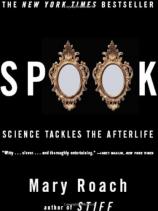
Spook: Science Tackles the Afterlife


Review
Spook: Science Tackles the Afterlife




Perhaps it's best to try defining this oddball book by what it is
not. It is not a serious scientific study; it is not a piece of
gallows humor; it is not a work with religious implications; it is
not an exercise in debunking; it does not champion one consistent
point of view. Yet it contains elements of all these
approaches.
The publisher has not provided much information about Mary Roach's
background, referring to her only as a "humor and science writer"
and listing publications in which her work has appeared. That's not
terribly helpful. Her one previous book, STIFF, explored ways in
which human cadavers are used to improve the lot of those of us
left behind. SPOOK takes us to the next obvious level: What about
the lot of the dead themselves? Where are they? Can they
communicate with us, or we with them? Do they even want to? With
her characteristic breeziness, Roach asks the ultimate question: Is
there a place in heaven where she can plug in her laptop?
Roach's approach may be summed up as amused to the point of
flippancy. SPOOK reads like a 300-page Sunday supplement feature
story. No opportunity for a crisp one-liner is ignored, no far-out
theory or colorful character is too bizarre to be mentioned. A
serious scientific tract it is not.
Consider the human soul. Is there such a thing? How much does it
weigh? Can we see it? Where does it reside in the body? Does it
exit us when we die --- and if so, from what body part and by what
means? We meet in Roach's book people --- apparently utterly
serious people --- who have gone to great lengths to try to answer
such questions.
Then there is the matter of communicating with the dead, either
directly or through mediums. Roach actually went to England and
attended a weekend-long academic course for medium wannabes --- but
her attendance was mainly for purposes of making the experience a
chapter in her book, not because she had any serious mediumistic
pretensions or even any talent in that direction. She also
infiltrated a laboratory at the University of Virginia where there
were ceiling cameras set up to try filming out-of-body experiences
by dying people --- but again her purpose was
literary/journalistic, not really scientific.
Roach's book brings before us a procession of odd characters who
take these matters with quasi-scientific seriousness. Some of them
are degreed and tenured academics, some are obvious frauds. None of
them have any definitive answers that satisfy her. She calls
herself "skeptical by nature," and invokes "evidence" and
"plausibility" as her personal criteria for judging the claims of
her subjects. She is suspicious alike of views based on ignorance
and those based on "accepted dogma." Many of her scientific
subjects are from the same breed of fence-sitters.
Her attitude toward most of the people she writes about, those
still living as well as those long dead, may be summed up as an
amused disbelief that keeps trying to veer off into open contempt.
We read about a North Carolina court case in which the existence of
a ghost was accepted as fact, about fake mediums who concealed
yards of cheesecloth "ectoplasm" in their vaginas, and of people
who have invented devices called the "psychic telephone" and the
"effluviograph."
One of her findings, I must confess, did hit me with a purely
personal immediacy. A few years ago, during a physical exam, my
doctor informed me that my corpus callosum was missing. Reacting to
my blank look, he explained that this is a membrane that binds the
left and right brain hemispheres together. He put it in blunt but
disquieting language: "Part of your brain is missing." That is not
the sort of thing you want to hear from your doctor, believe
me.
Now Mary Roach has disinterred a French surgeon named Gigot de la
Peyronie who determined back in 1741 that the corpus callosum may
well be the site of the human soul. No wonder people have been
looking at me funny.
Reviewed by Robert Finn ([email protected]) on January 23, 2011


Spook: Science Tackles the Afterlife
- Publication Date: October 17, 2006
- Genres: Nonfiction, Science
- Paperback: 311 pages
- Publisher: W. W. Norton & Company
- ISBN-10: 0393329127
- ISBN-13: 9780393329124