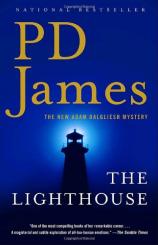
The Lighthouse


Review
The Lighthouse




I'm in love with Adam Dalgliesh. I know it's weird to have feelings
about a guy who doesn't exist outside the printed page, but I've
done it many a time (Heathcliff, Mr. Darcy, Prince Andrei…).
A man of action (he catches murderers) and intellect (he writes
poetry), Dalgliesh is simultaneously a romantic figure and a
practical one --- a policeman with a conscience and a complicated
sense of justice. I thought a confession was in order because my
bias disposed me to adore THE LIGHTHOUSE, the latest Dalgliesh
novel, and I did.
I don't want you to think I'm always this easy to seduce. Actually,
I'm rather choosy about mysteries. Anything experimental or slangy
--- especially authors who strive too visibly to write "more" than
a mystery --- turns me off; James is a favorite because she is a
master at taking the classic formulas to a higher level and
burnishing them until they glow.
Among these traditional conventions is a controlled setting and a
limited number of suspects --- in this case, the inhabitants,
temporary and permanent, of Combe, a fictional island off the
Cornish coast where VIPs seek a sanctuary of security and quiet and
nobody can come or go undetected (its isolation is increased later
in the story by the imposition of a quarantine). As in the best
thrillers, the landscape has a spooky beauty (cliffs, mists, and so
forth) that James evokes with her customary skill. One of the
pleasures of reading her, in fact, is a keenly literate voice in a
genre that does not always treat words with grace and respect. Even
the title is a sly homage to Virginia Woolf's TO THE
LIGHTHOUSE.
But there is little of Woolf's cryptic interior voice in the
straightforward plotting. When celebrated novelist Nathan Oliver is
found hanging from Combe's nonfunctioning (but meticulously
restored) lighthouse, and the evidence suggests that it wasn't
suicide, Dalgliesh --- head of Scotland Yard's Special
Investigation Squad, which handles politically tricky cases --- is
called in. He is a sleuth in the mastermind tradition of Holmes and
Poirot, and the very opposite of a hardboiled contemporary cop (he
feels every death deeply, one might even say soulfully). His team
is interesting, too: D.I. Kate Miskin is a self-made woman from a
poor and dysfunctional family, and Sergeant Francis Benton-Smith is
an Anglo-Indian man with a privileged background. They are alert,
ambitious, frighteningly bright, and wedded to their jobs. They
also hate each other's guts, partly because of class differences
and partly because they are rivals, both knocking themselves out to
impress the boss.
THE LIGHTHOUSE isn't a rapid-fire read. You have to savor the
deliberate pace, the quiet buildup, and the accumulation of
incriminating evidence and guilty secrets, as well as a creeping
threat of further violence (a second murder does, in fact, take
place). But there is an explosion of derring-do toward the end, as
Dalgliesh's team takes physical risks that show them to be intrepid
as well as intelligent --- Benton-Smith scaling cliffs with a
suspect, Kate stripping and oiling her body so she can slide
through a window of the lighthouse and nab the culprit. It's no
surprise that James is a master at this sort of action
sequence.
Still, it is the more contemplative moments --- the moral context,
if that doesn't sound too pretentious --- that make James's
mysteries so extraordinary. By creating a detective with a tragic
past, a complex sensibility, and a host of inner struggles between
the poet-humanist and the functionary of law-and-order, she can
permit herself ruminations of a sort that might otherwise seem
forced or digressive. In the course of THE LIGHTHOUSE, Dalgliesh
ponders (to name just a few) the secret service's declining
mystique, the risks of becoming a bureaucrat, the allure of
islands, the nature of good and evil, and the "finality and
mystery" of death. James's implicit point: Murders can be solved,
but the bigger issues of justice, truth, love and community are
still with us.
I have three complaints: The romantic entanglements of Adam, Kate
and Francis seem artificial, as if James is making certain to endow
her authority figures with a private life (I don't think she's
awfully comfortable writing about sex). The book could have been
more tightly and cleanly edited --- it does run on a bit, losing
momentum in places. And sometimes a blinding flash of insight or
crucial clue arrives just a little too fortuitously. But these are
minor quibbles. Although THE LIGHTHOUSE may not be James's best
book, it's a very satisfying one.
One last comment: P.D. James is now 85. Clearly, Dalgliesh is her
principal literary alter ego, but there are two other characters in
THE LIGHTHOUSE that suggest an autobiographical element: Nathan
Oliver, who is consumed with anxiety about whether or not he can
still write as well as he did as a younger man ("Give me back my
words!" he yells in a recurrent nightmare), and Emily Holcombe, at
80 the last surviving member of the family that established the
island retreat. Emily is smart, sharp, beautiful, honest to the
point of unkindness, and often self-absorbed, an unflinching
realist and something of a snob. She and Nathan Oliver, I suspect,
are ironic self-portraits, reflections of James's own
coming-to-terms with age. What a woman.
Reviewed by Kathy Weissman on January 11, 2011