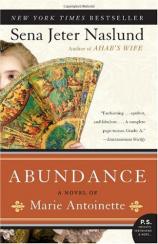
Abundance: A Novel of Marie Antoinette


Review
Abundance: A Novel of Marie Antoinette




According to this novel, much of what we think we know about Marie
Antoinette is false, beginning with that famous line about letting
the peasants eat cake. Sena Jeter Naslund's foreword to this
"imaginative re-creation" informs us that there's no evidence that
this Queen of France ever uttered those words. However, we do know
how the story ends, and that grisly fate hangs over the reader's
experience of her fantastic life story like a guillotine ready to
drop.
As in her earlier novel, AHAB'S WIFE, Naslund employs fascinating
historical detail to draw us in and authentic emotion to keep us
hooked. In the hands of lesser writers, some historical novels
about royalty plumb the scandalous, grasping behavior of nobility
merely to shock us, to assure us that while they may be kings,
queens and courtiers, their motivations are no better and in fact
maybe worse than the rest of us. But Naslund renders Marie
Antoinette compellingly human, seeking not to titillate but to
enlighten.
This first person narrative begins with the Austrian princess Maria
Antonia's rebirth as a French citizen, Marie Antoinette, on a
neutral island on the Rhine, where she is handed over to French
guardians, never to return to her homeland. She was a girl raised
to be a queen. While not among the oldest of her fourteen siblings,
she was apparently handy when her mother, the Empress of Austria,
desired to cement relations with France and so arranged her
marriage at age 14 to 15-year-old Louis Auguste, the Dauphin of
France (not before straightening the girl's teeth "with wires,"
Marie remembers). Her mother has told her how to anticipate "all
the events of my life to come," but the savvy reader recognizes
this as a young girl's hopeful naiveté. For literature's sake
we must be glad of the impossibility of such a task.
"Toinette," as her friends call her, charms everyone, the Dauphin
and his grandfather the King included. Her new life at Versailles
is sumptuous and exciting, tempered by the knowledge that in her
first duty to France --- that of providing heirs to the throne ---
she cannot succeed without her husband who, while tender and
respectful in bed, for years is reluctant to do what is necessary
to impregnate her. Since there seems to be nothing she can do about
this, she throws herself into friendships, fashion and gambling.
Yet she is thoughtful and, as Naslund presents her, somewhat of a
philosopher. Here she is, now a Queen, while stealing a half hour
of solitude before her first child is finally born: "I test time by
counting to sixty, and yes, those moments are gone, and another
minute is here to be counted out. Such is life! Such is life: the
passing of moments, none more or less real than another, for all
their difference in import. The moment it takes to move my eyes
from left to right is as real as a moment of love or fear."
ABUNDANCE spans nearly 25 years of alliances, betrayals and failing
political fortunes, and ends as we know it must. If we extend
Toinette's ruminations on moments to lives, perhaps this queen's
life is not of more import than those of the Parisian fishwives
clamoring in the end for her death. But by that time we've come to
admire the impetuous, loyal queen, and her bravery compliments this
intelligent and moving literary portrait.
Reviewed by Eileen Zimmerman Nicol on December 22, 2010


Abundance: A Novel of Marie Antoinette
- Publication Date: June 1, 2007
- Genres: Fiction, Historical Fiction
- Paperback: 592 pages
- Publisher: Harper Perennial
- ISBN-10: 0060825405
- ISBN-13: 9780060825409