
Excerpt


Excerpt
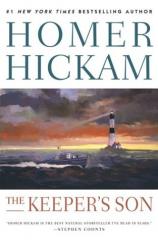
The Keeper's Son




PROLOGUE
The old wicker rocker creaked as Josh pushed back and forth in it, back and forth, back and forth, his bare feet slapping against the boards of the pizer with each rock. His chin rested on his chest and his hands restlessly worked up and down the arms of the chair. Every minute seemed to last an hour and it was only nine in the morning. According to the chart his father had told him to follow, sunset would occur fifteen minutes after six and then "civil twilight'' twenty-five minutes later. That meant there were nearly ten, unending hours that had to pass until he could do what he most wanted to do, what he had always wanted to do. Josh was not a boy who cared much for waiting, especially not today. It was going to be one of the most important days in his life, but first darkness had to come. Today, September 12, 1924, Josh would light the lamp in the Killakeet Lighthouse and he would do it all by himself.
Before Josh lay an apron of brown sand and the vast, great Atlantic Ocean, but he did not look at the blue-gray sea as either vast or great. It was simply his front yard and had been for all of the fourteen years of his life. The tall spire of the Killakeet Lighthouse cast its shadow across the sand toward the Keeper's House where Josh impatiently rocked on the pizer, as a porch was called on the island. As the day wore on and the sun sank lower, Josh knew the shadow of the tower would gradually move until it pointed at the ocean. Then, just before the shadow dissolved into the encroaching darkness, he would follow the schedule his father kept every day of every week of every month of every year. He would climb the 266 steps of the black iron staircase that spiraled inside the tower, carrying with him a three-gallon can of kerosene. Along the way, he would pass the brass plaque his grandfather, the second keeper of the Killakeet light, had placed at the third landing. It was inscribed with the words from the old hymn "Let the Lower Lights Be Burning'':
Brightly beams our Father's mercy
From His lighthouse evermore
But to us He gives the keeping
Of the lights along the shore.
Near the top, the stairs spiraled into the watch room where Josh would pour the kerosene into a holding tank, then pump air into it until there was enough pressure to feed the mantle in the lantern room above. Next, he would crank a clockwork mechanism and raise a sixty-pound weight on a wire rope. As the weight descended, it would turn the giant lens.
A dozen more steps would take him to the lantern room where the Fresnel lens sat like a huge glass beehive. He would pull back the curtains that protected the lens, then light an alcohol-spirit lamp to vaporize the kerosene coming up from the watch room. After the vaporized kerosene soaked the silk and zirconium mantle, he would light it with a long candle. If he had done everything just right, the kerosene would ignite and the mantle would begin to burn, to incandesce as the chemical reaction was called. Next, Josh would activate the clockwork mechanism, and the great glass structure would begin to slowly turn on chariot wheels along a circular track. There were eight prism panels, each with a glass bull's-eye that was designed to transform the illumination from the mantle into an intense cylinder of light. As the lens turned, its bright shafts turned with it, like the projecting spokes of a fiery wheel.
At sea, the light would appear as a brilliant beam for precisely two and three-quarters seconds with an equal period of darkness, each flash a warning of the deadly shoals offshore. To the north sat the lighthouses of Ocracoke, Hatteras, Bodie Island, and Currituck Beach. To the south was the lighthouse at Cape Lookout. Up and down the sandy islands off North Carolina, the Lighthouse Service had set up these great towers with their flashing spokes of light to warn the freighters, tankers, warships, fishing boats, banana boats, and every other kind of vessel that they were passing through what had been called for centuries the Graveyard of the Atlantic. Below the waves were the skeletons of hundreds of ships put there by sudden storms bashing them against hidden shoals. But the ships would be safe as long as they heeded the flashing towers, and as long as the keepers on those shores kept the light.
Josh glanced at the shadow of the lighthouse. It had barely moved since he'd last looked at it. It was as if the sun had gotten stuck in the sky. Frustrated, he took in a deep breath, let out a long sigh, and rocked some more. Josh's father, Keeper Jack Thurlow, had gone up to Bodie Island to see the keeper there and inspect a new rotation clockwork design. Keeper Jack had worried for days about leaving Josh alone, not only with the responsibility of lighting the lamp but also having to tend to Jacob, his baby brother just turned two. Josh knew his father wanted to go and finally convinced him to make the journey. Josh was, after all, fourteen years old and had proved himself a responsible son. He had done so much since his mother had died, not only working around the lighthouse, but also raising Jacob.
Josh rocked a little harder, as if he could force the sun to move along. Jacob was playing in the sand in the shadow of the lighthouse. Josh had made certain his brother was well covered with a sun suit and hat. He was a happy baby and knew how to entertain himself, sometimes to Josh's consternation. He'd caught Jacob in the sun-drenched room his mother had called her "art palace'' that very morning, playing with a spilled box of beach glass. The room had been left virtually untouched since Josh's mother had died during Jacob's birth. Josh knew why. One time when Doc Folsom had come by for a game of hearts, the Keeper had taken a little too much whiskey with his cards. Tears streaming down his whiskered cheeks, he'd confessed the "palace'' was the one place in the house where he could still sense his wife's presence.
Josh felt the same about the room. After he'd carried Jacob outside, he had returned and sat down in his mother's chair and touched the implements of her art, the small pliers she'd used to bend the silver and gold wire, the glass beads and beach glass and shells she had strung with the wire to make bracelets, anklets, broaches, necklaces, and pins. Then he'd taken a deep breath. He could almost smell her, a wonderful mixture of soap and the vanilla extract she liked to dab behind her ears. He'd scooped up the beach glass Jacob had spilled and traced his fingers through the smooth, translucent chips, loving the way they sounded like tiny, tinkling bells. Josh had accompanied his mother on many expeditions up and down the length of Killakeet in search of beach glass, which were pieces of broken bottles ground smooth by the workings of the surf and the sand. The rarest of all the beach glass was that off the Alexander Hamilton, a bark-rigged screw steamer that had fetched up on Bar Shoals and been battered to pieces. Among its cargo had been a few boxes of a rare California syrah wine called Rose of Sharon. Over the years since, the red glass of the Rose of Sharon bottles had been turned into ruby-colored gems that occasionally washed ashore. It had been those pieces that Jacob had spilled. "No, Jacob,'' Josh had told him sternly, and even slapped the boy's tiny fists, making him drop the tightly held scarlet glass. Josh was no tyrant as a brother, but he knew Jacob needed discipline. The boy had cried a little, but when Josh went outside to look after him, he seemed to have forgotten all about it and was happily playing in the sand.
As he rocked, Josh occasionally glanced at the ocean and the seabirds flying past. He saw a trio of pelicans, a lone gull, a squadron of mergansers, and a sea hawk. His mother had run a bird hospital right there on the pizer of the Keeper's House, not easy with more than a dozen cats on the premises. His mother had so loved her cats. Many of them were still around, good mousers all, and gentle creatures. They liked to sleep on his mother's grave, which was soft with grass and warm in the sun.
Josh missed his mother. He missed her with all his heart, missed everything about her, her gentle ways, her sparkling laugh over something he or his father had said, her joy of life on Killakeet Island, her dedication to taking care of its creatures. He would go visit her just before he went up on the tower to light the lamp. The Lighthouse Service had graciously allowed the Thurlows to have a family cemetery behind the Keeper's House. Josh wanted to tell his mother about getting to keep the light, and he also needed to tell her how Jacob was doing, and how much of her he could see in Jacob's face. He wanted to say he missed walking the beach with her, looking for beach glass. There was always so much he wanted to say, so much he could never possibly say it all. He always tried very hard not to cry when he talked to her, although he rarely succeeded. His father said there was no reason to cry, that she was gone because God needed her more than they did. Josh hoped God was happy but it seemed sad that the Almighty Creator of the Universe might be so needy as to take a mother away from her children.
Something small drifting along on the blue water caught Josh's eye and he stood to see it better. It wasn't a dolphin since it didn't appear and reappear. He thought it might be flotsam from the wreck of the Bertha Gaskill, a brigantine that had gone down in a storm just off Hatteras the past winter. Ever since, her planks had been floating in, and even a big section of her wheelhouse had come ashore near the Crossan House, the summer cottage of a rich Yankee family that sat about a mile south of the lighthouse.
Josh wanted to see what the thing was on the water. The best way to do that was to climb the tower and have a look with his father's binoculars. He didn't want to leave Jacob alone so he picked him up and carried him on his hip and started up the spiral staircase. Jacob burbled happily and clutched Josh's shirt with his tiny hands. He was a cute little boy with a mop of sun-whitened hair and big, blue eyes and strong, inquisitive hands. Josh had to remember to always empty Jacob's pockets before he took him in the house. He never knew what he would find in there, sand, sea oats, even the occasional cricket or beetle. Once, he'd even found a flattened penny with Josh's name stamped on it. Josh had forgotten who'd given him that penny or that he'd even lost it, but crawling around in the sand, Jacob had found it.
Josh tediously climbed the steps, one after the other, until he reached the lantern room. He picked up the binoculars off a hook on the wall and shifted Jacob with one arm onto his hip, then went out on the high parapet that encircled the lantern room. The wind struck him there as it always did. Wind ran like a constant river across Killakeet but it was always especially strong atop the lighthouse. Jacob giggled and squirmed and Josh worked to control him. "Stop wiggling, Jacob,'' Josh scolded. "Hang on to me and don't let go! It's a long way down!'
Jacob settled into his arm, chewing on his collar, giving Josh a moment to look at the dot on the ocean. He was astonished to discover it was a little boat, with its mast neatly stowed on its deck. Josh had never seen anything quite like it. It had a blunt bow and a square stern and a tiny cockpit. It looked very fast.
Josh wanted the little boat. The people of Killakeet had made their living for years fishing and what they called "wrecking,'' the taking of what the sea had stolen from one to give to another. Josh could already imagine how proud he'd be to show the little boat he'd "wrecked'' to his father and how jealous the other boys would be when he sailed circles around them with it. He managed to play a neat little scenario across his mind, how the people up in Whalebone City would say what a clever boy Josh Thurlow was to go out and catch that smart little boat.
"Look, Jacob,'' he said. "See the boat?'
Jacob proved himself a true Killakeeter. He looked and squealed, "Bo!'
"Yes, bo! Our bo! You want it, too, don't you?'
"Bo! Bo!'' Jacob giggled.
Josh took another look, noted the direction of drift, and went back down the staircase, arguing with himself all the way. What he wanted to do more than anything was to hop in his father's workboat and give chase. The workboat was a boat better sailed with two men but he'd taken it out alone before. He could easily do it. Why, he said to himself, he could be out and back in just a few minutes.
But what to do with Jacob?
The solution, when Josh forced it into his little scenario, was simple. He would take Jacob with him. Jacob had been on the workboat many times. He was a Killakeet baby, after all, and naturally loved the ocean. The more Josh thought about it, the more perfect his plan seemed. He would get a tarpaulin in case of rain, put Jacob in the workboat, and they'd both go out and catch the little boat.
It was a glorious day, the skies blue with just a cotton-puff cloud or two, the winds fair and light. Tonight, it was going to be a full moon, which meant a high tide and the water would be deeper over the shoals. It was going to be an easy sail. Josh expertly steered the workboat through the breakers and they were off on the chase. Jacob squealed with delight as they bounced through the waves, but once past the breakers, Josh realized it was going to be more difficult to find the little boat than he'd thought. He stood up and still couldn't see it. It was too low in the water and his own sail blocked his view. All he could do was head off in the direction he'd last seen it drifting. He tacked back and forth to cover more area. As he did, Killakeet slid past him. Before long, he'd passed Miracle Point, seven miles south of the lighthouse, and was out on open water.
There it was! Josh saw the little boat for just a moment as a wave tossed it up. It was farther out than he expected and he realized a little piece of the Gulf Stream must have grabbed it and drawn it east and then north. Josh tacked toward it, beating up against the wind until he was in the Stream, too. He felt the insistent river of warm tropical water grasp the workboat. Josh knew he'd have to work hard to get out of it after he caught the little boat. He looked at the sun and realized it was already well past noon. From willing the time to pass faster, now he wanted it to slow down. The lighthouse was just a tiny sliver of alabaster on the western horizon. I'd better catch her quick, he said to himself, even as he knew he should give up the chase, take Jacob home, and be ready at twilight to light the lamp.
But Josh didn't give up. He kept chasing until at last he tacked up to the boat and got a hand on it. To his delight, he discovered it was just as pretty and special as he thought and it looked brand-new, too. Its hull was painted a bright, cheerful red. He inspected the stiff new painter attached to its bow. Someone had not tied it off very well and the sea, being the sea, had grabbed it for itself. But now it belonged to Josh, and Jacob, too.
Josh took the little boat in tow, tying its painter to the stern of the workboat. He checked the sun. "We got to get back and light the lamp, Jacob,'' he said to his brother. Josh was worried now. What would happen if he didn't get back in time to light the lamp before darkness? Not only would his father hear about it and never trust him again, true disaster might occur. The ships at sea depended on the light. They could pile up on Bar Shoals without it. Josh had to hurry but it was difficult to get across the Stream, which was determinedly pushing him north. He would have to point the bow of the workboat directly southwest, he decided, and let the wind blow him across. With the Stream pushing him northeast, it would average out and he'd go mostly westerly. But that meant the hull of the workboat would be against the full power of the Stream. It would be hard to steer but he was confident he could do it. He had to do it.
The wind picked up, the way it will off the banks as September afternoons wear on. There was a chop on the sea that hadn't been there a minute ago, too. Josh got up to adjust the sail. Jacob kept getting in his way. He tripped over him and Jacob started to cry. "I'm sorry, Jacob,'' he told the baby.
Then, when he turned his back, he heard a splash and to his horror, he saw that Jacob had fallen in. The workboat was moving along with the wind behind it. The Stream was insistently carrying Jacob away. Jacob's face was in the water. Josh had no choice. He dived in and swam as hard as he could. The Stream carried him and within a few strokes he had Jacob, who sputtered and started crying again. "Please, Jacob,'' Josh begged. "Don't cry. It's going to be OK.'
But Josh wasn't so certain. Now he had to catch the workboat. He should have reefed the sail before he dived in. All the canvas was shaken out and the workboat was, if not a fast sailer, a steady one.
With one arm holding Jacob, Josh swam after the two boats. He had always been a powerful swimmer, and even against the Stream, he managed to catch the stern of the little red boat just before she passed. Desperately, he grabbed her with one hand and with the other lifted and dropped Jacob into the cockpit. Then Josh went hand over hand to the workboat and climbed aboard. He was exhausted from the swim and shaking from the terror of almost losing his brother.
The wind had shifted and was blowing even harder. Josh had to get to shore. He looked over his shoulder. Jacob was sitting in the little boat and had stopped crying. In fact, he was smiling at his brother. Josh got the tarpaulin and tossed it into the little boat's cockpit. "Stay under the tarp, Jacob,'' he said. "We're going home, don't you worry. We're going home right now!'
As he ran for shore, fighting the tiller, Josh looked over his shoulder every few minutes to check on Jacob, not that he needed to. He kept hearing him laugh as the little boat bounced across the waves. He was such a happy child and even the shock of being tossed in the ocean had not changed him.
The wind began to blow blister-hard now and it started to rain. Josh was having to use every ounce of his strength just to keep his heading, but still he kept checking the towed boat. Jacob had crawled under the tarp. Josh looked over his shoulder and saw Jacob's bare feet sticking out from under it. That was when the wind piled into him, a terrific gust, and knocked the workboat nearly over. Josh was tossed out into the warm fast current.
He came up swimming. The workboat had righted herself but her sail was a flapping mess. That was good, Josh realized. Otherwise the wind would have surely blown her past him. He climbed aboard and looked to make sure Jacob was all right, and that was when the greatest horror he'd ever felt coursed through his body. The little red boat was gone. The new painter was tied off on the workboat but the other end had come undone. Josh hadn't checked the knot. A landsman had probably tied the thing, some sort of granny knot that had come loose with all the bouncing around. The near knockdown had finished untying it and sent Jacob off on his own across the waves.
"I'll find you, Jacob!'' Josh screamed desperately into the wind, then set the sail and clutched the tiller and began to turn the workboat around against the mighty Stream.
Excerpted from THE KEEPER'S SON © Copyright 2003 by Homer Hickam. Reprinted with permission by Thomas Dunne Books, an imprint of St. Martin's Press. All rights reserved.


The Keeper's Son
- Genres: Fiction
- hardcover: 352 pages
- Publisher: Thomas Dunne Books
- ISBN-10: 0312301898
- ISBN-13: 9780312301897


