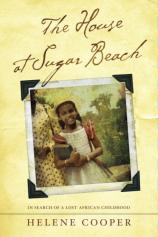
The House at Sugar Beach: In Search of a Lost African Childhood


Review
The House at Sugar Beach: In Search of a Lost African Childhood




Liberia is a country on the western African coast that in recent times has garnered headlines for the brutality of two horror-dealing regimes holding sway over 25 years. It is a country founded by American-born Africans, and as such, its history is partly our own, yet it has been easy to turn away from the headlines and leave Liberia out of our thoughts. Liberian-American journalist Helene Cooper will change that with this book. Subtitled "In Search of a Lost African Childhood," this chronicle is a saga of personal victory over terror, sorrow and separation.
Elijah Johnson, ancestor of Cooper's mother, was a freeman who fought for America in the War of 1812. Randolph Cooper was a free man, ancestor of Cooper's father. Both were original settlers of what became the independent nation of Liberia. They arrived in the 1820s, part of an initiative by highly placed American white men to deal with the growing number of ex-slaves and their potential influence in the newly founded, slavery-dependent nation. The colonists were referred to as "the Congo People" by the local tribespeople because they were presumed to be slavers like other interlopers in the region.
With superior resources, the new arrivals quickly became elite rulers of their coastal domain, with the result that Helene Calista Esmeralda Esdolores Dennis Cooper was born in 1966 to a life of incredible luxury, her family free to travel to America and England for education and business, retaining and polishing their own haughty version of the English language. The "Congo People" kept the locals (whom they called "Country People") as servants, and rarely was there any social mixing. The family was so affluent that they were able to hire a "sister" for Helene, a local girl named Eunice. To the family's credit, Eunice was treated like a near-equal with Helene, but her status as a Country Person implied that she could never rise to their level.
The deep divide between the Congo People and the Country People in Liberia was a recipe for disaster. The wound festered until 1980, when a soldier, Samuel Doe, staged a bloody coup. Helene, a young teen, watched in shock as the previous government leaders, some of them members of her family, were publicly executed near her palatial family home at Sugar Beach. Not long afterwards, Doe's guerrillas stormed that mansion. While Helene was locked in a bedroom, her beloved Mommee was gang-raped. The house at Sugar Beach became a venue for the regime's executions. Later, many dismembered bodies were exhumed on the grounds of the once-proud family home.
It is these memories that chased Helene as she immigrated to the United States, living mostly with her father and various siblings while Mommee stayed in Liberia collecting rents on family properties and sending nearly every cent to the émigrés. Her father, with no work skills and dogged by creditors, took loving care of his daughters while Mommee footed the bill. In high school, Helene found that she had a saving grace --- a gift for writing. She attended Journalism School at the University of North Carolina at Chapel Hill and wound up as a "wandering reporter" for the Wall Street Journal. That meant traveling around the Deep South questioning locals about seemingly trivial business-related issues, while her lost Liberia burst into the headlines again with word of a new coup staged by Charles Taylor. Prince Johnson, a rival to Taylor, captured Samuel Doe and drank a beer while overseeing his slow torture and death. Mayhem again reigned in Helene's homeland.
By that time, Helene was a U.S. citizen, and most of her family had settled in America. She had everything to gain by forgetting her roots. But her childhood companion, Eunice, was still in Liberia, and thereon hangs the completion of Helene Cooper's inner journey, one last trip to the house at Sugar Beach.
THE HOUSE AT SUGAR BEACH is a journalistic account that informs and provokes, yet often reads like a novel. It is personal, painful and true. Readers will want to know more about the subject matter and will be looking for Helene Cooper's next book.
Reviewed by Barbara Bamberger Scott on January 22, 2011


The House at Sugar Beach: In Search of a Lost African Childhood
- Publication Date: September 2, 2008
- Genres: Nonfiction
- Hardcover: 368 pages
- Publisher: Simon & Schuster
- ISBN-10: 0743266242
- ISBN-13: 9780743266246