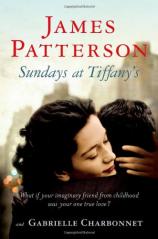
Sundays at Tiffany’s


Review
Sundays at Tiffany’s




James Patterson is acclaimed for his thrillers, detective series and countless #1 bestsellers, including the Women’s Murder Club novels (which were adapted into a television series that aired on ABC) and SUZANNE’S DIARY FOR NICHOLAS, a memorable love story. SUNDAYS AT TIFFANY’S, co-authored with children’s book writer Gabrielle Charbonnet, is the latest Patterson effort to have its audience buzzing. While reading, I theorized about which chapters were penned by which writer, or co-written and edited by both. The secret remains just that.
The gift of love is the basis upon which SUNDAYS AT TIFFANY’S develops a tender yet magical story. For anyone who has not experienced the wonder of an imaginary friend, the authors fill the pages with this real possibility. Imaginary friends appear and disappear, filling the needs of children who lack comfort and playful companionship. Jane Margaux, a lonely little eight-year-old girl, spends Sundays with her mother, Vivienne, window shopping at Tiffany’s jewelry store. But Vivienne, a successful Broadway theater producer, fills her time with production and boyfriends rather than Jane’s daily upbringing.
Michael --- who is in his 30s, witty, funny and handsome --- is Jane’s diligent imaginary companion. He is steady, and a rock for her insecurities. Their favorite treat together is a scrumptious double-scooped coffee ice cream sundae, heaped with drizzles of hot fudge sauce. Michael’s most painful day occurs when he has to bid the now-nine-year-old farewell and move forward to befriend another child.
According to the authors, children mature and forget about their past securities. Like the worn-out blanket dragged behind in “Peanuts” stories, the make-believe companion becomes a discarded memory. However, Jane carries Michael into her future when, at 31, she immortalizes his memory in her theatrical production Thank Heaven. The play is a smash hit and will be brought to the silver screen.
Hugh McGrath is a deliciously handsome actor with ambition to play Michael in the movie. He has wooed Jane and become her lover. Vivienne supports his landing the role, but Jane feels that she is being used by both her mother and Hugh. Her choice to deny Hugh the role destroys their future together, and this distraught young woman revisits the source of her childhood pleasure. Re-enter Michael. >From this point forward, the reader questions the hypothesis asked of him. Is Michael real, or merely a figment of Jane’s imagination?
Collaboration in writing is a recent trend more commonplace than in years past. Alternating styles carry the tale forward in SUNDAYS AT TIFFANY’S. Michael is written in third person, while Jane is portrayed in the first. The action tracks Michael’s journey from Jane’s playful childhood companionship to a grown-up role in her adult life. Her struggle with self-discovery into maturity is well-written from her viewpoint. At crisis points in the book, the reader might find denial. By its conclusion, the combined writing styles produce satisfaction. Charbonnet’s fantasy and Patterson’s mystery prowess unite for an entertaining story.
Michael’s diligence to Jane’s protection is an obsession that transforms his character from pure fantasy to near-reality. Jane’s unwillingness to forget Michael’s place in her youth affects her realities as an adult. If he leaves her for a second time, will she have the strength to overcome her insecurities? SUNDAYS AT TIFFANY’S is unforgettable because Patterson’s twist is “teddy bear” comfort at the conclusion.
Reviewed by Judy Gigstad on January 23, 2011


Sundays at Tiffany’s
- Publication Date: April 28, 2008
- Genres: Fiction
- Hardcover: 320 pages
- Publisher: Little, Brown and Company
- ISBN-10: 031601477X
- ISBN-13: 9780316014779