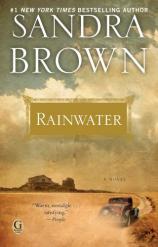
Rainwater


Review
Rainwater




True to her tradition of writing great books --- with over 50 bestselling titles to date --- author Sandra Brown releases another first-rate novel, RAINWATER, this time in the historical fiction genre. In the novel's background, familiar scenes from the Great Depression recall the dire situation for farmers who found themselves in the Dust Bowl of the ’30s. In the foreground, a tender love story is borne out of hardship.
It is in the countryside of Gilead that Ella Barron runs her boardinghouse. Families she knows are struggling, and some have become homeless. Money is tight, yet Ella works hard to keep her place full. She splits her daily time working and caring for her disabled 10-year-old son, Solly. The boy’s situation is complicated as doctors aren’t really sure what’s wrong; his disease leaves him unable to communicate but causes an odd fixation on order. There is no cure for Solly’s malady, and Ella would never consider sending him away. Her days are spent trudging forward, taking life day by day.
Summertime brings change as Ella takes in a new boarder, Mr. David Rainwater. Introduced by the town doctor, it seems Ella was drawn to him from the start. Sensing a change of the tides, Ella is intent on keeping her distance. She defies her instincts until the man makes an astounding discovery about her son. One afternoon, in an effort to get to know the child better, Mr. Rainwater seeks out Solly’s company. The two play simple games in solitude, and while playing dominoes, the child does something intriguing: under no direction whatsoever, he lines up dominoes in numerical order. This seems a minor achievement until one recognizes the discovery for what it is: a definite demonstration of reasoning ability in a child many presumed to have no intelligence. Mr. Rainwater quietly calls Ella in to show her, and she is simply overcome; it is an epiphany that fills her with hope as she can now dare to dream that Solly might lead a full life one day. Ella also watches the man who made Solly's discovery possible, realizing that he genuinely cares for her son. It is with this realization that she relinquishes the long battle and opens herself to Mr. Rainwater. Ella is now deeply in love, with Mr. Rainwater feeling the same. And it’s clear to both that their lives have been changed inexorably.
Ella’s home of Gilead is in what has been named the Dust Bowl. Once-productive farms in Texas are now barren wastelands. Farmers have gone bankrupt, joining the herds of homeless in the shantytown on the border. For many who remain, the only option left is to ask for federal aid. Franklin D. Roosevelt's Drought Relief Program offers farmers financial help: cattle are purchased at a fair price and hauled away, and the meat is distributed to hungry people nationwide. It's a program formed of honorable intentions, to be sure, yet it’s flawed in its execution. Though it’s saving many people, the fact remains that not all of the herds are taken. Large numbers are being slaughtered and wasted, sometimes even half the herd. Cows deemed "unfit for consumption" are led into a pit and shot, and then their carcasses quickly buried. These are animals that are simply too small or too thin to yield prime cuts of beef. And presumably this is done by federal mandate as it is being backed by law.
With homeless families starving in the same vicinity as large quantities of meat are wasted, it's not all that surprising that the injustice becomes too difficult to bear. Even the farmers who are selling the herds are disgusted by what is happening; essentially, they're watching much of their efforts (and their animals) go to waste. To top it off, even calves and nursing cows are among those shot and left. Some of them don’t die from the initial shot, and the shooters aren’t checking if they are dead before they bury them. Horrifically, some of the animals are certainly being buried alive.
Some of the farmers and the homeless families in this situation are folks whom Ella knows. As the government trucks arrive at each of the families’ farms, Ella and Mr. Rainwater ride out to see what's happening. Once Mr. Rainwater sees the injustice to the hungry people of the town, he is determined to do something. He is the one who will lead the charge to help them passively fight for the right to feed the hungry. The situation is sure to get bloody, of course, and there will be a showdown between the people and the law. To make matters worse, a man named Conrad Ellis --- who just happens to be a lawman --- is just itching to pick a fight.
The central focus of this deep, well-written novel is definitely the classic love story. And it's not one to be missed. As characters, Ella and Mr. Rainwater are courageous and admirable. The book touches on a myriad of subjects, including racism, poverty and pacifism. In a few ways, this Great Depression-era novel seems reminiscent of THE GRAPES OF WRATH. I felt it was equally thoughtful, showing just how bad things were. Where our nation is once again experiencing an economic crisis at the present, this seems an appropriate reminder that we’re sitting pretty compared to what was happening in America 80 years ago.
Reviewed by Melanie Smith on January 23, 2011


Rainwater
- Publication Date: November 23, 2010
- Genres: Fiction, Historical Fiction
- Paperback: 272 pages
- Publisher: Gallery Books
- ISBN-10: 1439177643
- ISBN-13: 9781439177648