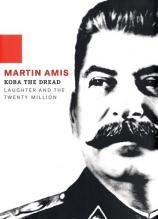
Koba the Dread: Laughter and the Twenty Million


Review
Koba the Dread: Laughter and the Twenty Million


Martin Amis is an English literary force. He is a modern
intellectual aristocrat. Stateside we have only political forces
with equal lineage, evidenced in George W. Bush and Al Gore. Bush
and Gore were given the first rights to their father's seats of
power, and Martin Amis commands an equal presence in Arts and
Letters.
Amis's latest addition to his large body of work is KOBA THE DREAD:
Laughter and the Twenty Million. It is an open conversation that is
equal parts personal history --- of the discussions his father
Kingsley Amis had with contemporaries (Phillip Larkin, Robert
Conquest) concerning the USSR --- as it is didactic hymnal for the
terror of the communist strategy of Lenin and Stalin.
Amis bases his evidence on the revealing works of Robert Conquest's
THE GREAT TERROR and Alexander Solzhenitsyn's THE GULAG
ARCHIPELAGO, and he puts them in context with memories and
discoveries of his own that have affected his enlightenment to the
Soviet Union.
Amis's primary argument, besides exacting the horror of 20 million
Soviet deaths, is that the tragedy still retains a sense of absurd
humor, evidenced in his choice of the tongue in cheek title (Koba
is Stalin's boyhood nickname), while the "other" atrocity of the
20th century, the German Holocaust, does not.
This opinion slants the lessons of the 20 million dead, it is
written with a strange deranged grin, one that permeates the air
after learning of the calculating madmen orchestrating the
revolution. Stalin is quoted as saying that one death is tragic and
the death of a million is merely a "statistic." Equally sinister is
the terrible and truthful history KOBA THE DREAD concerns itself
with and, worse yet, the great minds who were duped by this
regime.
I for one, had no idea. I realize that there are horrible quakes of
human tragedy when something occurs as socially destructible as a
government coup, but this was no ordinary transformation. Absent
was the right to your land, your family, your job, and finally, the
most staggering loss, your God. Without these, Russian life seems
hollow --- and it was. Famine was an intentional weapon of the
state, as was the evil whimsy weighing the decisions for who was
thrown in the gulag and whether they lived or died.
It was a collectivization of the sacred, and Amis does a dutiful
job through research and personal memory to explain these minds and
their acceptance of what one could today call collateral damage.
Using this term, of course, would be one of the most crippling
understatements of the 20th century; however, it is not an original
analysis. Great modern minds such as H. G. Wells and George Bernard
Shaw visited the Bolshevik state in the '30s and returned with
flowery rhetoric of their grand achievement. Wells was quoted to
say about Stalin, "never met a man more candid, fair, and
honest."
One of the most revealing and provocative memories Amis relays is
one of Christopher Hitchens (best friend, journalist, and
pontificator for the left of left) who argues that Stalin was a
great man. Christopher Hitchens, idealist and Clinton-basher, and
in his new role, apologist for Stalin's famine-induced Russia. In a
replay of a discussion, Martin Amis asks Hitchens, "'What about the
famine?' and he replied, 'there wasn't a famine, he said, smiling
slightly and lowering his gaze. There may have been occasional
shortages.'" Could he really have said such a thing? Can this be
true? It is.
Here is the grin, absurd, sad, hysterical.
This great mistake arising from the political left, trusted
defender of the minority, the woman, the sub-altern --- is it
possible that they could be so wholeheartedly duped?
As always with Martin Amis, the reader must be prepared for brutal
honesty and surprise. In his last book, the memoir EXPERIENCE, he
wields tragedy and romance all at once, but it is his life. The
story of his cousin Lucy Partington's grisly death by a serial
killer is mixed in with the mention of a youthful affair with Tina
Brown. Incidentally, it is Talk Miramax who is the publisher of
KOBA THE DREAD.
Back to the point of the book. I would like Martin Amis to be my
history teacher. His silver spoon was Kingsley Amis's world. Martin
Amis's overwhelming talent has of course proven his club membership
to the literary elite. Engaging oneself in his books offers a
unique experience. With the constant footnoted asides from the
writer, it becomes a secret world he is revealing to you. KOBA THE
DREAD is focused on Communist Russia but it is written in the same
style as his previous work, EXPERIENCE. They are in-depth tangents
and occasionally fill up a page of text. It has the effect of a
learned "Pop Up Video." The ultimate back-story to a writer's
life.
I do recommend taking the course, "The Soviet idea and how it duped
the West's brightest minds," Communism 101 taught by Martin Amis.
KOBA THE DREAD would be the perfect companion text; it is as human,
as overwhelming, as personal, and as honest a historical analysis
that I have ever read. The true weight of 20 million empty souls
and those leaders who took them there cannot be taken lightly or
without the mad grin that comes with its comprehension.
A joke from the text:
"Q: Why are the USSR and America the same?
A: Because in the USSR you can joke about America and in America
you can joke about America."
Here is the grin again, absurd, sad, hysterical.
- -- Reviewed by R. Scott Hillkirk ([email protected])


Koba the Dread: Laughter and the Twenty Million
- Publication Date: July 17, 2002
- Genres: Nonfiction
- Hardcover: 320 pages
- Publisher: Miramax
- ISBN-10: 0786868767
- ISBN-13: 9780786868766