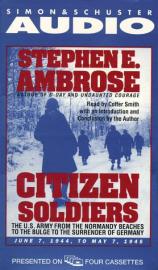
Citizen Soldiers (Audio)


Review
Citizen Soldiers (Audio)




This is a worthy follow-up to the author's D-DAY: JUNE 6,1944, which is also available on audio. Picking up where D-DAY leaves off, CITIZEN SOLDIERS, subtitled "The U.S. Army from the Normandy Beaches to the Bulge to the Surrender of Germany", presents scores of oral histories compiled by the author. These reminiscences, most by average American men who would have been home working in factories, going to school, or playing baseball in their neighborhood sandlots if not for the intrusion of the greatest conflict this world has yet seen, paint a vivid picture of the American experience in Europe in the last years of World War II.
Ironically, the performance of professional actor Cotter Smith comes off as curiously subdued and formal compared to the involving, energetic reading given by author and university professor Ambrose on his D-DAY audio. As the tape progresses, however, Cotter gets more in the spirit of the amazing events occuring around the men, and his demeanor picks up a bit. Listeners do get to hear Ambrose himself in a brief introduction and conclusion.
In the end, of course, it's Ambrose's material that is the star, not the performance. We get as close as a modern person could get to the day-to-day, always dangerous, often horrific, experiences of World War II's "citizen soldiers", or as the author also calls them,"soldiers of democracy". Be prepared, though: the stories Professor Ambrose presents to us make the opening battle sequence of "Saving Private Ryan" seem like a walk in the park.
It is important to note, however, that Ambrose doesn't just present tales of horrific battle sequences. He chronicles all facets of army life in the 1940's. Did you know, for instance, that German prisoners being transported within the United States routinely ate at our country's lunch counters while the black American G.I.'s guarding them had to wait outside, or go around to the back door of the diner and have sandwiches handed to them? Fortunately, the army soon saw the insanity of such occurrences, and took steps --- years before the general population --- to institute equality and integration among its black and white soldiers.
The audio is also refreshingly objective on another level: it shines a harsh, clinical light on the horror that is war. Though Ambrose quite rightly sings the praises of the brave men who fought for the Allies in "The Good War", he makes it clear that such a hellish event doesn't always bring out the best in people. To that end, he duly chronicles the abuses and atrocities that took place on both sides. He also shows us that, though most Americans believed in the cause for which they were fighting, all wanted to get the thing over with and get back to their lives.
After listening to this involving and educational audiobook, it becomes clear that the world didn't need Steven Spielberg to make people aware of the sacrifices our fathers and grandfathers (and many mothers and grandmothers) made during the darkest years of this century. Stephen Ambrose was already doing an excellent job with his well-researched and dramatic works about World War II. We should be grateful, however, if "Saving Private Ryan" encourages a few additional people to pick up an Ambrose book or audio. They are certainly eye-openers. For four days, CITIZEN SOLDIERS turned my mundane daily commute into a transforming experience. I'll never look at our senior citizens quite the same way again.
Reviewed by Joe Menta, Jr. (JoePaulJr) on January 21, 2011


Citizen Soldiers (Audio)
- Publication Date: November 1, 1997
- Genres: History, Nonfiction
- : pages
- Publisher: Simon & Schuster Audio
- ISBN-10: 067157714X
- ISBN-13: 9780671577148