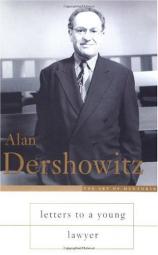
Letters to a Young Lawyer


Review
Letters to a Young Lawyer




Like many spouses of major media figures, Alan Dershowitz's wife
doesn't always recognize the guy who looks like her husband but
says such strange things on television. She even has a name for
that guy: sound-bite Dersh.
Most people know Alan Dershowitz from his cinematic doppelganger,
played by Ron Silver, in the film Reversal of Fortune. They
may also know him from his blockbuster book, CHUTZPAH; or, more
likely, from his involvement in the O. J. Simpson case, for which
he signed on to be the appellate counsel, if one became necessary.
They may also know that Dershowitz is a respected professor at
Harvard Law School, an opponent of anti-pornography feminism and a
patron of nude beaches. Clearly there are a lot of levels to this
"sound-bite Dersh." But if his book, LETTERS TO A YOUNG LAWYER, is
any indication, Dersh in his own words isn't a whole lot different
from Dersh on "Geraldo."
Like many successful people, Alan Dershowitz is incredibly
single-minded. It's curious that he chooses the Talmud as his
touchstone for matters of justice, because unlike the famously
equivocating ancient rabbis, he tends to approach legal matters
with the surety of a true Christian. His basic texts are the U. S.
Constitution and the U. S. legal code, but his faith in them could
be no more steadfast if they
came down from Sinai.
The central argument of LETTERS TO A YOUNG LAWYER is simple and
clear: In an oppositional system of justice it is the obligation of
the defense counsel to seek what is best for his client and
not necessarily what serves the interest of Justice as he
perceives it --- Justice is bigger than any one person, however
well informed that person may be. In other words, defense lawyers
must "zealously" (Dershowitz's word) defend their client's
interests, even if they know their client to be guilty. So, what
looks like a shyster lawyer springing a scumbag client for big
money is actually the closest thing you'll see to perfect justice
on earth in action. And the better the lawyer is at using
"technicalities" to overturn a sentence, the more he is achieving
in the name of Justice.
The O. J. case provided the perfect example of how hard this idea
is for the public to swallow. Shows like "LA Law" made it
their stock in trade to depict cases in which defendants, who
appeared to be guilty as sin, were set free by clever lawyers who
found ways to exclude the prosecution's evidence. The deep-seated
feelings of disgust that such cases instill in most people is a
great source of dramatic tension. Alan Dershowitz realizes this and
uses it to create great public theater, PR, whatever.
What Dershowitz's motives are for stirring up so much trouble is an
open question. Dershowitz would claim that his actions are entirely
in the interest of educating the public about our legal system. His
critics would claim that they are in the interest of making
Dershowitz a bigger celebrity. Perhaps they're both correct;
therein lies the beauty of Alan Dershowitz the public figure.
All this is good and well, but what is notably missing from LETTERS
TO A YOUNG LAWYER is any of the pedagogical advice that its title
would imply the book is chock full of. With the exception of a few
chapters of pat wisdom like "Don't Limit Your Options by Making a
Lot of Money," Dershowitz seems to see the book as an opportunity
to further his own agenda. Despite his impassioned thoughts on the
importance of mentors, he doesn't end up offering much of any
advice to young lawyers that they couldn't have gleaned from
"sound-bite Dersh."
To his credit, Dershowitz does offer an apologia of the book's
weaknesses in the introduction. If a young lawyer took the time to
read it before purchasing the book, they would know that Dershowitz
believes that career advice should be "retail" not "off the rack"
(an almost hilariously stereotypical choice of metaphor). What he
proposes to offer instead of career advice is a blueprint for
improving the state of the law as a whole; and as someone versed in
the distinction between a zealous defense and absolute justice must
know, the two are hardly the same thing.
Reviewed by Fred Kovey on January 22, 2011


Letters to a Young Lawyer
- Publication Date: November 30, -0001
- Genres: Nonfiction
- Hardcover: 226 pages
- Publisher: Basic Books
- ISBN-10: 0465016316
- ISBN-13: 9780465016310