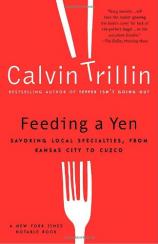
Feeding a Yen: Savoring Local Specialties From Kansas City to Cuzco


Review
Feeding a Yen: Savoring Local Specialties From Kansas City to Cuzco




The United States is a nation covering more than 3.5 million square
miles, measuring nearly 2,800 miles from Battery Park in Manhattan
to the Santa Monica Pier just west of Los Angeles. According to
current Census Bureau figures, more than 290 million people live in
the U.S., most of whom don't have to trace their roots back too far
to find relatives who arrived on American soil from elsewhere. As a
nation we are a diverse and interesting bunch. But if you look at
what we eat, it is apparent that the great melting pot has been
simmering for perhaps too long and is now yielding an increasingly
bland porridge. From sea to shining sea, a nation populated by
people from all points of the globe has become a gigantic, generic
food court that threatens to erase the vast national cornucopia of
ethnic eats and local treats. It's a creeping culinary crime that,
if left unchecked, may one day turn the entire planet into an
Applebee's. But all is not lost.
FEEDING A YEN, the latest effort from the prolific and always
entertaining Calvin Trillin, offers an escape for those who have
grown tired of food that has suffered a spectrum of indignities,
from gentrification to generification. Each of the fourteen
chapters in FEEDING A YEN covers a different local specialty, from
pumpernickel bagels in New York City, to pimientos de Padron (a
dish made with tiny green peppers) in Galicia, Spain, to boudin (a
kind of Cajun sausage) in New Iberia, Louisiana, to ceviche (a cold
fish soup) in Ecuador --- and plenty more along the way.
If you're looking for a book on pricey eateries, find something
else to read. FEEDING A YEN is about simple, honest food, often
made from recipes that have been passed down for generations. In
describing these various treats and his efforts to find them,
Trillin exhibits a palpable glee, particularly when skewering some
of the more pretentious aspects of the business of feeding
people.
In a chapter on Napa Valley wines, Trillin plays on his own
ignorance of the vintner's art as he investigates a test that
reputedly proves that even the experts can't really tell a red from
a white. Another chapter deals with the good-natured squabbles
within a Web community that has emerged via chowhound.com, a Web
site devoted to ferreting out great ethnic food in the
neighborhoods of New York and Los Angeles.
If you're a fan of Anthony Bourdain's A Cook's Tour on the
Food Network, you'll enjoy FEEDING A YEN. Trillin and Bourdain
share a passion for the food purveyed in small shops and by street
vendors. But Bourdain, who apparently will eat just about anything,
has the more adventurous palette. The various treats Trillin
describes are often exotic, but never involve anything that you'd
keep as a pet or that might buzz around your porch light on a warm
summer night. Trillin writes about good, simple food, food rooted
to specific locations by tradition as much as by the availability
of the necessary ingredients.
Technology has made the world a much smaller place. Mere hours
stand between the cargo of fishing boats and the dinner table and,
by virtue of the same technology, the idea of a growing season is
rendered a moot point. You can get nearly anything you want,
anytime you want it. But that abundance and convenience risk the
very essence of the local specialty. If you've had the good fortune
to travel in the U.S. you've surely noticed that, with the
exception of geography and climate, the differences that existed
between various points on the map are eroding. And the same thing
is happening around the world (for a different take on that issue
read William Gibson's PATTERN RECOGNITION). Food is a basic and
visceral expression of local and regional culture. If that
expression is lost, if people no longer seek out unique dishes like
those so vividly described in FEEDING A YEN, then the creeping
blandness that has already claimed so much of what makes the world
interesting will have achieved another milestone in mediocrity. But
if Calvin Trillin has his way, that sad and flavorless day will
never arrive.
Reviewed by Bob Rhubart on January 21, 2011


Feeding a Yen: Savoring Local Specialties From Kansas City to Cuzco
- Publication Date: May 11, 2004
- Genres: Nonfiction
- Paperback: 216 pages
- Publisher: Random House Trade Paperbacks
- ISBN-10: 0375759964
- ISBN-13: 9780375759963