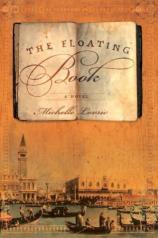
The Floating Book: A Novel of Venice


Review
The Floating Book: A Novel of Venice


Given the latest politics of literacy (e.g., The Patriot Act's
shadowy reminders of censorship), glancing backwards to a time
where a book could mean life or death has resonance. We currently
consider whether or not a person's reading materials signal
terrorist tendencies --- choosing to publish a pagan poet in
Renaissance Italy, Michelle Lovric reminds us, could mean utter
ruin.
THE FLOATING BOOK: A Novel of Venice turns on real events ---
German immigrant printer Wendelin von Speyer's decision to print
the poems of Catullus. In Lovric's richly imagined text, narratives
set in different fonts include those of the Roman poet, of von
Speyer's Venetian bride Lussieta, and the sad, sordid wanderings of
one Sosia Simeon, a Dalmation Jewess whose doctor husband quietly
acquiesces to her many extramarital dalliances.
While Sosia embarks on a love triangle that will ruin her, the von
Speyer's storybook marriage is threatened by events that sweep
through their lives like cold winds through their city's canals.
Lussieta's first-person narration shows her as flawed yet loving.
Lovric's "controlling metaphor" is that of her title --- comparing
the water-bound Venice to a "floating book," whose pages not only
turn at random, but have a certain changeability, like the denizens
of the city themselves. Set during the early days of the printed
book, the novel offers myriad nuggets about inkmaking, typesetting
and bookselling during the Renaissance. Von Speyer's awe on first
reading the erotic of Catullus would have been enough to carry a
plot --- the stolid, German craftsman standing up for something
both exotic yet indigenous to his newly found land.
However, as Sosia crams a worn ledger with details of her
conquests, Lovric seems to have been determined to cram her own
book with characters --- from the young editor Bruno to the wily
scribe Felice to Bruno's simple-minded and convent-bound sister
Gentilia, on to Fra Filippo da Strata and his gruesome sidekick
Ianno, and then back to Catullus, his lover (and the "Lesbia" of
his verses) Clodia and her sybaritic entourage, back to the city of
Venice itself that plays a role. Thus, there seems to be too many
players on the stage. Of course, a number of books have a large
cast; it's just that here, the comings and goings float as
aimlessly as a gondola for lovers.
Those who do wade through the details will be rewarded by finally
learning what ties all of these disparate souls together, and
Lovric has contrived some ingenious ways of connecting the
historical dots that she knows so well. Still, I wondered on
turning the final page if a simpler plot would have served her
better and given readers a better sense of what it means to live in
a time when art really mattered.
Reviewed by Bethanne Kelly Patrick on January 22, 2011


The Floating Book: A Novel of Venice
- Publication Date: January 1, 2004
- Genres: Fiction
- Hardcover: 496 pages
- Publisher: Harper
- ISBN-10: 0060578564
- ISBN-13: 9780060578565