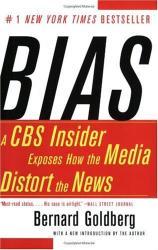
Bias: A Cbs Insider Exposes How the Media Distorts the News


Review
Bias: A Cbs Insider Exposes How the Media Distorts the News




On February 13, 1996, The Wall Street Journal published an
editorial entitled "Networks Need a Reality Check" by Bernard
Goldberg, a fixture at CBS News. The premise of the editorial was
that 1) there was a liberal bias on the part of television news
reporters that 2) got in the way of their reporting. This was not
exactly an earthshaking revelation to most people --- Gallup Poll
results have long indicated that three out of four Americans are
aware of this --- but Goldberg's editorial set off shockwaves for
two reasons. The first reason was that a network newsman was
stating the obvious. The second (and perhaps more important) reason
was that the author of the editorial is, himself, a liberal. The
editorial resulted in Goldberg's ostracism from CBS and,
ultimately, in the writing of BIAS: A CBS Insider Exposes How the
Media Distorts the News.
The editorial that caused all the problems for Goldberg, as well as
subsequent op-eds published on February 15, 1996 and May 24, 2001,
are reprinted in BIAS. It would have been better, perhaps, if they
had been reprinted in the front of the book rather than in an
appendix at the end. They seem, at first blush, rather harmless,
certainly when contrasted to the subsequent reaction they received
in television newsrooms. And the reaction was not to the truth, or
falsehood, of what Goldberg was saying; it was that he was making
the observation at all.
Goldberg's position and the ultimate premise behind BIAS is that
network news has failed in its mission by presenting the liberal
position on issues as the baseline, if you will, of reasonableness
and that any variation from that position is controversial or a
deviation from how things should be. Reasonable minds, in other
words, do not differ. Goldberg's observation, both at the time he
wrote his initial editorial and now, is that differing viewpoints
should be presented without disparagingly labeling one and giving
the other, more favored, viewpoint a pass. Again, Goldberg is a
liberal, but he is secure enough in his worldview and fair enough
in his journalistic outlook to welcome the presentation of
differing views.
The meat of BIAS is where Goldberg systematically illustrates how,
when dealing with the major issues of our time such as
homelessness, the Middle East, racism, AIDS and abortion, the
networks have systematically favored one view to the exclusion of
the other and have knowingly distorted the facts in order to do so.
Goldberg also notes that the popularity of Fox News Channel in
general --- and Bill O'Reilly in particular --- has occurred as a
direct and proximate result of the major networks' failure to do
the job they ostensibly set out to do.
FNC's policy of seeking viewpoints from responsible spokespersons
of groups such as Right to Life and CORE, in addition to the usual
suspects such as NOW, Friends of the Earth and the NAACP, has been
rewarded with enhanced viewership. It has also been derided as a
conservative network, if only for its steadfast determination to
present more than the liberal point of view. Again, this is not
exactly a bulletin, especially to those who have attempted to watch
network news objectively over the past 30 or so years. What is
fascinating about BIAS, however, is that Goldberg did not permit
his personal worldview to interfere with his role as a journalist.
As is noted in BIAS, he ultimately became a pariah at the network
he had dedicated his life to for pointing out that the emperor had
no clothes.
While BIAS does not contain any earthshaking revelations, it
systematically and irrefutably lays out its case, point by point,
for Goldberg's proposition concerning distortion of the news. For
those who have been aware of this practice, BIAS will be a
reaffirmation. For those who have been unaware of it, BIAS will be
the salve that will cause the scales to fall from their eyes.
Recommended.
Reviewed by Joe Hartlaub on January 21, 2011


Bias: A Cbs Insider Exposes How the Media Distorts the News
- Publication Date: February 1, 2003
- Genres: Nonfiction
- Paperback: 256 pages
- Publisher: Harper Paperbacks
- ISBN-10: 0060520841
- ISBN-13: 9780060520847