|
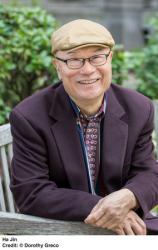
BIO
Born
in mainland China, Ha Jin grew up in a small rural town in Liaoning
Province. From the age of fourteen to nineteen he volunteered
to serve in the People's Liberation Army, staying at the northeastern
border between China and the former Soviet Union. He began teaching
himself the middle-and high-school courses since his third year
in the army, which he left in the sixth year because he wanted to
go to college. But colleges remained closed during the
Cultural Revolution, which continued when he was demobilized, so
he worked as a telegrapher at a railroad company for three years
in Jiamusi, a remote frontier city in the Northeast. During
this time, he began to follow the English learner's program, hoping
that someday he could read Friedrich Engels' The Condition of the
Working Class in England in 1844 in the English original.
In 1977 colleges reopened, and he passed the entrance exams and
went to Heilongjiang University in Harbin where he was assigned
to study English, even though this was his last choice for a major! He
received a B.A. in English in 1981. He then studied American
literature at Shandong University, where he received an M.A. in
1984. The following year he came to the United States to do graduate
work at Brandeis University, from which he earned a Ph.D. in English
in 1993. In the meantime, he studied fiction writing
at Boston University with the novelists Leslie Epstein and Aharon
Appelfeld.
After the Tianeman massacre, he realized it would be impossible
to write honestly in China, so he decided to emigrate. Unlike most
exiled writers already established in their native language, Ha
Jin had no audience in Chinese, and so chose to write in English.
To him, this meant much labor, some despair, and also, freedom.
Currently he is an associate professor in English at Emory University.
He has published two volumes of poetry, BETWEEN SILENCES (University
of Chicago Press, 1990), and FACING SHADOWS (Hanging Loose Press,
1996), and two books of short fiction, OCEAN OF WORDS (Zoland Books,
1996) which received the PEN Hemingway Award, and UNDER THE RED
FLAG (University of Georgia Press, 1997), which received the Flannery
O'Connor Award for Short Fiction and was a finalist for the Kiriyama
Pacific Rim Book Award. He also published a novella, IN THE POND
(Zoland Books, 1998), which was selected as a best fiction book
of 1998 by the Chicago Tribune. His short stores have been included
in The Best American Short Stories (1997 and 1999), three Pushcart
Prize anthologies, and Norton Introduction to Fiction and Norton
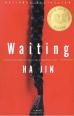
Introduction to Literature, among other anthologies. WAITING
Ha Jin's first full-length novel, is the winner of the 1999 National
Book Award for Fiction and the 2000 PEN/Faulkner Award for Fiction,
and a finalist for the Los Angeles Times Book Award for fiction.
He has also written a collection of stories called, THE BRIDEGROOM,
published by Pantheon Books.
Back to top.
PAST INTERVIEW
October
13, 2000
Granted the 1999 National Book Award for his moving novel, WAITING,
Chinese born Ha Jin continues to impress fans all over the world
with his new collection of stories called THE BRIDEGROOM. Having
only written in English for twelve years, Jin's mastery of the language
is indeed astounding and can be enjoyed in novels, short stories,
and poetry. Join Bookreporter.com's Jana Siciliano as she finds
out more about this renown author and professor's writing life,
his cultural background, his inspirations and much more.
TBR: You have said that you think "the ultimate goal for a piece
of literature is to transcend time to some degree..." Which story
or stories in your collection, THE BRIDEGROOM, do you think accomplishes
this?
HJ: This is impossible to say,
because the life of a story is beyond its author's control. But
I like "A Tiger-Fighter Is Hard to Find" and the title story a lot.
To me, they are stronger ones.
TBR: Your work certainly incorporates a heavy political element.
Do you think of yourself as a political writer or do the events
surrounding your characters evolve because of politics?
HJ: I'm not a political
writer, but my characters' lives are often affected by politics. So
I cannot avoid politics in telling the stories.
TBR: In your National Book Award winning book WAITING, no one
seems aware of the world outside of their small community. In THE
BRIDEGROOM, the characters are affected a great deal more by the
political regime under which they are living. Do you have any plans
to write about a world outside of China?
HJ: Yes, gradually
I will have to write about stories outside of China, which has become
remote and blurred to me.
TBR: Your characters seem to have so little choice in their lives,
so little control over what happens to them. Does this relate to
your experience as a Chinese man or as an immigrant or as a writer
--- or a combination of these factors?
HJ: A combination
of different experiences, most of which are not autobiographical.
I don't write my own story.
TBR: What is your experience as an immigrant like in your rarefied
position as lauded author and poet? Will you be writing a novel
or even memoir about your experiences in America?
HJ: I plan to write
at least two books about the American immigrant experience, but
not my own story.
TBR: You write about Walt Whitman in WAITING. Does his work have
great personal resonance for you as a poet and writer?
HJ: Yes, I love his
poetry, especially his openness and abundance.
TBR: How different was the experience writing WAITING than writing
your first book, THE POND? And how did the experience of WAITING
help you to delve into the short story format?
HJ: I started with
short fiction. My first fiction book is a collection of short stories,
OCEAN OF WORDS. By comparison, WAITING is an easier book for me
and I wrote it almost in a trance. But a collection of short stories
is always a difficult project. It demands more labor and more intense
struggle.
TBR: It is hard to believe you've only been writing in English
for twelve years now. Do you write any of your work in Chinese anymore?
Or is working in English becoming more natural for you?
HJ: I don't write
in Chinese, though I have to use the language because of the translations
of my work. Writing in English has never come naturally. I am often
scared by the labor.
TBR: How hard was it to make the decision to stay in the United
States after viewing on television the events in Tianamen Square?
If that hadn't happened, how would your life and your writing have
changed?
HJ: It took me more
than a year to decide to write in English, which had resulted from
my decision to immigrate. Without the massacre, I would have returned
to China and wouldn't have become a creative writer. Probably I
would have been a university professor.
TBR: How did you end up at Emory College? What was your experience
trying to get a job as a writer/teacher?
HJ: For three years
in a row I couldn't find an academic job. Then in 1993, Emory hired
me as a poet. Emory was the only school that would offer me a job.
Usually I jot a lot of interviews, but when people saw my face and
heard me talk they would discard my application. So I am very grateful
to Emory.
TBR: How much of your time is devoted to your life as a poet?
How much to your life as a novelist? And how much to your teaching?
HJ: It depends. When
I am teaching, I have to spend a lot of time preparing for the classes.
A novel usually takes more time, because it will occupy my mind
for a long time. Poetry needs bursts of energy and often depends
on luck.
TBR: Do you find it difficult to write about China without being
there? Will you ever return?
HJ: It depends on
which period of the Chinese experience I am writing about. The
current China may be unfamiliar to me. If I go back to China, it
will only be a short visit.
TBR: Did your experience in the army as a teenager affect the
way you thought about your future? Did you yearn for a life of the
mind while exercising your duty as a Chinese citizen?
HJ: My stay in the
army might have given me the opportunity to mix with different kinds
of people, but those years were not that hard mentally. I was young
and innocent and to a degree enjoyed staying at the front, though
physically it was harsh. We didn't even have enough food during
the first two months. I didn't think much and didn't have a life
of the mind, which was alien to me until my last year in the army
when I began to teach myself.
TBR: When did you become a reader?
HJ: When I was 16
or 17, but there wasn't much to read at the time.
TBR: What authors inspired you growing up, and what authors inspire
you now?
HJ: Lu Xun was the
author most Chinese in mainland China read and I couldn't avoid
being influenced by him. Gradually I figured out that
he had been influenced by the Russian authors, especially Gogol.
So I went to the Russians directly. As for inspiration, there are
many, besides the great Russians, V.S. Naipaul, Alice Munro, Saul
Bellow, Adrienne Rich, Susako Endo.
TBR: Thank you so much for taking the time to answer these questions.
HJ: You're welcome.
© Copyright 1996-2008, Bookreporter.com. All rights reserved.
Back to top.
|